

🌍 THE NEW SCRAMBLE FOR AFRICA
Why Are the World’s Most Powerful Nations Competing for Africa’s Resources?
There was a time when European powers came to Africa with flags, soldiers and colonial administrations.
Today, the methods look different.
There may be no colonial governor sitting in an African capital.
There may be no European flag flying over an African territory.
But the competition for Africa’s resources, markets, strategic locations and political influence has not disappeared.
It has changed form.
And Africa must pay attention.
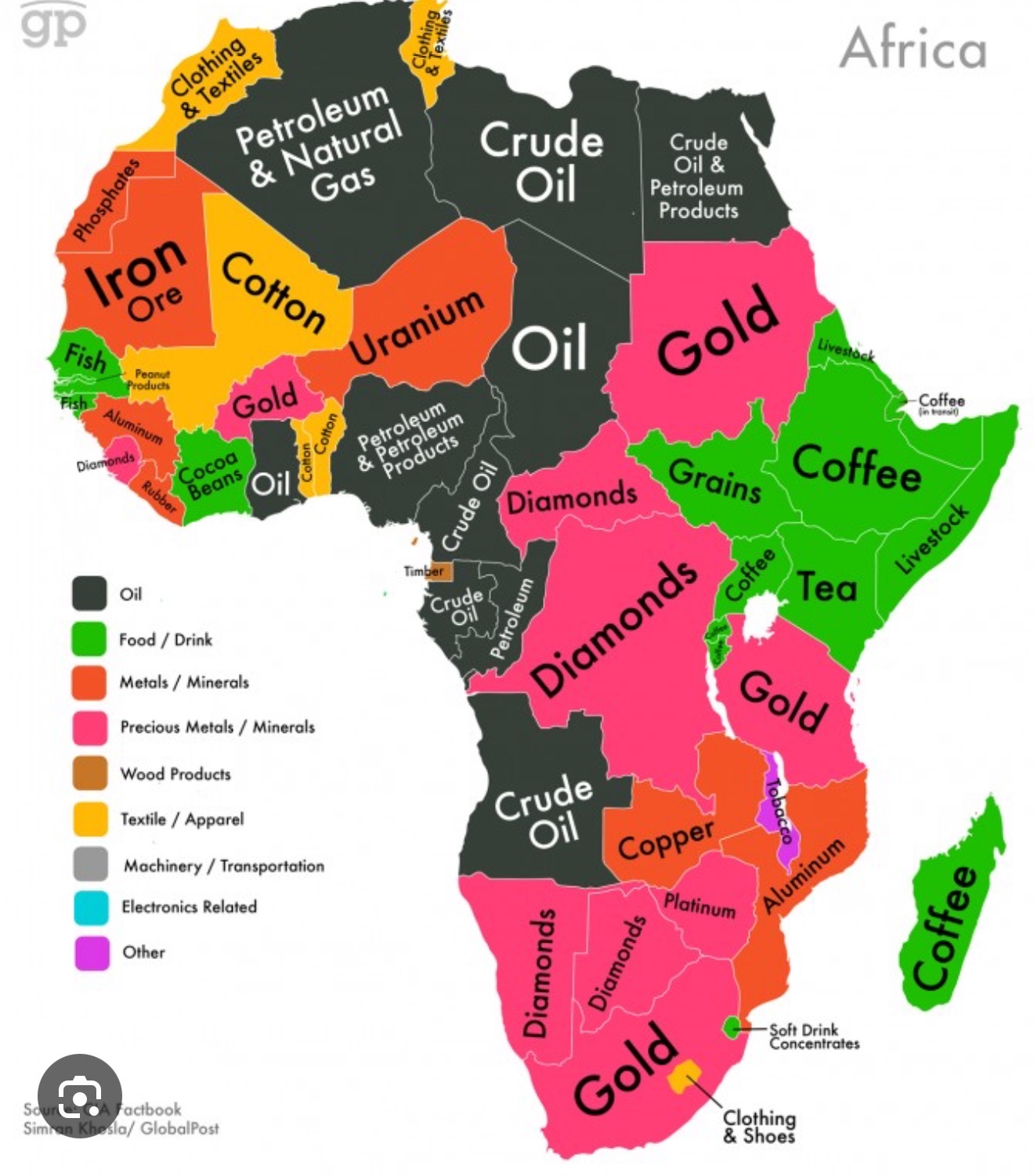
🔥 AFRICA HAS SOMETHING THE WORLD NEEDS
Africa possesses enormous quantities of resources essential to the modern economy.
Cobalt.
Copper.
Lithium.
Graphite.
Manganese.
Platinum.
Uranium.
Gold.
Oil.
Natural gas.
Bauxite.
Rare-earth and other critical minerals.
And these resources are becoming increasingly important as the world races toward electric vehicles, renewable energy, advanced electronics, artificial intelligence infrastructure, telecommunications and modern manufacturing.
This creates a new geopolitical reality:
The world needs what Africa possesses.
But here is the question Africans should be asking:
Will Africa use this moment to become powerful—or will Africa once again become the place where other powers come to obtain what they need?
—
⚔️ THIS TIME, EVERYONE WANTS A PIECE
The competition is no longer simply between European countries.
Today, Africa is dealing with a much larger group of international powers.
The United States and Europe want secure access to strategic resources and markets.
China has become deeply involved in African infrastructure, mining, trade and investment.
Russia seeks strategic and political influence in parts of the continent.
Gulf states are expanding their investments in African agriculture, ports, energy and other sectors.
India, Turkey and other emerging powers are also strengthening their relationships with African countries.
And multinational corporations operate across many of these industries.
This does not mean every foreign partnership is exploitation.
It means something much simpler:
Africa has become increasingly important to the future of the global economy.
And whenever something becomes strategically important, powerful nations compete for access.
That is geopolitics.
—
⛏️ THE DRC SHOWS WHY THIS MATTERS
Consider the Democratic Republic of the Congo.
The country possesses enormous deposits of minerals critical to modern industries.
Yet possessing a resource and controlling its economic value are two very different things.
A country can have the mineral beneath its soil while foreign companies possess much of the capital, technology, equipment, processing capacity and international market connections necessary to turn that mineral into a finished product.
That creates a fundamental question:
Can Africa transform its resources into African industrial power?
Because the real wealth is not necessarily in digging something out of the ground.
The real wealth is in everything that happens after it comes out.
Mining.
Processing.
Refining.
Manufacturing.
Research.
Technology.
Transportation.
Finance.
And the final product.
Whoever controls those stages captures much more of the value.
—
🧠 THE MOST DANGEROUS MISTAKE AFRICA CAN MAKE
Africa must be careful not to replace one dependency with another.
If Africa becomes dependent on the West, that is a problem.
If Africa becomes dependent on China, that is also a problem.
If Africa becomes dependent on Russia, the Gulf states, or any other external power, the fundamental problem remains.
Dependency is dependency.
Africa should cooperate with everyone.
But Africa should become dependent on no one.
A strong African foreign policy should be able to say:
“We will trade with you.”
“We will invest with you.”
“We will cooperate with you.”
But also:
“We will decide what is in Africa’s interest.”
—
🕯️ THE NEW SCRAMBLE MAY NOT LOOK LIKE THE OLD ONE
The original European scramble for Africa was accompanied by territorial conquest and colonial rule.
The modern competition is more complicated.
Influence can operate through:
Investment.
Mining agreements.
Infrastructure projects.
Debt.
Trade relationships.
Security cooperation.
Political alliances.
Technology.
Access to strategic ports.
Control of supply chains.
None of these things is automatically evil.
But all of them deserve scrutiny.
Because an agreement can be presented as an investment while its long-term consequences may create dependency.
And that is why African citizens must learn to look beyond political speeches.
—
⚠️ THE AFRICAN LEADER MUST ASK DIFFERENT QUESTIONS
Before signing a major resource agreement, African governments should be asking:
How much value remains inside Africa?
How many Africans will be employed?
Will the resource be processed locally?
Will African companies participate?
Will African universities and engineers gain knowledge from the project?
What happens to the environment?
How transparent is the agreement?
What happens when the contract ends?
Who controls the infrastructure?
Does this agreement strengthen our independence—or increase our dependence?
These questions are more important than whether the foreign partner comes from the West, East, North or South.
Africa should judge partnerships by African interests—not by the identity of the partner.
—
🇦🇫 AFRICA’S GREATEST WEAPON IS NOT ITS MINERALS
This may surprise some people.
Africa’s greatest strategic asset is not cobalt.
It is not gold.
It is not oil.
It is not lithium.
It is Africa’s people.
Africa has one of the world’s youngest populations.
Millions of young Africans are entering the workforce.
They are engineers.
Scientists.
Developers.
Entrepreneurs.
Farmers.
Doctors.
Teachers.
Researchers.
Artists.
Business owners.
Innovators.
The continent’s natural resources become dramatically more valuable when combined with African knowledge and human capital.
That is why education is not merely a social investment.
It is a geopolitical investment.
—
🔥 AFRICA MUST STOP THINKING LIKE A RAW-MATERIAL SUPPLIER
Imagine if Africa stopped asking:
“Who will buy our minerals?”
And started asking:
“What can we manufacture from our minerals?”
Instead of exporting crude resources, build processing industries.
Instead of exporting agricultural products cheaply, build food-processing industries.
Instead of importing technology indefinitely, develop African technological capacity.
Instead of competing individually for foreign investment, strengthen African regional markets.
Instead of allowing outsiders to define Africa’s value, let Africans determine what their resources are worth.
That is not hostility toward the rest of the world.
That is economic maturity.
—
🌍 THE QUESTION OF THE NEXT GENERATION
African youth need to understand that geopolitics is not something happening only in presidential offices.
It affects their lives.
It affects the price of food.
It affects employment.
It affects electricity.
It affects technology.
It affects education.
It affects the value of national currencies.
It affects who controls natural resources.
It affects the future industries Africans will work in.
Therefore, young Africans cannot afford to remain politically and economically uninformed.
Study the contracts.
Study the history.
Study the resources.
Study the economies.
Study the geopolitical interests.
And most importantly:
Question everyone—including your own government.
Because blindly trusting foreigners is dangerous.
But blindly trusting African politicians is equally dangerous.
—
🌅 THE NEW AFRICAN MOMENT
Perhaps the greatest opportunity in Africa’s modern history is unfolding right now.
The world is competing for resources that Africa possesses in abundance.
Africa therefore has an opportunity to negotiate from greater strength.
But opportunity can become another tragedy if African governments sell tomorrow’s wealth to solve today’s problems.
The continent must learn from history.
The goal should not be:
“Which foreign power should control Africa?”
The goal should be:
“How can Africans build enough strength that no foreign power can control Africa?”
That is the real conversation.
Africa does not need to isolate itself from the world.
Africa needs to become strong enough to engage with the world as an equal.
—
🔥 FINAL QUESTION
The world is entering a new era of competition for energy, minerals, technology and strategic influence.
Africa possesses many of the resources that this new era requires.
So here is the question:
Will the 21st century become another era in which the world comes to Africa for what it needs—or will this finally be the century in which Africa uses what it possesses to build itself?
What do you think?
Is the current global competition for African resources an opportunity for Africa to become powerful, or could it become another form of exploitation if African governments are not careful?
👇 Let’s debate this in the comments.
Follow History of the Black Race for the next chapter in this series.
#HistoryOfTheBlackRace #AfricanHistory #Africa #AfricanResources #NewScrambleForAfrica #AfricanYouth #AfricanSovereignty #Geopolitics #AfricanDevelopment #EconomicIndependence #CriticalMinerals #AfricanFuture #AfricanUnity #PanAfricanism
History of the black race

Leave a Reply