
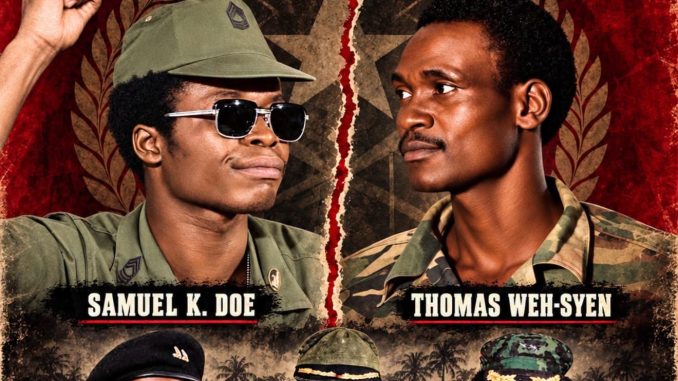
FROM COMRADES TO CONDEMNED: The Bloody Split in Liberia’s Military Junta.
Doe Versus Weh-Syen, and the struggle over who had earned the right to lead.
By St Clarence D. Avery
MBA | Author | Military Veteran
In April 1980, Liberia’s soldiers brought down a president.
Sixteen months later, the military government was putting its own senior members to death.
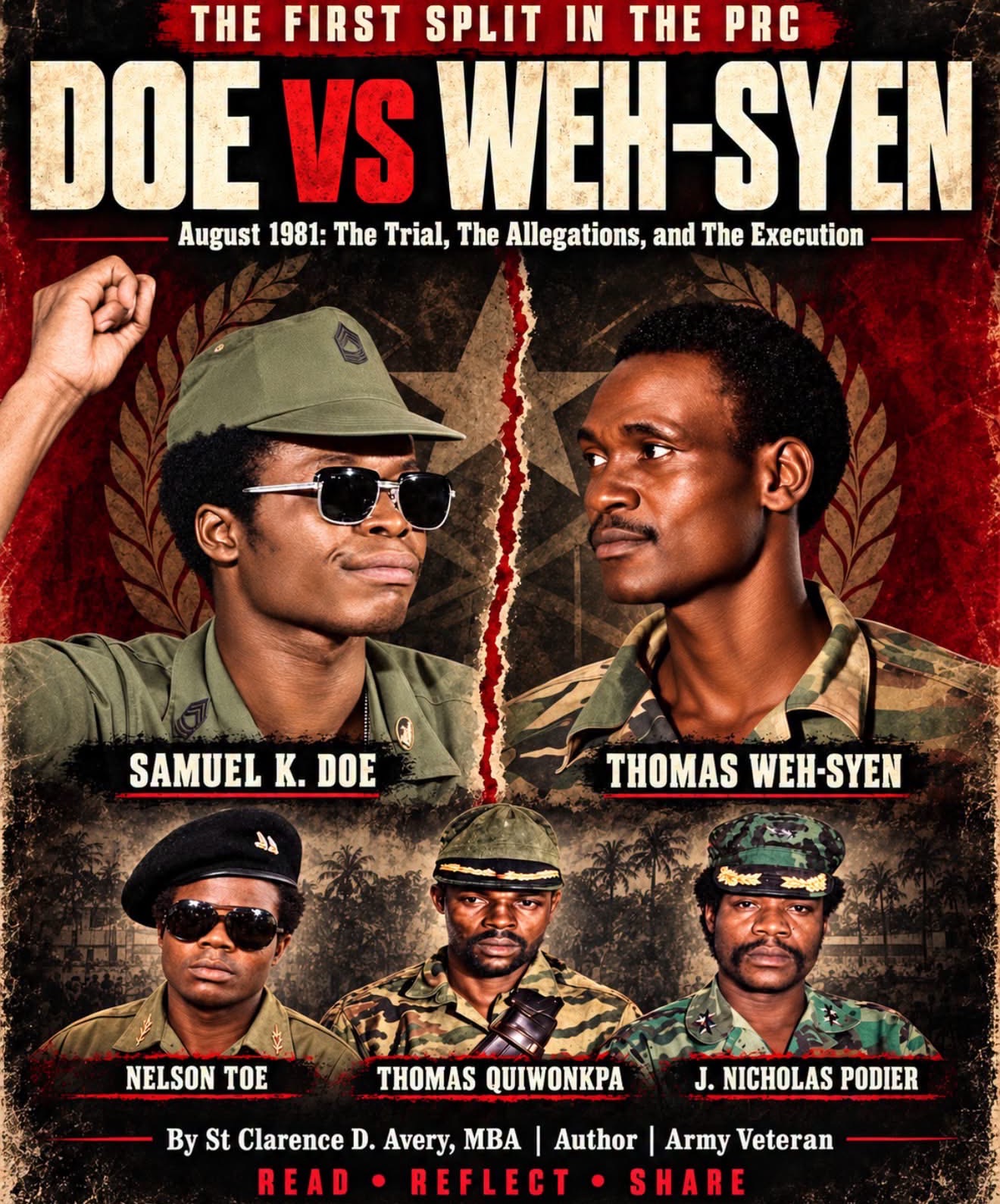
One of the condemned was Thomas Weh-Syen, the junta’s vice head of state. Another was Nelson Toe, named in later testimony as the first soldier to shoot President William R. Tolbert Jr.
Toe was the PRC’s youngest member, just 22 when he was executed.
They had shared power with Samuel K. Doe. Now they stood accused of plotting against him.
The split reached back to the very beginning.
On April 12, 1980, Tolbert was killed and the True Whig Party’s long rule came crashing down. The soldiers had seized the country. But agreeing on who should command them was another struggle altogether.
Doe had the higher military rank. That helped put him at the top of the People’s Redemption Council, the PRC.
Weh-Syen challenged his right to be there.
Historian Yekutiel Gershoni records that Weh-Syen considered himself better suited to lead and accused Doe of cowardice for being afraid to join the assault on the Executive Mansion.
The oral account behind this story makes an even sharper allegation: Doe hid in the mansion’s garden and emerged only after Tolbert was killed. That detail remains unverified. Gershoni documents the accusation of cowardice, not the garden story.
At stake was a bitter question: did military rank alone give Doe the right to command men who challenged his contribution to the coup?
Then there was Nelson Toe.
Charles Taylor later testified that Thomas Quiwonkpa had told him Toe fired the first shot at Tolbert, followed by Harrison Pennue. Taylor was passing along Quiwonkpa’s account; he had not witnessed the shooting himself.
The argument over leadership also appears in testimony before Liberia’s Truth and Reconciliation Commission. Alhaji G. V. Kromah, recounting what PRC member Abraham Kollie told him, said Weh-Syen demanded the top position. Quiwonkpa proposed Doe as chairman provisionally, pending another meeting. The soldiers agreed.
In that account, Doe’s selection was a temporary compromise. No formal timetable for replacing him has been established.
Doe became chairman. Weh-Syen became vice head of state and PRC cochairman. The positions were assigned. The rivalry remained.
Gershoni places Toe, Harris Johnson, Henry Zuo and Robert Sumo in Weh-Syen’s camp.
By early 1981, Quiwonkpa summed up the trouble in a sentence recorded in Liberia: A Country Study:
“Each member of the PRC thinks he is Head of State.”
The council had taken power together. Its members were struggling to share it.
Their differences extended beyond who had done what on the morning of the coup. Weh-Syen opposed the junta’s strongly pro-American direction. Liberia closed the Libyan People’s Bureau in May 1981. Weh-Syen warned Doe against “dictatorial advice.”
Money entered the story too.
Retired Captain Samuel Kalongo Luo later told the TRC that money and valuables taken from Tolbert’s Bentol home reached Doe. He alleged that Weh-Syen demanded disclosure and his share. Luo believed that quarrel helped explain the executions under a coup allegation. That was his interpretation, not an established verdict on what caused the purge.
Leadership, foreign policy and the spoils of power: several disputes surrounded the split.
Then came August.
Amnesty International records that on August 10, 1981, Doe publicly accused Weh-Syen and four PRC colleagues of plotting against him. A closed inquiry was supposed to be followed by a trial with defence counsel.
On August 13, they were sentenced to death.
On August 14, they were executed.
Thomas Weh-Syen. Nelson B. Toe. Harris Johnson. Robert Sumo. Henry Zuo.
Five senior members of the government, dead barely sixteen months after the coup.
Years later, former Special Security Service officer James Yarncie Hunder recalled a message Weh-Syen asked him to carry to Doe:
“I never planned with anyone to kill him.”
Hunder told the TRC that he delivered the message. He also said he later witnessed the five men being shot.
The denial did not save Weh-Syen.
Amnesty International concluded that the proceedings failed international standards of fairness. A 1982 United States Senate staff report, quoted in Liberia: A Country Study, said the United States had no evidence of an organized plot involving Weh-Syen and his comrades.
That leaves the official conspiracy charge open to serious scrutiny. It does not tell us everything each accused man intended.
Even after Weh-Syen’s death, accusations followed him. Amnesty recorded Doe later blaming him for the presumed deaths of A.B. Tolbert and former police chief Varney Dempster. Those claims also deserve examination.
For the surviving PRC members, the executions showed how deadly a dispute inside their own government could become. Doe’s rival camp was gone.
The men who had seized power in the people’s name had failed to give their own colleagues a fair hearing before taking their lives.
The struggle began over who had earned the right to lead. It ended with five executions, and a ruling council whose balance of power had changed forever.
They had shared power as comrades. They met death as condemned men.
The struggle for power was far from over.
Another of Doe’s former comrades would become his challenger.
Next episode: Samuel K. Doe versus Thomas Quiwonkpa.
Another story worth telling. Stay tuned.
Please share any story you know of Thomas Weh-Syen and the other PRC members who were executed.
#Droyuah
#LiberianHistory #DoeVsWehSyen #SamuelKDoe #ThomasWehSyen #NelsonToe #PeoplesRedemptionCouncil #Liberia1981 #AfricanHistory

Leave a Reply