
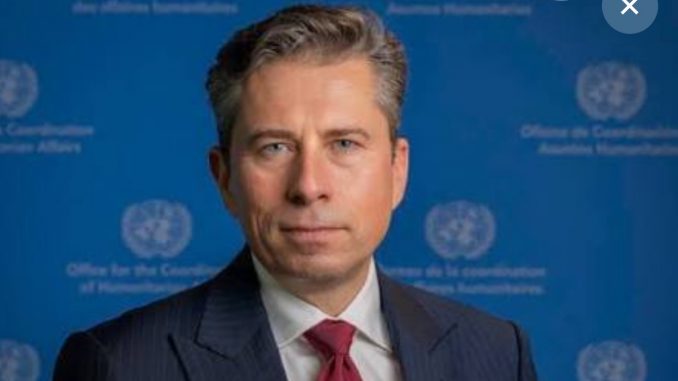
With over 1,000 aid workers killed, often at the hands of Member States, UN Relief Chief demands action, accountability
Statement to the Security Council by Tom Fletcher, Under-Secretary-General for Humanitarian Affairs and Emergency Relief Coordinator, pursuant to resolution 2730 (2024) on the safety and security of humanitarian personnel and the protection of United Nations and associated personnel
New York, 8 April 2026
As delivered
Thank you, Mr. President.
In 2025, at least 326 humanitarians were recorded as killed across 21 countries, bringing the total number of humanitarians killed in three years to over 1,010.
We recognise, grieve and honour each of our 326 colleagues, and commit the work ahead to their memory.
Of those over 1,000 deaths, more than 560 were in Gaza and the West Bank, 130 in Sudan, 60 in South Sudan, 25 in Ukraine and 25 in [the Democratic Republic of the Congo].
That number – over 1,000 – compares to 377 recorded as killed globally over the previous three years – so that’s almost tripling the death count.
This is not an accidental escalation – it is the collapse of protection.
These humanitarians were killed while distributing food, water, medicine, shelter. They died in clearly marked convoys and on missions coordinated directly with authorities.
And, too often, they were killed by Member States of the United Nations.
Mr. President,
Humanitarians know we face risks. It is the nature of our work, the places in which we operate.
These deaths are not because we are reckless with our lives. They are because parties to the conflict are reckless with our lives.
So, on behalf of over a thousand dead humanitarians and their families, we ask: why?
Is it because the world no longer believes in Security Council resolution 2730, in which you spoke with such moral urgency about ending violence against humanitarians?
Is it because international humanitarian law, forged by a generation of wiser political leaders for just such a time as this, is no longer convenient?
Is it because it is more important to protect those designing, selling, supplying and firing lethal weapons – including drones, cyber tools, artificial intelligence – than protecting us?
Is it because those killing us feel no cost for their actions? How many were prosecuted? How many of their leaders resigned? On how many investigations did the UN Security Council insist? Were you ever selective in your outrage?
Or is it because Member States see these numbers as collateral damage, part of the fog of war? Or worse, are we now seen as legitimate targets?
And perhaps the most chilling question: if these deaths were ‘preventable,’ why then were they not prevented?
Mr. President,
Over 110 Member States have chosen to act together through the political declaration on the protection of humanitarians.
Yet across multiple crises, humanitarians are not just being killed.
Our action is being restricted, penalized, delegitimized. We are told where not to go, whom not to help. We are harassed or arrested for doing our job.
And we are lied about – and those lies have these consequences.
And, of course, when humanitarians are harmed, aid often stops. Clinics close, food doesn’t arrive.
In Yemen, 73 UN and dozens of NGO personnel remain arbitrarily detained by the Houthis. In Afghanistan and Yemen, women humanitarians are prevented from doing their jobs. In Gaza, Israel restricts UN agencies and international NGOs. In Myanmar, insecurity and access constraints cut off aid to over 100,000 people in a single month.
And in Ukraine, drone attacks have forced aid groups to pull back from frontline communities.
In all these cases, the results of the deaths of humanitarians is too often the death of hope for millions who rely on them.
Mr. President,
These trends, alongside the collapse in funding for our lifesaving work, are a symptom of a lawless, bellicose, selfish and violent world. Killing humanitarians is part of the broader attack on the UN Charter and on international humanitarian law.
International humanitarian law was never, and is not now, an academic exercise. In honour of our colleagues killed, and in solidarity with those now risking their lives, we ask you to act with much greater conviction, consistency and courage.
Mr. President,
I normally conclude with three asks of this Council. But it seems insulting to over one thousand colleagues killed to echo back to you the commitments of SCR 2730: protection, integrity, accountability.
We come here not to remind you of these commitments, but to challenge you to uphold them.
Because if we cast aside these hard-won principles, then the integrity of this Council, and the laws we are here to protect, die with our colleagues.
Thank you.
Leave a Reply