
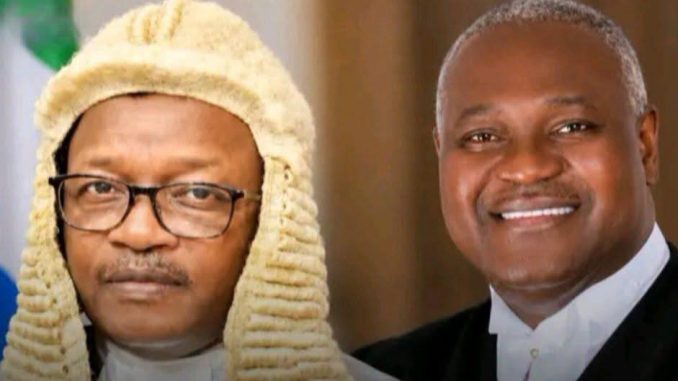
Another big political drama broke out in Freetown yesterday , this time between the Supreme Court and the lead attorney of the opposition All People’s Congress ( APC ) , former Minister of Justice and Attorney General Joseph Fitzgerald Kamara, during the hearing on the disputed 2025 Constitutional Amendment Bill.
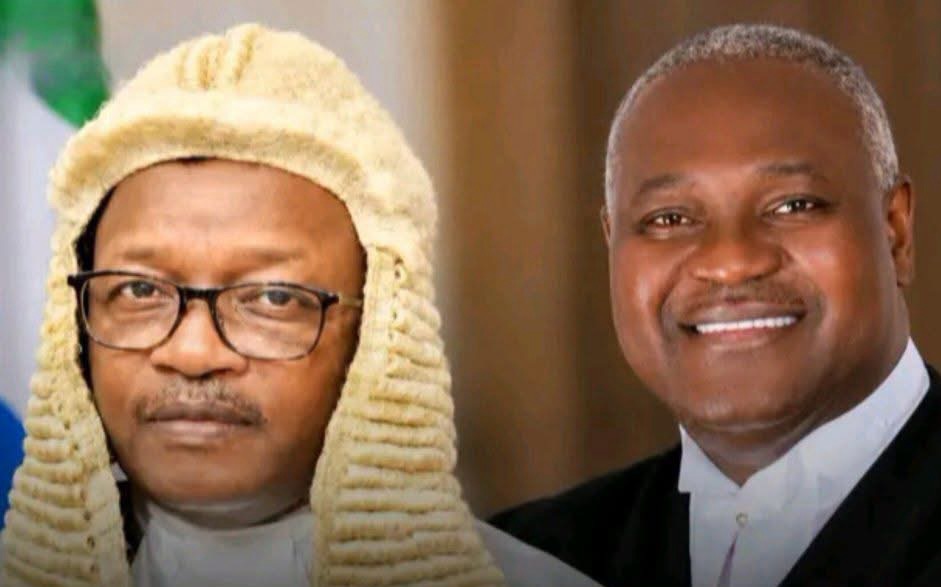
JUSTICE KAMANDA ( LEFT ) AND APC’S JFK
During the session, a tense exchange sparked between Chief Justice Komba Kamanda and APC Counsel Joseph Fitzgerald Kamara (JFK) over preliminary objections raised by All People’s Congress (APC) counsel Joseph Fitzgerald Kamara regarding the disputed passage of the Constitutional Amendment Bill 2025.
After an acrimonious exchange between the Chief Justice and the former Attorney General , Justice Komba Kamanda overruled JFK’s procedural objections and arguments regarding Rule 92 and filing technicalities raised .
Following the dismissal of the preliminary objections, the court adjourned the proceedings to hear applications to consolidate multiple related constitutional cases concerning the bill.
The legal challenge centers on how the Constitutional Amendment Bill was passed in Parliament (including changes to presidential election thresholds and proportional representation rules), which President Julius Maada Bio referred to the Supreme Court under Section 122(1) of the 1991 Constitution rather than signing it, alongside parallel suits filed by the APC, individual MPs like Hon. Osman Timbo, and the Lawyers’ Society.
WE BRING YOU VARIOUS REPORTS FILED BY NEWS OUTLETS COVERING THE SUPREME COURT SESSION YESTERDAY
JFK RAISES PROCEDURAL OBJECTION BEFORE THE SUPREME COURT
Lawyer Joseph Fitzgerald Kamara (JFK) has raised an important procedural objection as the Supreme Court continues hearing matters arising from the constitutional amendment controversy.
The Attorney-General is seeking to consolidate the three related constitutional cases, so that the Court can deal with the overlapping issues together.
JFK’s objection, in simple terms, is about procedure.
His argument is that before the Attorney-General can move an application seeking consolidation, the proper preliminary requirements under the Supreme Court Rules must first be satisfied.
Put simply, JFK’s position is:
“You cannot jump from Step 1 to Step 4 without first completing the required earlier steps.”
During the exchange, Justice Kamanda questioned the legal basis of the objection, asking counsel essentially: under what rule is the objection being made?
JFK referred the Court to Rule 92 as part of his argument.
The important point is that the Court has not yet ruled on the main constitutional dispute concerning Sections 91 and 108. This is a preliminary procedural argument, and the Supreme Court will determine whether the objection has legal merit.
We continue to follow the proceedings carefully.
— Haroun Zubairu | SALONE CONNECT
Day 1 of the Supreme Court Constitutional Amendment Hearing: From Diarrhoea (Run Belleh) Excuse to Adjournment.
( A Political Commentary)
By: Dictionary Liam Caulker
(Journalist | Political Analyst | Social Scientist)
If Day One of the Supreme Court hearing on the Constitutional Amendment Bill was supposed to reassure Sierra Leoneans about constitutional certainty, it instead produced legal drama, procedural disputes, communication confusion, and yet another reminder that politics often follows constitutional controversies wherever they go.
Even before substantive arguments on the constitutionality of the Amendment Bill could begin, controversy emerged outside the courtroom.
Several lawyers complained after being denied access to the Law Courts Building. The Judiciary explained that attendance had been restricted to lawyers with at least ten years of legal practice and those whose matters were listed for hearing, citing limited courtroom space.
While the Judiciary’s explanation may appear practical, the criticism from lawyers highlights an important question: how should access be managed in cases of significant national interest?
Constitutional matters are not ordinary cases. They shape governance, representation, and the interpretation of the supreme law of the land. Consequently, restrictions on access, even when administratively justified, are likely to attract scrutiny.
Inside the courtroom, proceedings quickly became heated.
Counsel for the APC, Joseph Fitzgerald Kamara (JFK), raised preliminary objections regarding the failure of the Law Officers’ Department to file certain court processes. The objection challenged whether the matter could properly proceed in the absence of the required filings.
The disagreement escalated into a tense exchange between counsel and the Attorney-General’s team, prompting Chief Justice Komba Kamanda to remind all parties that the Supreme Court is an independent judicial forum and not a political platform.
That intervention was perhaps the most important statement of the day.
The Constitutional Amendment dispute may have emerged from a political process, but once before the Supreme Court, the matter becomes a legal and constitutional question. The Court’s responsibility is not to determine political winners and losers but to interpret the law and the Constitution.
After hearing arguments, the Supreme Court unanimously dismissed the preliminary objections raised by Joseph Fitzgerald Kamara and adjourned proceedings to Thursday, 8 October 2026, when arguments relating to the consolidation of the three matters will continue.
But while legal arguments dominated proceedings, public attention quickly shifted elsewhere.
From “Run Belleh” to Official Assignment
One of the most talked-about developments of the day concerned the absence of the Speaker of Parliament, Rt. Hon. Segepoh Solomon Thomas.
The Speaker is a defendant in one of the matters before the Court because he presided over the parliamentary proceedings that culminated in the passage of the Constitutional Amendment Bill.
During proceedings, his lawyer, Hon. Hindolo Moiwo Gevao, informed the Court that the Speaker was unwell and suffering from diarrhoea.
The explanation immediately generated public discussion, particularly given the significance of the hearing.
However, later in the day, Parliament issued a statement dismissing reports that the Speaker was absent because of illness.
According to Parliament, the Speaker was outside the country on official assignment and, in any event, did not need to be physically present because the State was adequately represented before the Court.
The contradiction instantly became a story of its own.
Was the Court misinformed?
Was there a communication breakdown?
Was there a misunderstanding between legal representation and Parliament?
Or was it simply a case of inaccurate information being conveyed before official clarification emerged?
At this stage, only those directly involved can provide definitive answers.
However, what is undeniable is that such conflicting explanations create unnecessary public speculation in an already politically sensitive matter.
Public confidence in institutions is strengthened by consistency and clarity, particularly during constitutional disputes.
When two different explanations emerge regarding the same issue, attention naturally shifts from the constitutional questions before the Court to the credibility of institutional communication.
A New Voice Enters the Debate
Amid the legal arguments and political discussion, the Supreme Court also made an important ruling regarding participation in the proceedings.
The Court granted an application by the Institute for Legal Research and Advocacy for Justice (ILRAJ) to participate as amicus curiae—a friend of the court.
Represented by counsel Basita Michaels Esq., ILRAJ informed the Court that it sought neither to support the applicants nor the respondents but rather to assist the Court with independent legal analysis.
Chief Justice Kamanda emphasized that admission as amicus curiae is discretionary and requires an applicant to demonstrate how their participation would assist the Court in reaching an informed decision.
The Court ultimately granted the application in the interest of fairness and justice.
The decision is significant.
Constitutional interpretation often extends beyond the interests of the immediate parties before the Court. The inclusion of an independent legal advocacy institution may provide broader constitutional perspectives as the Court examines issues that could have far-reaching implications for governance and legislative procedure.
More Questions Than Answers
By the end of Day One, Sierra Leoneans had not yet received answers to the fundamental constitutional questions at the heart of the case.
Instead, the day produced several developments:
– Restrictions on access to the Law Courts Building.
– Preliminary objections from APC counsel.
– A reminder from the Chief Justice that the Supreme Court is not a political arena.
– The admission of ILRAJ as amicus curiae.
– Conflicting explanations regarding the Speaker’s absence.
– The dismissal of preliminary objections.
– An adjournment to continue proceedings.
In many ways, Day One was less about constitutional interpretation and more about setting the stage for what lies ahead.
The substantive question remains unresolved:
Did Parliament lawfully pass the Constitutional Amendment Bill in accordance with the requirements of the Constitution?
That is ultimately the question the Supreme Court must answer.
But if Day One demonstrated anything, it is that constitutional disputes are never merely legal contests.
They are also tests of institutional credibility, procedural discipline, public communication, and democratic maturity.
And judging by the events of the first day, the road to constitutional clarity may prove just as contentious as the constitutional questions themselves.

Leave a Reply