
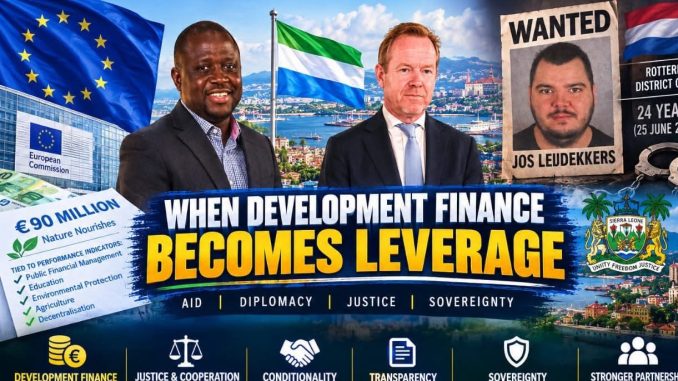
WHEN DEVELOPMENT FINANCE BECOMES LEVERAGE*
By Mahmud Tim Kargbo
Friday, 2 October 2026
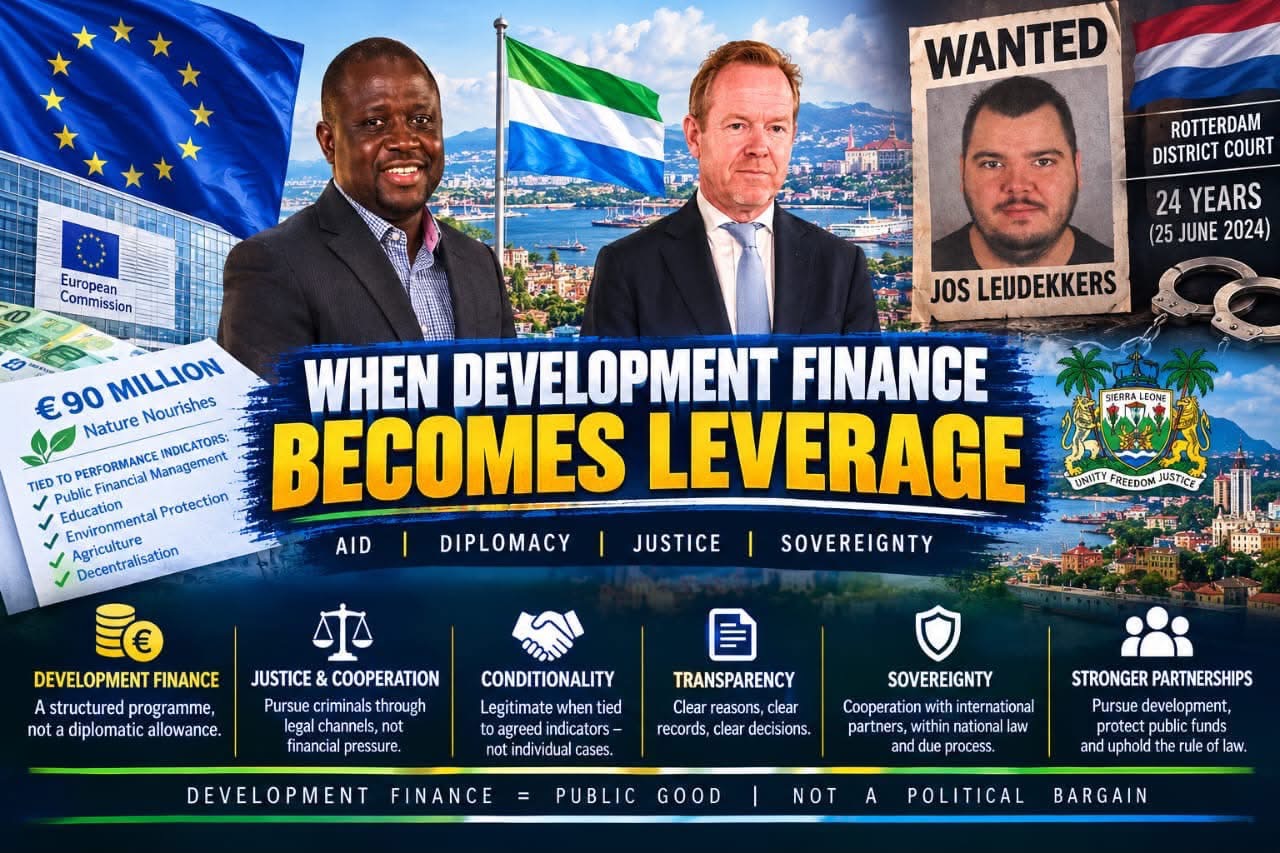
The European Union’s decision to withhold Sierra Leone’s 2026 budget support has suddenly acquired a far more consequential dimension. Dutch Justice and Security Minister David van Weel says the financial pressure is intended to push Freetown towards the arrest and extradition of fugitive Dutch drug trafficker Jos Leijdekkers. Sierra Leone says the European Commission’s July decision had nothing to do with Leijdekkers and instead followed the late timing of a request to amend its financing agreement. What appears at first to be a dispute over one fugitive is therefore becoming a test of something much larger: whether development finance can be used as leverage in an individual criminal case without blurring the boundaries between aid, diplomacy and justice.
The Dutch case is grave. The Dutch Police records that the Rotterdam District Court sentenced Leijdekkers on 25 June 2024 to 24 years for six drug transports involving more than 7,000 kilograms of cocaine, a violent robbery in Finland and ordering a murder. Dutch police later said they were certain he was residing in Sierra Leone and that bringing him to the Netherlands was their highest priority. Other suspected offences remain under investigation. These facts establish a substantial Dutch interest in judicial cooperation, but do not establish that Sierra Leone’s development financing should depend upon his extradition.
The financing agreement gives that distinction weight. The European Union’s official account says the €90 million Nature Nourishes programme includes up to €65 million in budget support over four years, tied to indicators covering public financial management, education, environmental protection, agriculture and decentralisation. In December 2024, the EU endorsed its first €11 million budget support payment, channelled directly into Sierra Leone’s Treasury. This is a structured development instrument, not an informal diplomatic allowance.
That makes the chronology decisive. Sierra Leone says the Commission communicated its 2026 decision in July and cited the late timing of a request to amend the Financing Agreement and the difficulty of completing the necessary procedures within the reporting cycle. It says the 2026 and 2027 disbursements were proposed for 2027 and 2028. Reuters reported Van Weel’s 1 October claim that the suspension was intended to pressure Sierra Leone over Leijdekkers, while ANP reported EU Commissioner Magnus Brunner saying the suspension had “technical reasons”. The competing accounts are documented in those reports. Until the Commission decision is published, the causal link remains contested.
That does not make European conditionality illegitimate. Nature Nourishes links disbursements to measurable reforms, and the EU is entitled to protect public funds and enforce agreed benchmarks. But conditionality attached to a development programme is institutionally different from pressure attached to a particular criminal case. The first is established when the programme is designed and assessed against defined indicators. The second, if established, would bring development finance much closer to sovereign criminal justice. Partnerships become unstable when an agreement’s purpose is retrospectively expanded to accommodate a new dispute.
The fiscal consequences are also real. The International Monetary Fund’s 2026 review records that Sierra Leone’s fiscal parameters were being adjusted for delays in budget support and the timing of external disbursements. The Government also committed to repay overdue budget support loans to the Bank of Sierra Leone, estimated at about 1.5 per cent of GDP, by the end of 2026. The IMF evidence does not establish a link to Leijdekkers. It does establish that delayed budget support can affect public finances.
The Dutch interest extends beyond one fugitive. The Dutch Public Prosecution Service says it sought more than €221.6 million in criminally obtained assets linked to fourteen drug transports involving about 14,000 kilograms of cocaine. A later court ruling assessed the illicit benefit at nearly €127 million and imposed a payment obligation of almost €97 million; prosecutors appealed. The scale of those proceedings shows why Dutch authorities regard the case as part of a wider criminal economy. It strengthens the case for serious cooperation without settling which instruments are legitimate.
Sierra Leone’s position should be judged by the same institutional standard. The Government says it remains committed to cooperation against transnational organised crime and judicial cooperation with international partners, subject to national law and established legal processes. That position carries greater authority if institutions can demonstrate that lawful procedures are being followed, even where confidential matters cannot be disclosed. Sovereignty is strongest when institutions show that decisions are made through law rather than pressure or expediency.
The European Union faces a corresponding obligation. Its December 2024 partnership dialogue records cooperation with Sierra Leone around democracy, the rule of law and development, while its 2026 delegation record marks fifty years of bilateral relations and development cooperation. The relationship is larger than one fugitive. If the July financing decision was administrative, the documentary record should make that clear; if a subsequent political decision altered its application, that should be stated with equal precision. A partnership built around the rule of law cannot afford ambiguity over the purpose of its own financial instruments.
The lesson reaches beyond Freetown, Brussels and The Hague. Donor governments increasingly expect development partnerships to serve security and organised crime objectives, while recipient states insist that cooperation cannot erase sovereign legal processes. Both interests can be legitimate, but they require different institutional channels. Once development finance becomes indistinguishable from coercive diplomacy, future agreements become harder to interpret and public confidence harder to sustain. The strongest partnerships are not those in which one side possesses the greatest leverage. They are those in which leverage remains bounded by rules.
The immediate dispute requires less rhetoric and more documentary clarity.
The Netherlands should pursue its judicial interests through lawful channels. Sierra Leone should demonstrate that its institutions can respond to international cooperation requests without surrendering due process. The European Union should explain the legal and administrative basis for any alteration to financing governed by a formal agreement. The enduring test is whether all three can pursue legitimate objectives without allowing one form of state power to substitute for another. A serious partnership must be capable of pursuing criminals, protecting public money and respecting lawful sovereignty at the same time. Its credibility will be measured not by who speaks loudest today, but by whether its institutions still command confidence when today’s controversy has passed.


Leave a Reply