

*Pontius Pilate in Parliament: The Hands Had Already Acted Before the Water Arrived*
By Yoni Emmanuel Sesay
Pontius Pilate is remembered not because he lacked authority, nor because he was oblivious to the gravity of the decision before him. His story has endured because he appears to have understood enough to hesitate and possessed enough authority to act differently, yet in the end allowed expediency to prevail.
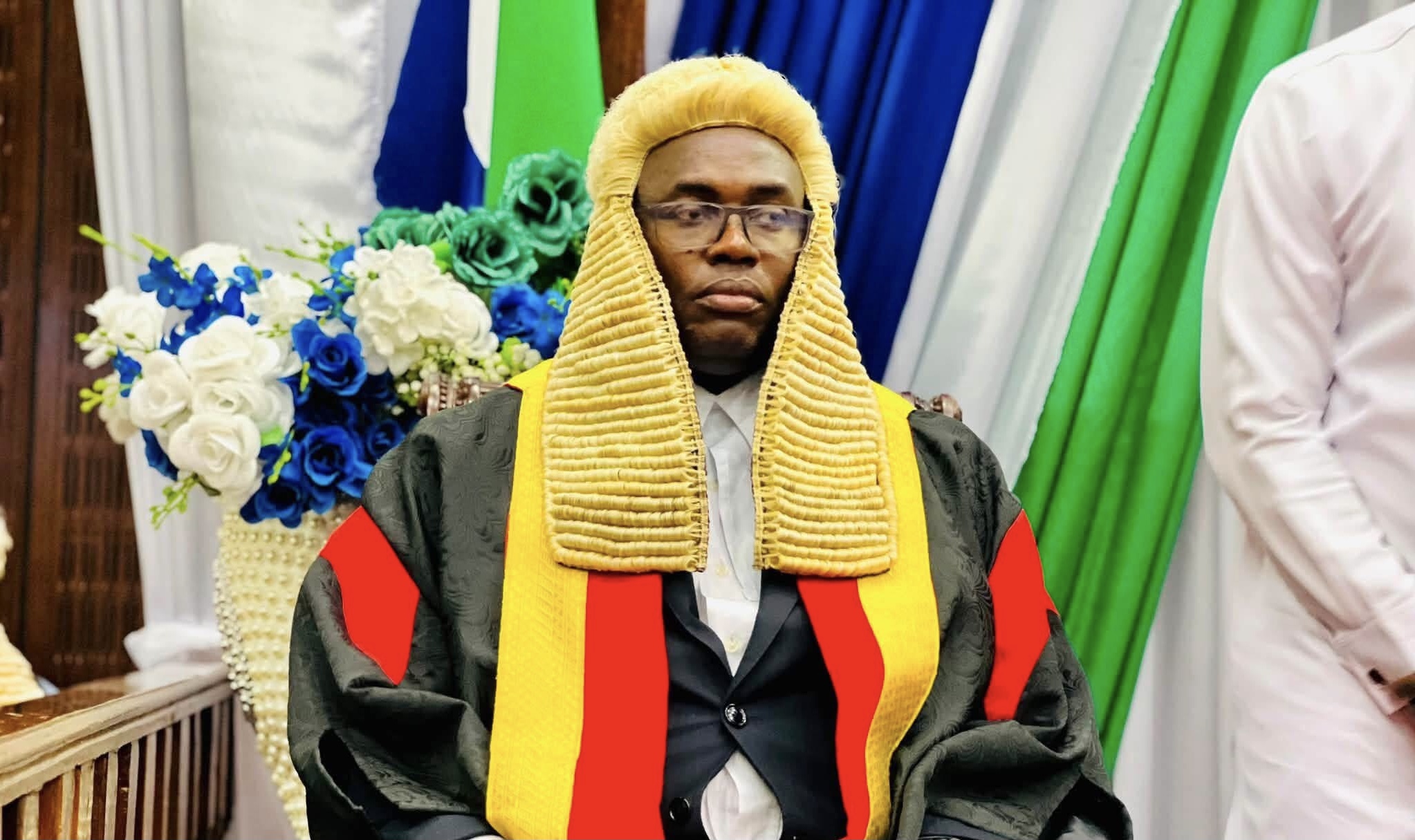
The Gospel accounts portray a man who was unconvinced by the case against Jesus. Pilate questioned, hesitated and searched for a way out. But the pressure around him grew, and the man entrusted with making the decision eventually allowed the course demanded of him to proceed. Then came the gesture that has followed his name for two thousand years: he called for water and washed his hands.
The water changed nothing. The decision had already been made possible.
That, perhaps, is the deeper moral of the story. Responsibility does not disappear because the person who exercised authority later seeks to distance himself from its consequences. Neither public pressure, political necessity nor procedural form can easily convert one’s own decision into somebody else’s responsibility.
There was no basin of water in Sierra Leone’s Parliament on 10 August 2026. There was, however, a ruling. Parliament proceeded on the strength of it. The opposition walked out. Thereafter came the Speaker’s indication that the constitutional controversy should go to the Supreme Court.
The comparison should not be taken too far. The Speaker is not Pontius Pilate, and whatever rumours may be circulating about instructions from elsewhere remain just that – rumours – unless supported by evidence. The analogy lies elsewhere. It lies in the relationship between authority, pressure, judgment and responsibility when the holder of public office is confronted with a decision of exceptional constitutional importance.
The constitutional question is therefore more interesting than the rumours. What authority did the Speaker possess? Where did it end? And if the issue ultimately required the Supreme Court to determine what the Constitution permits, what was left for the Court to decide after Parliament had already proceeded upon the Speaker’s ruling?
*Authority under law*
The Speaker unquestionably has considerable authority over parliamentary procedure. Section 94 of the 1991 Constitution recognises Parliament’s power to regulate its proceedings, while Standing Order 83 allows the Speaker, in consultation with the Clerk of Parliament, to resolve procedural questions where genuine doubt exists or the rules provide no express answer.
There is, however, an important qualification in section 94 which should not be lost in the argument: Parliament regulates its procedure subject to the Constitution.
Those words establish the hierarchy. The Constitution comes first. Parliament derives its authority from it. The Standing Orders regulate parliamentary business within that constitutional framework, and the Speaker exercises the authority of the Chair within both.
Standing Order 44 sets out the ordinary rule that questions before the House or Committee are decided by a majority of Members present and voting. But that rule yields where the Constitution or Standing Orders provide otherwise. Section 108 creates a special regime for altering the Constitution, including the requirement that an amendment Bill receive the support of not less than two-thirds of Members at its second and third readings.
The Speaker therefore has discretion, but discretion is not constitutional licence.
*Power given by law must remain servant to law.*
That principle assumes particular importance because Parliament was not dealing with an ordinary piece of legislation. It was exercising the exceptional power to alter the very instrument from which Parliament itself derives its authority.
*The difficulty the Speaker faced*
It would be unfair to pretend that the question before the Speaker was entirely straightforward.
Section 108 expressly identifies the second and third readings when prescribing the two-thirds requirement. It does not expressly say that every clause or amendment considered during Committee Stage must separately receive two-thirds support.
That leaves a legitimate question: what majority applies when Parliament considers individual provisions of a constitutional amendment Bill at Committee Stage?
The Speaker ruled that the ordinary majority applied. The opposition disagreed. Significantly, the confrontation reportedly crystallised around the proposed Search and Nomination Committee for Electoral Commissioners, a proposal which the APC itself supported.
That fact strips away some of the party politics surrounding the dispute. At that particular moment, the disagreement was not necessarily about whether the proposed reform was desirable. The two sides could agree on the destination while disagreeing fundamentally about the constitutional road Parliament was entitled to take.
There is a respectable argument in support of the Speaker. Section 108 may have deliberately reserved the two-thirds requirement for the stages it expressly identifies, leaving individual Committee Stage questions subject to the ordinary majority rule.
If that is the proper interpretation, the Speaker may ultimately be vindicated.
But that does not dispose of the constitutional difficulty.
When procedure begins to determine substance
Suppose a simple majority can determine, clause by clause, the substantive content of a constitutional amendment Bill during Committee Stage, while the special majority becomes relevant only when the resulting Bill reaches the stages expressly mentioned in section 108. What practical protection does the constitutional safeguard provide during the stage at which the content of the amendments is actually being settled?
The issue is therefore larger than whether Standing Order 44 ordinarily permits simple-majority voting in Committee. The question is whether ordinary parliamentary procedure can accomplish something which the Constitution has deliberately subjected to an extraordinary amendment process.
Perhaps the answer is yes because that is precisely the architecture section 108 establishes. Perhaps the answer is no because constitutional safeguards cannot be reduced to formal checkpoints while ordinary majorities determine their substantive content elsewhere in the process. That is a question deserving authoritative constitutional interpretation.
But one principle should survive either argument: Parliament cannot acquire indirectly through its procedural rules a constitutional power which the Constitution itself withholds.
The Speaker may fill a silence in the rulebook. He cannot create a silence in the Constitution.
*When the servant risks becoming master*
This brings the controversy to the larger distinction between constitutional supremacy and parliamentary supremacy.
Sierra Leone does not operate under the classical Westminster conception of unlimited parliamentary sovereignty. Parliament exists under a written Constitution. Its authority originates there and is limited there.
The Standing Orders regulate the exercise of parliamentary power. They cannot logically become an independent source through which Parliament enlarges the constitutional authority given to it. Otherwise the hierarchy begins to turn upside down: instead of the Constitution determining Parliament’s authority and Parliament regulating its procedure within that authority, parliamentary procedure begins to determine the reach of the Constitution itself.
That would move Sierra Leone towards parliamentary supremacy in practice while maintaining constitutional supremacy in theory.
This is not to suggest that the Speaker consciously intended such a result. There is no proper basis for attributing such a motive to him. The concern is with the possible constitutional consequence of the interpretation, not the intention of the person who made it.
And this is where Pilate’s story becomes relevant beyond the simple image of washing one’s hands. Public office will always involve pressure. Governments have objectives. Oppositions resist them. Majorities want to proceed. Minorities want protection. The test of constitutional authority comes precisely when political convenience, parliamentary practice and constitutional restraint begin pulling in different directions.
*The crowd and the Chair*
The crowd in the Pilate story carries its own warning, although that analogy too requires care. The lesson cannot be that public opinion is inherently dangerous. Democratic institutions exist to hear citizens. The danger arises when the person entrusted with independent judgment allows pressure to become a substitute for judgment.
The legitimacy of a constitutional office does not come from satisfying whichever side is strongest at a particular moment. It comes from fidelity to the authority under which that office exists.
This is another reason why speculation about political instructions surrounding 10 August adds little. Unless evidence emerges, such claims should remain outside serious constitutional analysis. What occurred openly is enough.
The Speaker heard the arguments. He made the ruling. Parliament acted upon it. Whatever pressures may have existed outside the Chair, constitutional responsibility for the ruling remained with the Chair.
When the Chair rules, the ruling belongs to the Chair.
Where procedure ends and constitutional interpretation begins
There is, however, another difficulty.
Section 94 gives substantial protection to Parliament’s control over its internal procedure. That protection serves an important purpose. Courts cannot become routine appellate chambers for every disagreement about Standing Orders or every disputed ruling made on the floor of Parliament.
Yet the Constitution also gives the Supreme Court responsibility for constitutional interpretation.
Somewhere between those two principles lies a boundary.
If the disagreement concerns nothing more than the Speaker’s interpretation of an internal parliamentary rule, Parliament’s procedural autonomy deserves considerable respect. But what happens when the interpretation of that rule determines the extent of Parliament’s power to alter the Constitution itself?
At that point the issue begins to move beyond parliamentary housekeeping.
The question becomes a much more fundamental one: when does a protected procedural ruling cease to be merely procedural because its effect determines the limits of constitutional power?
That may prove to be one of the most important constitutional questions arising from the events of 10 August.
*Then came the water*
It is against that background that the Speaker’s subsequent indication that the constitutional controversy should go to the Supreme Court assumes particular significance.
There is nothing objectionable about seeking constitutional interpretation from the Court. Indeed, recognising the Court’s role acknowledges an important distinction between parliamentary procedure and authoritative constitutional interpretation.
The difficulty lies in the sequence.
The Speaker ruled. Parliament proceeded upon the ruling. The consequence followed. Then the Supreme Court was invoked.
The proposed adjudication was therefore a posteriori. The Court was not being asked to illuminate the constitutional road before Parliament travelled it. It was being asked to determine the constitutional safety of a road already travelled.
If the uncertainty was sufficiently serious to require Supreme Court determination, an obvious question follows: why was that determination not obtained before Parliament proceeded upon the disputed interpretation?
Had clarification been sought beforehand, the proposition would have been simple: tell Parliament what the Constitution permits, and Parliament will proceed accordingly.
Afterwards, the proposition looks rather different: Parliament has acted; now determine whether the constitutional foundation beneath that action was sound.
And here Pilate’s basin becomes more than a literary device.
The hands had already acted before the water arrived.
*Washing does not absolve*
There is a fair answer available to the Speaker. He may say that parliamentary procedure was his responsibility, while authoritative constitutional interpretation belongs to the Supreme Court. On that view, he did no more than exercise the authority of the Chair before recognising the separate jurisdiction of the Court.
That argument deserves serious consideration. It may ultimately prevail.
But it does not entirely answer the question of timing. If the dispute had become sufficiently constitutional to require determination elsewhere, why allow the contested procedure to produce its consequence before obtaining that determination?
Nor can subsequent judicial approval transfer responsibility for the original ruling. If the Supreme Court eventually agrees with the Speaker, it may establish that his interpretation was constitutionally sound. If it disagrees, the opposite follows. Either way, the Court does not become the author of the decision made in Parliament.
This is perhaps the most enduring lesson of Pilate’s hands washing. Formal distance from a consequence does not erase one’s part in enabling it.
Authority carries responsibility.
*Truth, power and expediency*
There is another moment in the Pilate story which speaks directly to constitutional government. In John’s account, Jesus speaks of bearing witness to truth. Pilate responds with the question that has echoed through the centuries: “What is truth?”
Then the encounter moves on.
The significance of the question lies partly in the fact that the man exercising political power appears more concerned with managing the situation before him than pursuing the truth underlying it.
Constitutional government faces its own version of that temptation. Constitutional safeguards are often most inconvenient precisely when they are most necessary. Special majorities, procedural restrictions and judicial scrutiny deliberately make certain exercises of power slower and more difficult. That inconvenience is not necessarily a defect. Sometimes it is the protection.
The temptation is always to ask what procedure allows today rather than what constitutional principle protects tomorrow.
Constitutionalism demands more. It requires institutions to remain faithful to limitations even when those limitations obstruct immediate political objectives.
And that obligation belongs equally to Government and Opposition. Today’s majority may be tomorrow’s minority. A procedural interpretation which assists one government today remains available to another government tomorrow.
The enduring constitutional question should therefore never be simply, Can we do this?
There is another question which every temporary majority should ask:
Would we accept this interpretation of constitutional power if our opponents possessed it?
*The burden remains*
The controversy of 10 August is ultimately larger than one Speaker, one government or one opposition party. It concerns the relationship between parliamentary procedure and constitutional supremacy. It asks whether ordinary parliamentary mechanisms can determine the substance of extraordinary constitutional change, and it exposes the difficult boundary between the Speaker’s authority over parliamentary proceedings and the Supreme Court’s responsibility for interpreting the Constitution.
The Supreme Court may eventually vindicate the Speaker completely. It may reach another conclusion. That determination belongs elsewhere.
But whatever happens afterwards cannot alter the responsibility already exercised.
The Speaker is responsible for his ruling. Members are responsible for their votes. Government is responsible for the constitutional changes it promoted. The Opposition is responsible for the course it chose. If the matter reaches the Supreme Court, the Court will be responsible for the constitutional interpretation it gives.
That is how constitutional government works. Responsibility may be divided between institutions, but it cannot simply be passed from one to another.
Perhaps that is why the story of Pontius Pilate has endured. It is not merely the story of a villain. It is a story about a more ordinary and therefore more troubling failure of public authority: a person confronted by law, pressure and consequence who discovers that expediency cannot relieve him of responsibility for the decision ultimately taken.
Modern constitutional democracy offers something better than Pilate’s basin. It offers written constitutions, divided powers, procedural safeguards and courts entrusted with interpreting the fundamental law. But those institutions work only when the people occupying them accept that authority carries a price: sometimes the obligation to say no, sometimes the wisdom to wait, and always the duty to remain faithful to the law from which their power comes.
*Power given by law must remain servant to law.*
Pilate had his basin. The Speaker had the Chair, the Standing Orders and the Constitution. The Supreme Court may now be asked whether the constitutional boundary was respected.
Whatever answer eventually comes, the order of events cannot be rewritten. The ruling had been made. Parliament had proceeded. The consequence had followed.
The water came afterwards.
*The hands had already acted.*

Leave a Reply