By Alan Luke
A CATASTROPHE UNDER A CATASTHROPHIC PRESIDENT
Catastrophic’: Sierra Leone sells rainforest for Chinese fish plant
Controversial deal with China would be ‘disastrous’ for fishing and protected rainforest, say opponents
A $55m (£39m) deal struck by the government of Sierra Leone with China to build an industrial fishing harbour on 100 hectares (250 acres) of beach and protected rainforest has been criticised as “a catastrophic human and ecological disaster” by conservationists, landowners and rights groups.
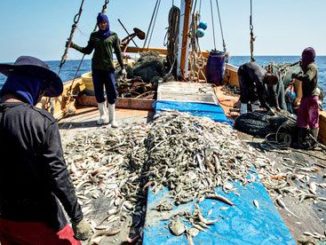
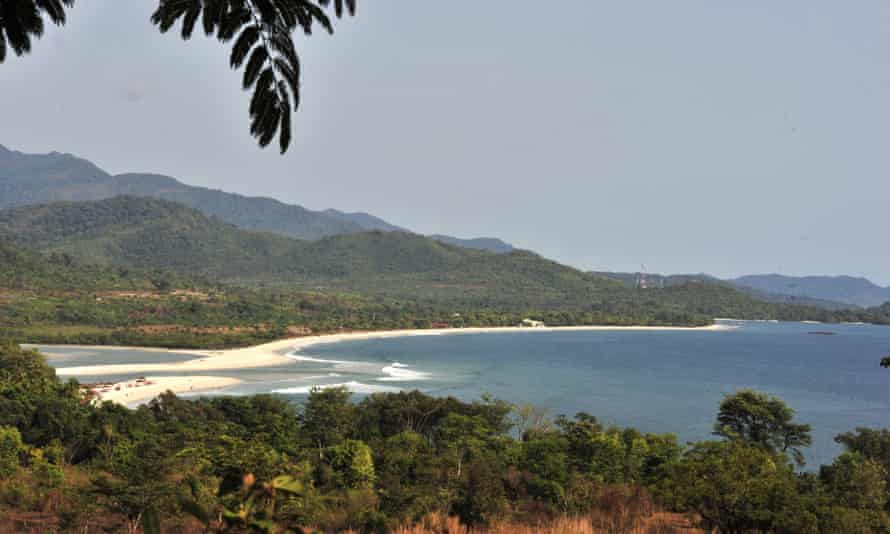
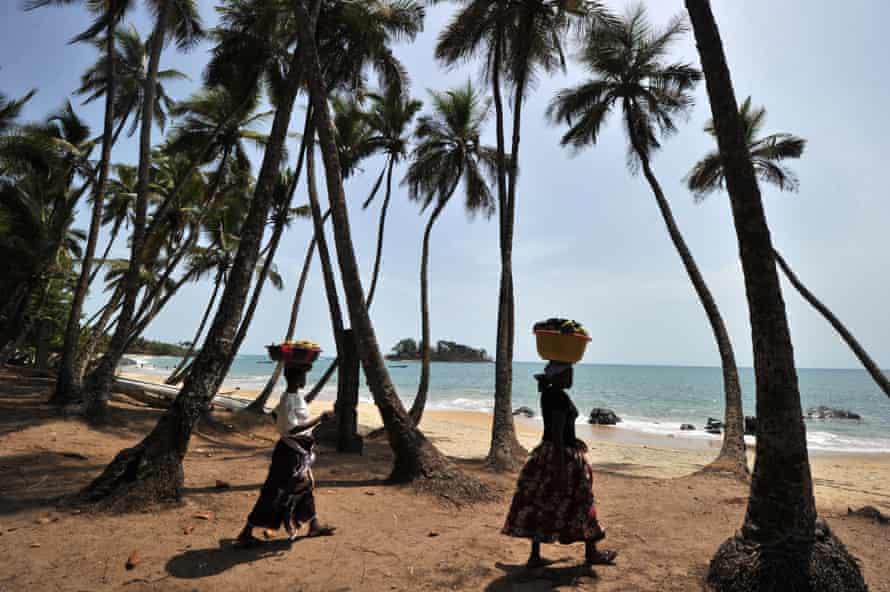
The gold and black sands of Black Johnson beach fringe the African nation’s Western Area Peninsula national park, home to endangered species including the duiker antelope and pangolins. The waters are rich in sardines, barracuda and grouper, caught by local fishermen who produce 70% of the fish for the domestic market.
For more on this story, click on the link.
‘Catastrophic’: Sierra Leone sells rainforest for Chinese harbour
Controversial deal with China would be ‘disastrous’ for fishing and protected rainforest, say opponents
Seascape: the state of our oceans is supported by

About this contentKaren McVeigh and Kabba Kargbo in Freetown@karenmcveigh1Mon 17 May 2021 01.00 EDT
974
A $55m (£39m) deal struck by the government of Sierra Leone with China to build an industrial fishing harbour on 100 hectares (250 acres) of beach and protected rainforest has been criticised as “a catastrophic human and ecological disaster” by conservationists, landowners and rights groups.
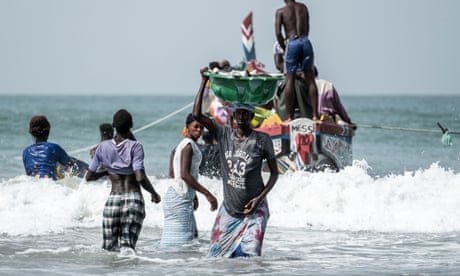
The gold and black sands of Black Johnson beach fringe the African nation’s Western Area Peninsula national park, home to endangered species including the duiker antelope and pangolins. The waters are rich in sardines, barracuda and grouper, caught by local fishermen who produce 70% of the fish for the domestic market.
After reports of a Chinese-backed fishmeal plant began circulating on social media, A statement that appeared to be from the Sierra Leonean fisheries ministry confirmed the deal, but denied the planned construction was a “fish mill”. The facility would be a harbour for tuna and “other bigger fishing” vessels exporting to international markets, it said. It would include a “waste-management component” to “recycle marine and other wastes into useful products”.
The government said the beach, one of many along the nation’s 250-mile (400km) coastline, was the “most suitable place” for construction, and revealed the finance ministry had set aside a compensation package of 13.76bn leone (£950,000) for affected landowners. But the statement leaves more questions than answers, say those objecting to the plan.
Advertisementhttps://6da6d3a939742a7dbcd5e012e663c2bb.safeframe.googlesyndication.com/safeframe/1-0-38/html/container.html
Two legal campaign groups, the Institute for Legal Research and Advocacy for Justice (ILRAJ) and Namati Sierra Leone, have written to the government, under the 2013 Right to Access Information Act, demanding to see the environmental and social-impact assessment studies, and the report showing that the beach was, as claimed, the most suitable place for construction “in terms of bathymetry, social safeguards (minimum resettlement costs) and environmental issues”. They are also seeking a copy of the grant agreement between China and Sierra Leone.
Basita Michael, a lawyer for the ILRAJ, said: “The press release was very vague. It left us wondering how did we arrive here and how come we are only hearing about this now. We have a right to know more.”
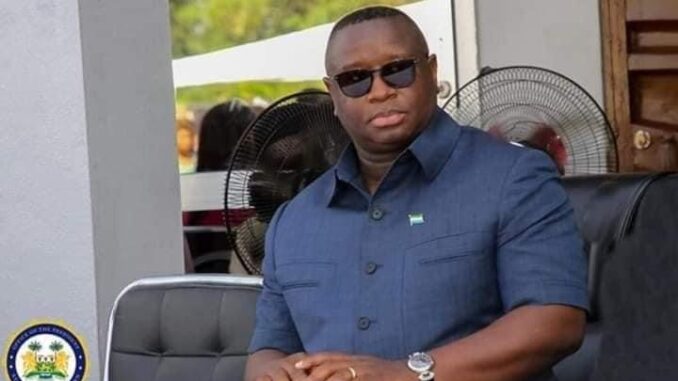
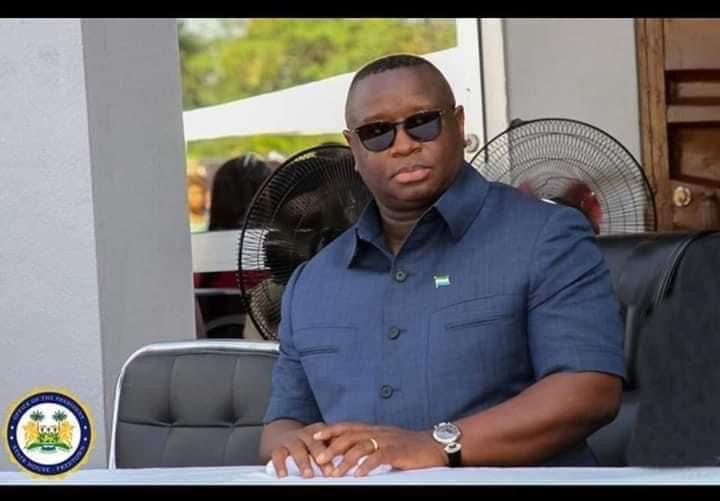
James Tonner, who owns land at Black Johnson with his mother, Jane Aspden Gbandewa, has written an open letter to the president, Julius Maada Bio, calling for him to intervene and stop the construction, which Tonner said would be “disastrous for the country and the planet”.
It would destroy pristine rainforest, plunder fish stocks and pollute fish breeding grounds and several ecosystems, Tonner said. The beach is on Whale Bay, so-named because whales and dolphins are seen there.
Tonner, who lives in London, has set up a crowdfunding page to fund a judicial review into the deal. The government could be acting unconstitutionally if it acquired the land compulsorily, he said, because the constitution requires any such move to be in the public interest. The compensation stated by the government was also unfair, he argued, claiming that the rate was about 30 times lower than the market value of the land.
“Under the constitution, the government can sequester land if it is in the public interest,” Tonner said. “Even if this just a deep-water harbour, it is not in the public interest because it’s not a suitable site. There are fish breeding sites in the lagoon. It will wipe out the local fish people live on.”
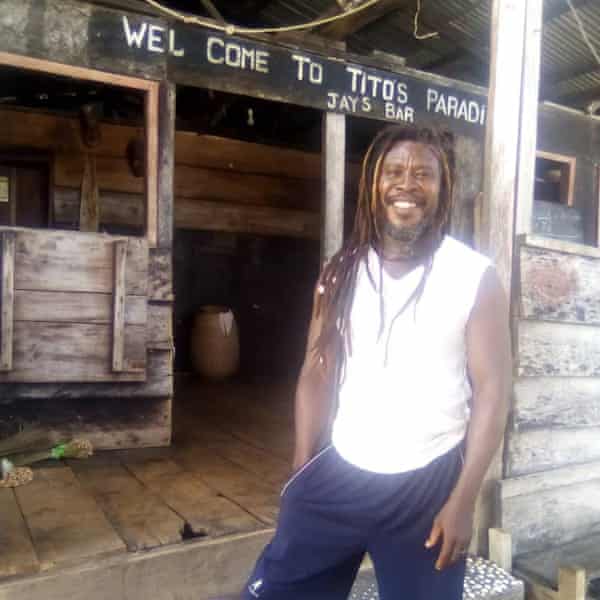
Tito Gbandewa, Tonner’s stepfather, is a former fisherman who runs an ecotourism business on the beach and owns about 1.2 hectares. He said: “If they do this here, the water will be dirty, there will be a lot of oil and noise, the trawlers will be all around.
“Our own fishermen won’t have a place to fish. Everything will be spoiled. Tourism will be finished.”
Dr Sama Banya, president emeritus of the ConservationSociety of Sierra Leone, echoed Gbandewa’s comments, saying the proposed development would have a “disastrous” impact on tourism and “the very fish industry that it’s supposed to support”.Advertisement


 Gaza hit by heavy airstrikes as UN warns of ‘uncontainable’ crisis | First Thing https://imasdk.googleapis.com/js/core/bridge3.458.0_en.html#goog_737426002https://imasdk.googleapis.com/js/core/bridge3.458.0_en.html#goog_784882298https://imasdk.googleapis.com/js/core/bridge3.458.0_en.html#goog_1726391518SKIP AD
Emma Kowa Jalloh, Sierra Leone’s fisheries minister, insisted that the plan was for a harbour and not a fishmeal factory. She said: “I can categorically tell you there is no fish mill [sic] going in at Black Johnson. What we are doing is a fish harbour that will be built by the Chinese government. A fish mill is something where you go and catch all the baby fish and grind it into food to give to piggeries, and fish in aquaculture – and that is so not true.”
It would be built with a Chinese government “grant” and equity from Sierra Leone in the form of land, she said. Half of the land needed was government-owned, she said, including the seafront, up to 200 metres from the sea. The rest has been acquired through compulsory acquisition, she said.
“People are making this fuss about it,” the minister added. “I would just appeal to people: ‘be patient, we want to be developed, we want to grow, we want to be classified as an upcoming country. There must be development and somebody has to sacrifice.’
“I’m not saying everything is going to be 100% perfect but we will make sure that it is near-perfect.”
… as it’s our birthday month, we have a small favour to ask. It’s not every day you turn 200. We hope you’ll join us in celebrating two centuries of independent, high-impact Guardian journalism, as we gear up for centuries more. Since 1821, tens of millions have placed their trust in our quality reporting, turning to us in moments of crisis, uncertainty, solidarity and hope. And we’re just getting started.
Thanks to funding from more than 1.5 million Guardian supporters in 180 countries, we’ve remained open to all, and fiercely independent. With no shareholders or billionaire owner, we set our own agenda and provide truth-seeking journalism that’s free from commercial and political influence. When it’s never mattered more, we can investigate and challenge without fear or favour.
Unlike many others, Guardian journalism is available for everyone to read, regardless of what they can afford to pay. We do this because we believe in information equality. Greater numbers of people can keep track of global events, understand their impact on people and communities, and become inspired to take meaningful action.
Over the past 200 years, we have reported on the most critical issues and events of the day, and published countless exclusives that have held the powerful to account and exposed incompetence, injustice and impropriety. From the global movement for racial justice to the climate crisis, from a broken food system to life in an age of misinformation, our fact-based journalism highlights injustice, offers solutions and helps make order out of a dizzying news cycle.
If there were ever a time to join us, it is now. Every contribution, however big or small, powers our journalism and helps sustain our future.