
The Harder They Come: Sierra Leone’s Politics of Power and Patronage
By Melvyn Thomas
Jimmy Cliff’s “The Harder They Come” is more than a song about personal struggle. It is an anthem of resistance against poverty, exploitation and entrenched power. Its central character refuses to accept a life determined by forces more powerful than himself. He demands his share, rejects submission and insists on living with dignity.
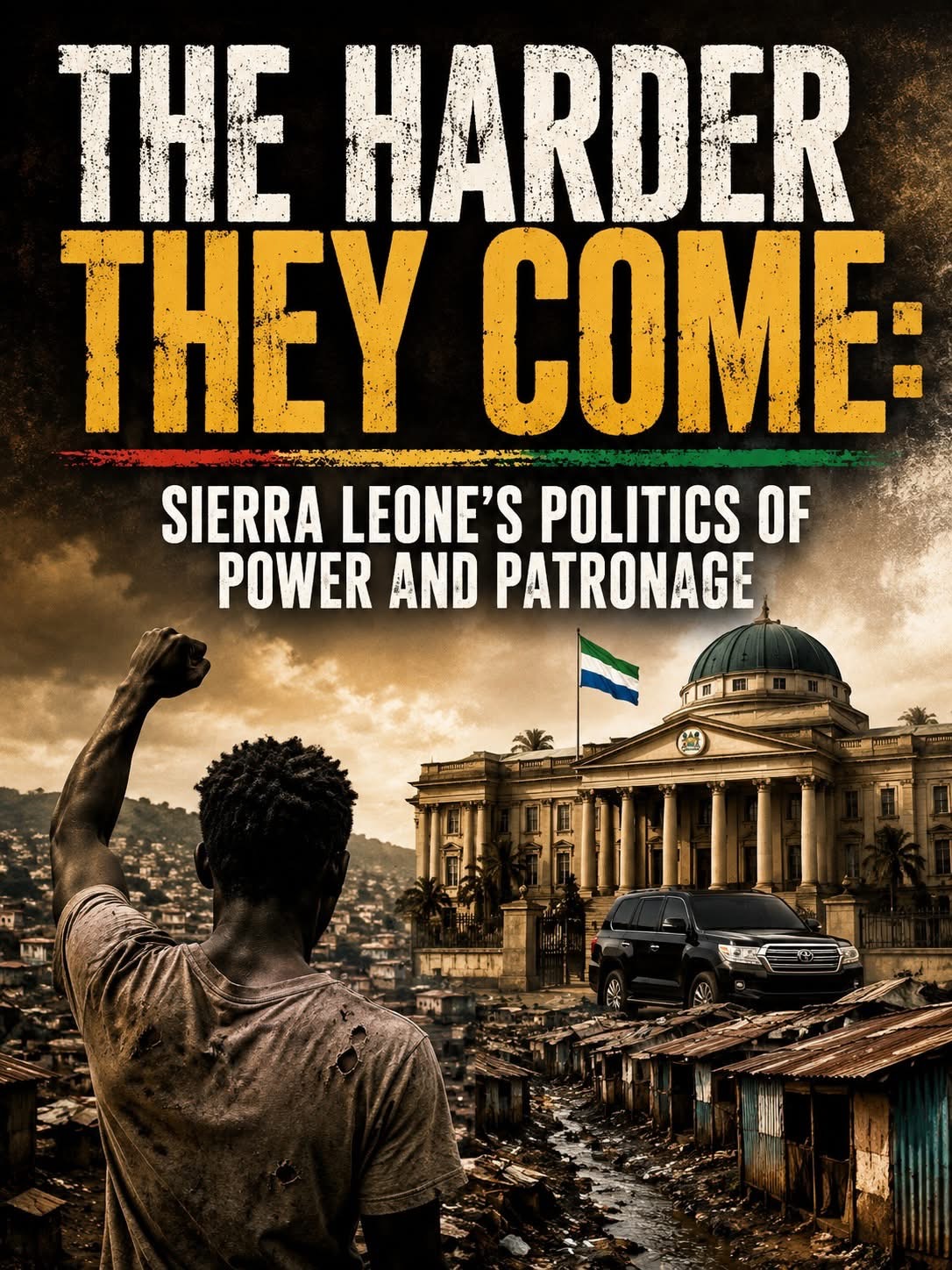
Viewed through a Sierra Leonean lens, the song becomes a powerful metaphor for the relationship between ordinary citizens and an “oppressor class” sustained by institutionalised corruption.
“They Never Seem to Hear Even Your Cry”
One of the song’s strongest themes is the frustration of people whose suffering appears invisible to those in power. The narrator rejects the idea of simply waiting for a better life in the hereafter. He wants his share now.
This sentiment resonates with citizens who have heard repeated promises of development, employment, better public services and prosperity while watching politically connected individuals accumulate wealth and influence.
The problem is not simply that individual politicians may be corrupt. Institutionalised corruption is far more dangerous because it turns corruption into a system.
When political patronage, weak accountability, opaque procurement and poor enforcement become embedded in government, corruption stops being an exception and becomes part of how the system operates.
The Oppressor Class
When Cliff sings about the “oppressors” trying to keep him down, the oppressor can be understood as more than one individual. It can represent a network of political and economic interests that benefits from the unequal distribution of power and opportunity.
In Sierra Leone, this can be reflected in the relationship between political influence, business interests and access to state resources.
Access can determine who obtains government contracts, employment opportunities, licences, land, concessions and other economic benefits.
The ordinary citizen can therefore be excluded without anyone explicitly telling them “no.” The system itself can make opportunity easier for those with connections and considerably harder for those without them.
“I’m Gonna Get My Share”
Perhaps the song’s most powerful declaration is the determination to get one’s share.
For Sierra Leone, this becomes a metaphor for citizens demanding that the country’s natural and human resources produce tangible benefits for the wider population.
A country blessed with minerals and other resources should not leave its citizens feeling permanently excluded from the wealth generated around them.
The question becomes brutally simple:
If the country’s resources belong to everyone, why does prosperity appear to belong to so few?
That question captures the frustration at the heart of Cliff’s song.
When Institutions Protect Power
The situation becomes even more troubling when institutions designed to prevent corruption become weak, compromised or politicised.
An individual corrupt official can be removed. A corrupt system can replace him with another.
When political connections influence appointments, contracts or access to opportunities, citizens can lose faith in the principle of equal treatment.
The result is a dangerous perception that the law is strongest against the powerless but negotiable for the powerful.
That perception can create political apathy, cynicism and eventually anger.
“I’d Rather Be a Free Man in My Grave”
The narrator’s determination to remain free represents the song’s deepest challenge to oppression.
Applied to Sierra Leone, it can be understood as a demand for political dignity and independence—the right to participate in society without having to become somebody’s political client simply to survive.
It challenges a culture in which citizens may feel compelled to depend on powerful individuals for jobs, contracts, favours or access to basic opportunities.
A population that demands rights rather than favours becomes considerably harder to control.
The Harder They Come, the Harder They Fall
The famous refrain provides the song’s ultimate warning.
The greater the effort to suppress, exploit or exclude people, the stronger their determination to resist can become.
For Sierra Leone, that resistance need not mean violence. It can mean demanding transparency, accountable leadership, independent institutions, fair access to opportunities and responsible management of national resources.
Ultimately, “The Harder They Come” is a song about refusing to accept oppression as destiny.
Its message to Sierra Leone’s political and economic establishment is unmistakable:
A nation cannot remain permanently divided between those who control the system and those who merely survive it.
The more the powerful use institutions to keep people down, the harder the people will eventually demand to rise.

Leave a Reply