
MY PERSONAL REFLECTION ON THE COURTROOM CONFRONTATION BETWEEN CHIEF JUSTICE KOMBA KAMANDA AND MR. JOSEPH FITZGERALD KAMARA
By Albert Julius Gulama
I have known both the Honourable Chief Justice Komba Kamanda, Esq., and Mr. Joseph Fitzgerald Kamara, former Attorney General and Minister of Justice, and I have known them to be men of good character. It is therefore unfortunate to witness a courtroom confrontation of this nature between two distinguished members of our legal community.
Having followed the reported proceedings and reflected on the exchanges that took place, I wish to share my personal observations, not to condemn either man, take sides, or question the integrity of either individual, but to consider whether the situation could have been handled differently.
1. Where did things begin to go wrong?
From my understanding, the confrontation escalated when Mr. Kamara made a remark suggesting that the Chief Justice was “showing his hand too early.” The Chief Justice responded by saying that the Court was not a political theatre, and Mr. Kamara replied by telling the Chief Justice to “mind his words.”
In my layman’s understanding, the expression “showing one’s hand too early” could mean that a judge appears to be revealing a position before all the arguments have been heard. Whether that was what Mr. Kamara intended, however, is something I cannot conclusively determine.
Perhaps the first opportunity to prevent the escalation was right there. Rather than allowing the exchange to become personal, the Chief Justice could have asked Mr. Kamara to explain precisely what he meant. If the remark was intended to suggest that the Court had prejudged the matter, the Chief Justice could then have addressed that concern directly. If it meant something else, clarification might have prevented a misunderstanding from becoming a confrontation.
2. Could Mr. Kamara have handled his response differently?
I believe so. A lawyer must be able to defend his client’s interests firmly, raise objections and challenge legal positions. However, the manner in which those objections are expressed is equally important.
Telling the Chief Justice to “mind his words” could understandably be perceived as confrontational. Mr. Kamara could instead have respectfully stated that he took exception to the characterization of his submission and wished to clarify his point.
That would have allowed him to maintain his professional position without making the disagreement personal.
3. Could the Chief Justice have handled the situation differently?
I also believe there was room for a different approach. The Chief Justice has the responsibility to maintain order, protect the dignity of the Court and ensure that proceedings are conducted respectfully. Those responsibilities are essential to the administration of justice.
However, authority does not lose its strength when exercised with patience and restraint. A calm warning, a request for clarification or a brief recess might have achieved the same objective without allowing the confrontation to intensify.
In my view, the ability to distinguish between a lawyer’s poorly expressed objection and a deliberate attempt to undermine the Court is an important part of judicial leadership. Of course, determining which description applies requires careful consideration of the full context.
4. The disagreement over the apology
From the subsequent exchanges, the Chief Justice appeared to require not only an apology but also a clear withdrawal of the disputed expression. Mr. Kamara repeatedly apologised and at one point asked the Chief Justice to show him what he wanted him to say.
That question could have been a genuine request for clarification, although its meaning would also depend on the tone and context in which it was delivered.
Perhaps the Court could have clearly explained what it required: an apology for the language used and an express withdrawal of the particular statement. Mr. Kamara, in turn, could have offered an unambiguous apology and retraction without abandoning his underlying legal argument.
For example, he could have said that he regretted the expression, withdrew it and had not intended to suggest that the Court had prejudged the matter.
Would the Chief Justice necessarily have accepted such an apology? We cannot know. But a clear explanation of what was required might have created another opportunity for resolution.
5. The intervention of other members of the legal community**
The reported attempts by Mr. S. K. Koroma, counsel for the Plaintiff’s side and the Attorney General, counsel for the Defendants, to seek an opportunity for the matter to be resolved deserve consideration.
Their intervention appeared to recognise that the dispute was no longer simply about a particular remark. It was becoming a matter affecting the relationship between the Bench and the Bar.
A short recess or a further opportunity for discussion might have helped the parties step back from the confrontation. Granting a recess would not necessarily have weakened the authority of the Court. Equally, accepting such an opportunity would not have required Mr. Kamara to surrender his professional independence.
Sometimes, the wisest course is not to determine who has the last word, but to find a way for the institution to continue functioning with dignity.
6. When the confrontation moved beyond words
The reported direction for Mr. Kamara to remove his wig and enter the dock, followed by the summoning of police, marked a significant escalation.
At that point, the dispute had moved beyond the original exchange of words to a question of compliance with the Court’s directions and the exercise of judicial authority.
A court must be able to enforce lawful orders. At the same time, any coercive action must have a proper legal basis and comply with the applicable procedures. Whether those requirements were met in this particular case cannot be conclusively determined from excerpts of the exchange alone; that would require examination of the full recording, the relevant rules and the official court record.
MY CONCLUSION
I do not believe that this incident should automatically define either man’s character. People of good character can disagree, misunderstand one another and make mistakes in difficult moments.
My concern is that an exchange that might have been resolved through clarification, restraint and a carefully expressed apology developed into a public confrontation with consequences extending beyond the two individuals involved.
The Chief Justice had the responsibility to uphold the authority and dignity of the Court. Mr. Kamara had the responsibility to advocate firmly while maintaining the professional respect expected of an officer of the Court. Both responsibilities could have been upheld without allowing the disagreement to escalate as it did.
In my personal view, the most constructive outcome would have been one in which the Chief Justice calmly clarified his concern, Mr. Kamara clearly withdrew the disputed expression and apologised, and the proceedings resumed with the dignity of the Court preserved.
The lesson for me is simple: firmness does not have to become hostility, an apology does not have to mean surrender, and authority does not have to be demonstrated through escalation.
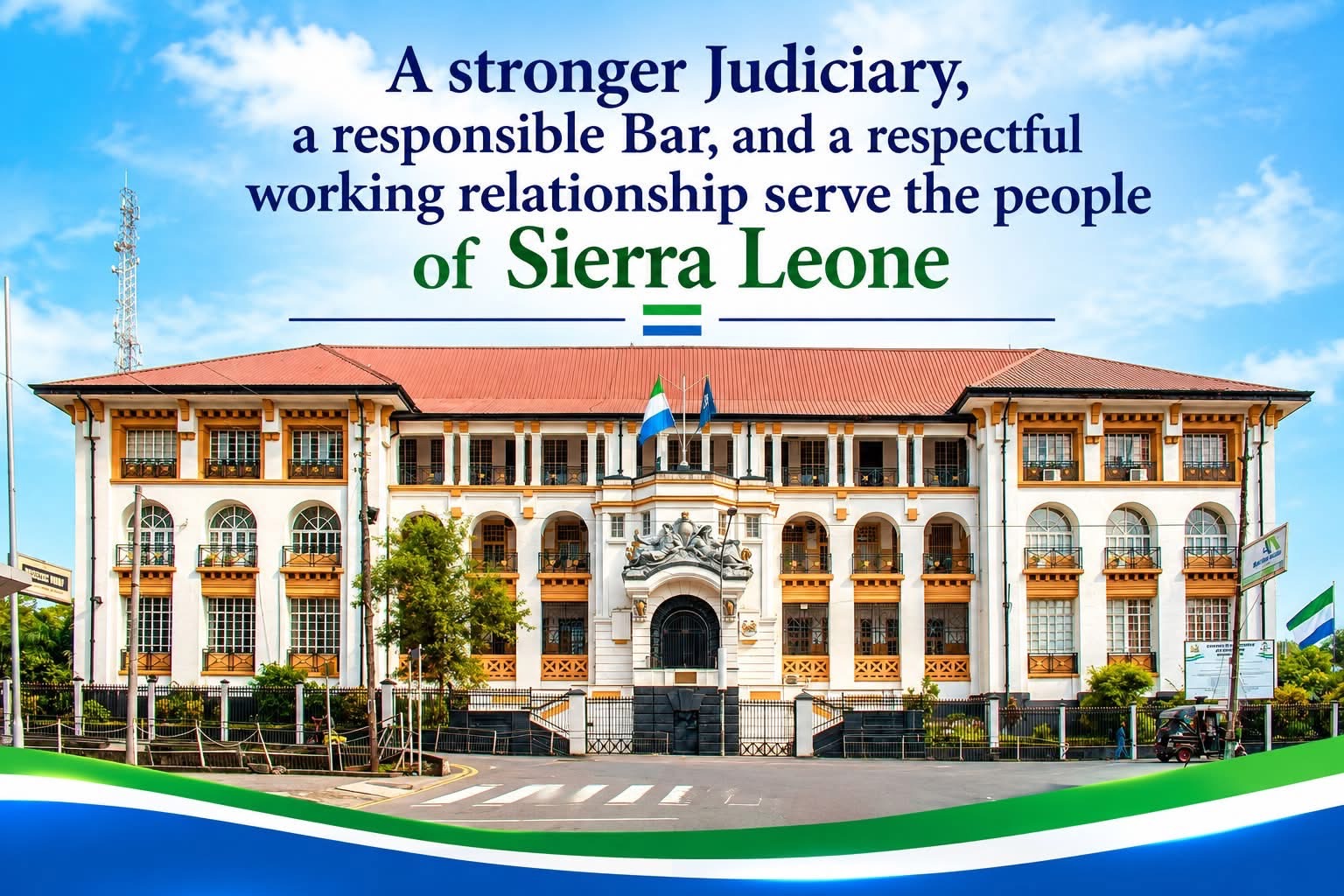
Our nation needs a strong and independent judiciary, a courageous and responsible Bar, and a professional relationship between the two. They may disagree vigorously, but they must also be able to resolve disagreements in ways that preserve public confidence in the administration of justice.
I hope this unfortunate incident will ultimately remind us all of the importance of mutual respect, humility, restraint and reconciliation.
**DISCLAIMER:** I am not a lawyer, and this post is not legal advice or a formal legal opinion. I am simply expressing my personal views as a layman based on my understanding of the reported courtroom exchanges. I do not claim to know the private intentions of either individual, nor do I intend to malign, defame or prejudge either man. My purpose is to encourage a fair, respectful and constructive discussion about how such a confrontation might have been avoided and how the dignity of both the Bench and the Bar can be preserved.



Leave a Reply