
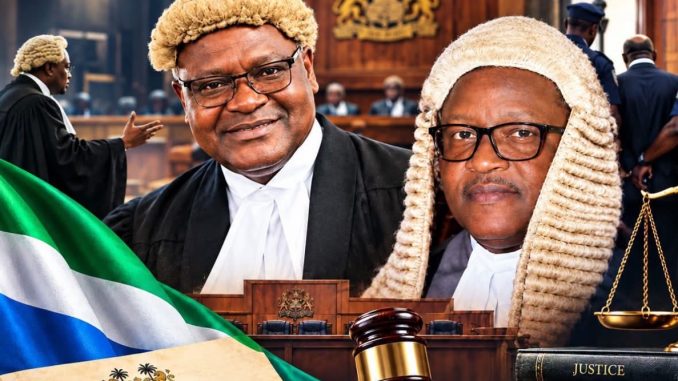
THE BAR, THE BENCH AND THE TEST OF JUSTICE
By Mahmud Tim Kargbo
Friday, 9 October 2026
A courtroom dispute has become a test of judicial authority, professional restraint and public confidence in justice in Sierra Leone. On 7 and 8 October 2026, an exchange between senior counsel Joseph Fitzgerald Kamara and the Chief Justice escalated into a contempt finding and custodial punishment at the Supreme Court, during proceedings concerning the Constitution of Sierra Leone (Amendment) Act, 2025. The General Legal Council has since urged the Court to reconsider the custody order. The episode raises a question larger than the fate of one lawyer: how should a constitutional court defend its authority while ensuring that its own exercise of that authority remains open to scrutiny?
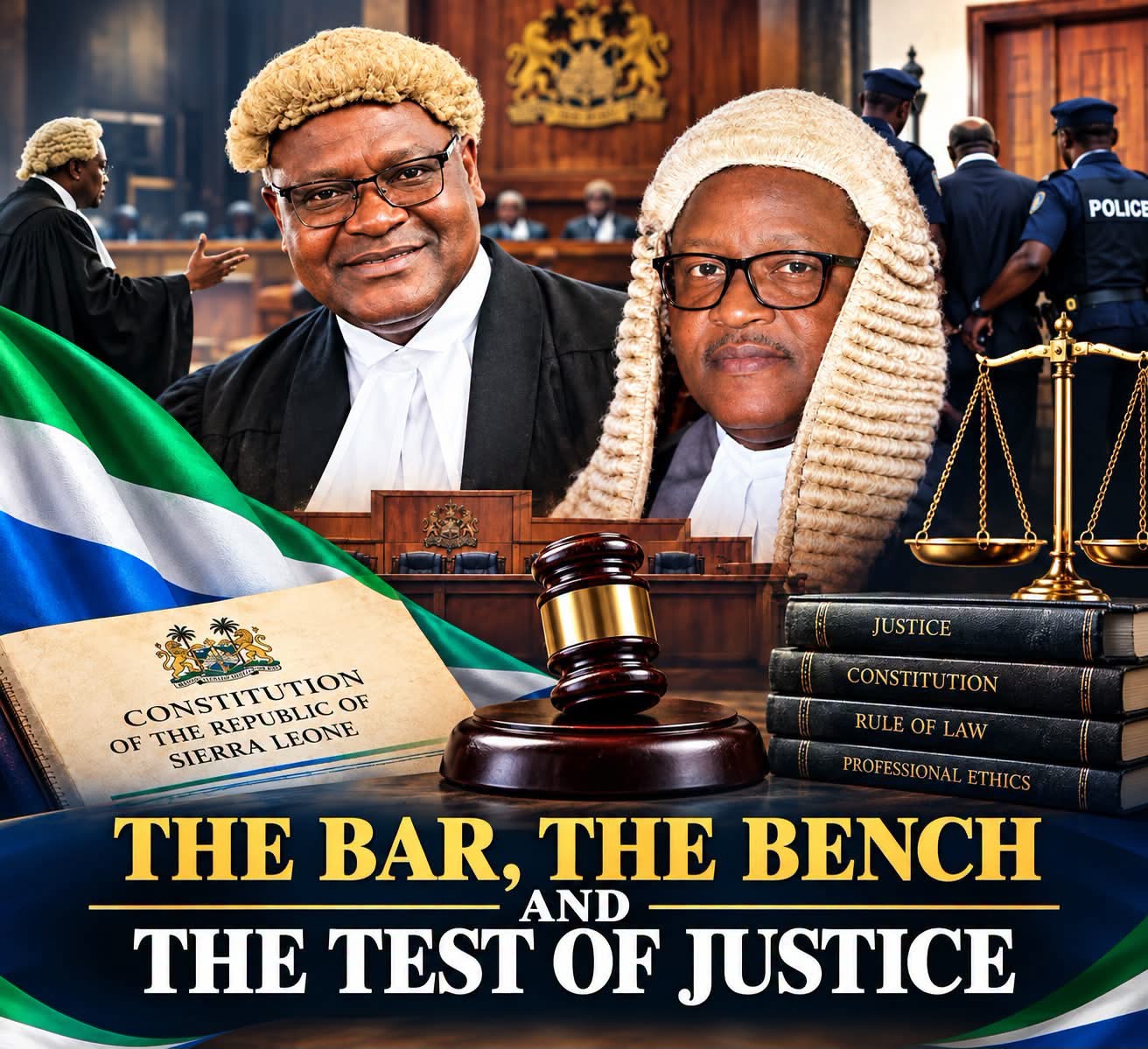
The first day’s exchange, as supplied by an account from the courtroom, began with Kamara telling the Chief Justice: “You are opening your hands too early.” The Chief Justice responded: “Mr Kamara please can you please mind your language. This isn’t a political theatre, please.” Kamara replied: “my lord I wish you also to take that back. We are here in a court of law and I citing the provisions of the law and you cannot talk to me like that. This isn’t politics, we are here to promote justice my lord. That imprint is not fair, absolutely not fair my lord. Allow me to make my case”. The Chief Justice then said: “Mr Kamara please we are going for recess now we will be coming shortly”. The words matter, but so does the context in which they were exchanged. A dispute over a judge’s approach to an argument can be legitimate; the manner in which that dispute is conducted is a separate question.
On 8 October, according to the account provided, the Chief Justice called Kamara to stand and described the previous day’s conduct as uncalled for and unacceptable, particularly in the Supreme Court. He apologised to the public and referred to interviews in which Kamara had reportedly defended the exchange as falling within the law. The Chief Justice raised his phone and said, “I have evidence of them here”. The Chief Justice called on him to apologise and withdraw the offending remarks. Kamara tendered an apology, but the Bench considered it inadequate, ordered him to remove his wig and proceed to the dock, and called police officers to escort him. He was committed to custody for contempt. As he was escorted away, he reportedly told members of the Bar: “Members of the Bar, I will be back!” These details should be assessed against the full courtroom record, not stripped of context or converted into partisan slogans.
The constitutional setting makes restraint especially important. Parliament’s published record of the amendment process, including its notice of a pre-legislative hearing, provides relevant context. The Supreme Court’s own institutional explanation states that it has exclusive jurisdiction to determine questions concerning constitutional interpretation. This is therefore not an ordinary quarrel detached from public consequence. The Court is dealing with a constitutional measure whose meaning and legal implications deserve careful argument. That makes orderly proceedings essential, but it also makes the freedom to advance legal submissions without intimidation or personal affront indispensable.
Judicial authority is not optional. A court must be able to hear arguments, control proceedings and protect the dignity necessary for its work. Lawyers cannot treat judicial scrutiny as an insult, nor can they assume that the courtroom is a stage on which confrontation earns public approval. A practitioner who believes a judge has mischaracterised an argument should make the objection clearly, firmly and professionally. Yet authority is strongest when exercised with composure. The Bench’s responsibility is not simply to command obedience; it is to demonstrate that discipline is being maintained for the proper administration of justice, rather than for personal vindication.
That principle also requires the proportionality of punishment to be considered seriously. Contempt powers exist to protect the administration of justice, not to shield judges from legitimate criticism or to turn a tense exchange into a contest of institutional pride. Whether the conduct in this instance justified immediate custody, and whether a lesser measure could have protected the Court’s authority, are questions that should be answered by reference to the full record and applicable law. Nothing in the available account alone permits a definitive legal verdict on the order. Equally, the fact that an apology was offered does not automatically settle whether it was adequate or whether the Court was entitled to reject it.
The General Legal Council’s statement of 8 October recognises both sides of the institutional problem. It expressed concern about the altercations, describing the conduct as discourteous and damaging to the profession’s standing, while calling on the Supreme Court to reconsider the custodial punishment when proceedings resume or at a practicable time before the next hearing. The Council cited rule 4(2) of the Legal Practitioners (Code of Conduct) Rules, 2010, which requires practitioners to act courteously and respectfully towards those with whom they have professional contact, including judges and other lawyers. The rules are published by the Law Reform Commission. The Council’s position is not that professional conduct is irrelevant, but that discipline and reconciliation need not be mutually exclusive.
The Council’s appeal should not be mistaken for a finding that the Bench acted unlawfully, just as the Court’s contempt order should not be treated as proof that every aspect of its response was necessarily proportionate. Institutional fairness demands both distinctions. The Chief Justice must protect the Court from conduct that obstructs its work; counsel must be free to challenge legal reasoning without being presumed politically motivated. Neither role is strengthened by public pressure to declare a winner before the relevant record and legal principles have been properly examined. The public interest lies not in humiliating a judge or glorifying a lawyer, but in preserving a process in which legal disagreement remains possible and courtroom order remains credible.
The wider danger is that a constitutional case becomes overshadowed by the spectacle surrounding it. When attention shifts from the legal questions to personalities, gestures and competing accounts of disrespect, public understanding of the underlying dispute suffers. The Court’s transparency, including the accreditation of media houses to livestream proceedings as welcomed by the General Legal Council, can help citizens assess what occurs. But visibility alone cannot guarantee fairness. The record must be read carefully, statements attributed accurately, and commentary kept distinct from established fact.
The test is not whether the Bench or the Bar emerges victorious. It is whether both can demonstrate the restraint that public office and professional duty require. If the Court reviews the custodial order, it need not surrender its authority; it may instead show that authority can coexist with measured reconsideration. If counsel accepts the obligations of courtroom courtesy, he need not abandon robust advocacy. Justice depends on a Bench secure enough to exercise power proportionately and a Bar disciplined enough to challenge power without diminishing the court in which justice must be done. The constitutional proceedings deserve to return to their substance, and public confidence deserves nothing less.


Leave a Reply