
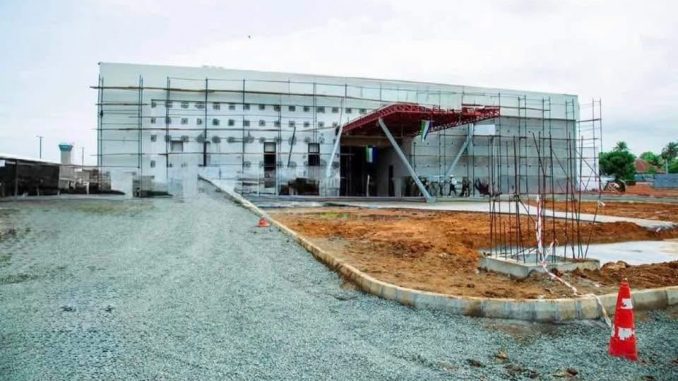
Looking Beyond OAU vs ECOWAS Numbers
Part 1: Reassessing the “Lost Opportunity” Argument — A More Realistic Valuation of the 1980 OAU Summit Expenditure
By Yoni Emmanuel Sesay
One of the strongest arguments made in comparing the 1980 OAU Summit with the 2026 ECOWAS Summit is the claim that Sierra Leone sacrificed a historic economic opportunity by spending approximately US$200 million on hosting the event.
The argument is based on a future value calculation: if that USD 200 million had instead been invested and allowed to grow at an annual return of 12% over 46 years, it would have accumulated to approximately USD 36.7 billion by 2026.
At first glance, this figure is striking. It creates the impression that Sierra Leone did not simply spend USD 200 million; rather, it lost tens of billions of dollars in potential national wealth. It presents the OAU Summit as a decision that deprived future generations of enormous economic benefits.
However, while the mathematical formula is correct, the economic assumptions behind the calculation require careful examination.
The central question is not whether USD 200 million invested wisely could have generated significant returns. It clearly could have. The more important question is whether Sierra Leone in 1980 possessed the political stability, institutional capacity, economic environment and investment conditions required for that theoretical outcome to become reality.
Countries do not develop through mathematics alone. Money does not automatically multiply because a formula produces a large number. Investment generates wealth only when supported by effective institutions, competent management, political stability, productive economic activity and the ability to protect capital over time.
The calculation of USD 36.7 billion assumes a Sierra Leone that never existed.
It assumes that:
the USD 200 million would have been invested efficiently;
the investment would have been protected from mismanagement and economic leakage;
Sierra Leone would have experienced 46 uninterrupted years of economic stability;
the capital would have achieved a consistent 12% annual return;
there would have been no major political, economic or social disruptions.
These assumptions do not fully reflect Sierra Leone’s actual historical experience.
The Missing Reality of Sierra Leone’s Economic Journey
Following the OAU Summit in 1980, Sierra Leone entered a period of increasing economic difficulty and institutional weakness. The country experienced declining economic performance, governance challenges and growing social pressures.
Then came the devastating civil war from 1991 to 2002.
For almost ten years, large parts of the country were effectively ungovernable. Economic production collapsed, infrastructure was destroyed, businesses closed, human capital was lost, investors withdrew and national resources were redirected from development towards survival, security and reconstruction.
Those years matter.
A calculation that assumes 46 uninterrupted years of 12% annual growth effectively removes the civil war and other national challenges from the historical record. It creates an imaginary investment environment that Sierra Leone did not experience.
A more honest question is therefore not:
“What would USD 200 million have become if everything had gone perfectly?”
The more realistic question is:
“What could USD 200 million realistically have become given Sierra Leone’s actual historical circumstances?”
To answer that question, the calculation must recognise that investment returns are shaped by the environment in which they occur.
A More Historically Grounded Valuation
The original calculation uses the standard future value formula:
Future Value = Present Value × (1+r)ⁿ
Where:
Present Value (PV) = USD 200 million
Annual return (r) = 12%
Period 👎 = 46 years
Therefore:
USD 200 million × (1.12)⁴⁶ = USD 36.7 billion
This represents a theoretical maximum outcome under perfect conditions.
However, a more realistic assessment must introduce additional factors reflecting Sierra Leone’s actual historical circumstances.
1. Macroeconomic Stability Factor (M)
Investment requires a stable environment. While Sierra Leone experienced serious disruptions, it is reasonable, for the sake of argument, to assume that approximately 35 years out of the 46-year period represented relatively investable conditions.
This is a more generous assumption that recognises periods of recovery, stability and economic opportunity after the civil war.
Therefore:
M = 35/46 = 0.76
This means that approximately 76% of the period could reasonably be considered suitable for sustained investment growth.
2. Absorption and Investment Efficiency Factor (A)
The original calculation assumes that every dollar invested would have been successfully converted into productive economic assets.
However, in developing economies, investment outcomes are affected by:
institutional capacity;
quality of project selection;
implementation efficiency;
governance systems;
corruption risks;
capital losses and leakages.
Even under favourable circumstances, it would be unrealistic to assume 100% efficiency.
A reasonable assumption that 60% of the investment would have been effectively converted into productive national wealth gives:
A = 0.60
3. National Shock Adjustment Factor (S)
Even during periods of relative stability, Sierra Leone experienced significant national shocks, including:
the civil war;
destruction of infrastructure;
loss of productive capacity;
Ebola;
global economic crises;
COVID-19 disruption.
A conservative adjustment recognising these shocks:
S = 0.50
Applying the Adjusted Formula
The revised calculation becomes:
Adjusted Future Value = PV × (1+r)ⁿ × M × A × S
Using the original theoretical value:
USD 36.7 billion × 0.76 × 0.60 × 0.50
= approximately USD 8.37 billion
Therefore, under a more generous historical assumption of 35 years of relatively investable conditions, the estimated value would be approximately:
USD 8.4 billion
rather than the theoretical USD 36.7 billion.
Why This Difference Matters
The difference between USD 36.7 billion and USD 8.4 billion is not simply a mathematical adjustment. It represents two fundamentally different interpretations of history.
The original calculation suggests that Sierra Leone possessed a guaranteed economic pathway where USD 200 million would inevitably have grown into USD 36.7 billion.
The adjusted calculation recognises a more complex reality: Sierra Leone lost a significant opportunity, but that opportunity existed within a challenging historical environment where converting capital into wealth was never automatic.
This distinction is important.
A potential loss of approximately US$8.4 billion would still represent a major missed opportunity for a country of Sierra Leone’s size. It would be irresponsible to dismiss the importance of such an amount.
However, it is equally important to avoid presenting a hypothetical maximum outcome as a guaranteed historical fact.
There is a difference between saying:
“USD 200 million could have been invested more productively and created significant national wealth.”
and saying:
“Sierra Leone definitely lost USD 36.7 billion.”
The first is a legitimate debate about opportunity cost.
The second requires assumptions that do not adequately reflect the country’s actual economic journey.
The Real Lesson of the OAU Decision
This analysis should not be interpreted as a defence of the OAU expenditure.
Public money belongs to citizens. Governments have a responsibility to ensure that major financial decisions are transparent, justified and aligned with national priorities.
The important questions remain:
Were alternative uses of the money properly considered?
Was the expenditure proportionate to expected national benefits?
Were citizens given sufficient value in return?
Were accountability mechanisms strong enough?
These questions are central to democratic governance.
However, history must be analysed honestly. A country cannot learn from the past by replacing complexity with convenient calculations.
The real lesson of 1980 is not only about the amount of money spent. It is about the systems surrounding public decisions:
Good governance determines whether resources become national assets or missed opportunities.
This principle applies equally to governments of the past, present and future.
Looking Forward: Comparing OAU 1980 and ECOWAS 2026
The purpose of history is not to provide political weapons. It is to help nations make better decisions.
Therefore, the comparison between OAU 1980 and ECOWAS 2026 should not focus only on the amount of money committed.
The deeper questions are:
How is the expenditure financed?
What risks are carried by the state?
Are there transparent agreements?
Are citizens protected from hidden liabilities?
What long-term economic benefits are expected?
Are the institutions strong enough to deliver those benefits?
The true measure of a national decision is not simply how much money is spent, but whether that spending creates lasting value for citizens.
The debate should therefore move beyond hypothetical numbers and focus on the principles that determine national success:
transparency, accountability, responsible investment and genuine commitment to the welfare of Sierra Leone’s people.
In Part 2, I will examine whether ECOWAS 2026 has genuinely avoided the weaknesses associated with OAU 1980 — particularly in relation to PPP financing, government guarantees, transparency, public risk and long-term economic returns.

Leave a Reply