
 ALPHA SESAY, CONSTITUTIONAL REFORM, AND THE DIFFERENCE BETWEEN PAPER AND POWER
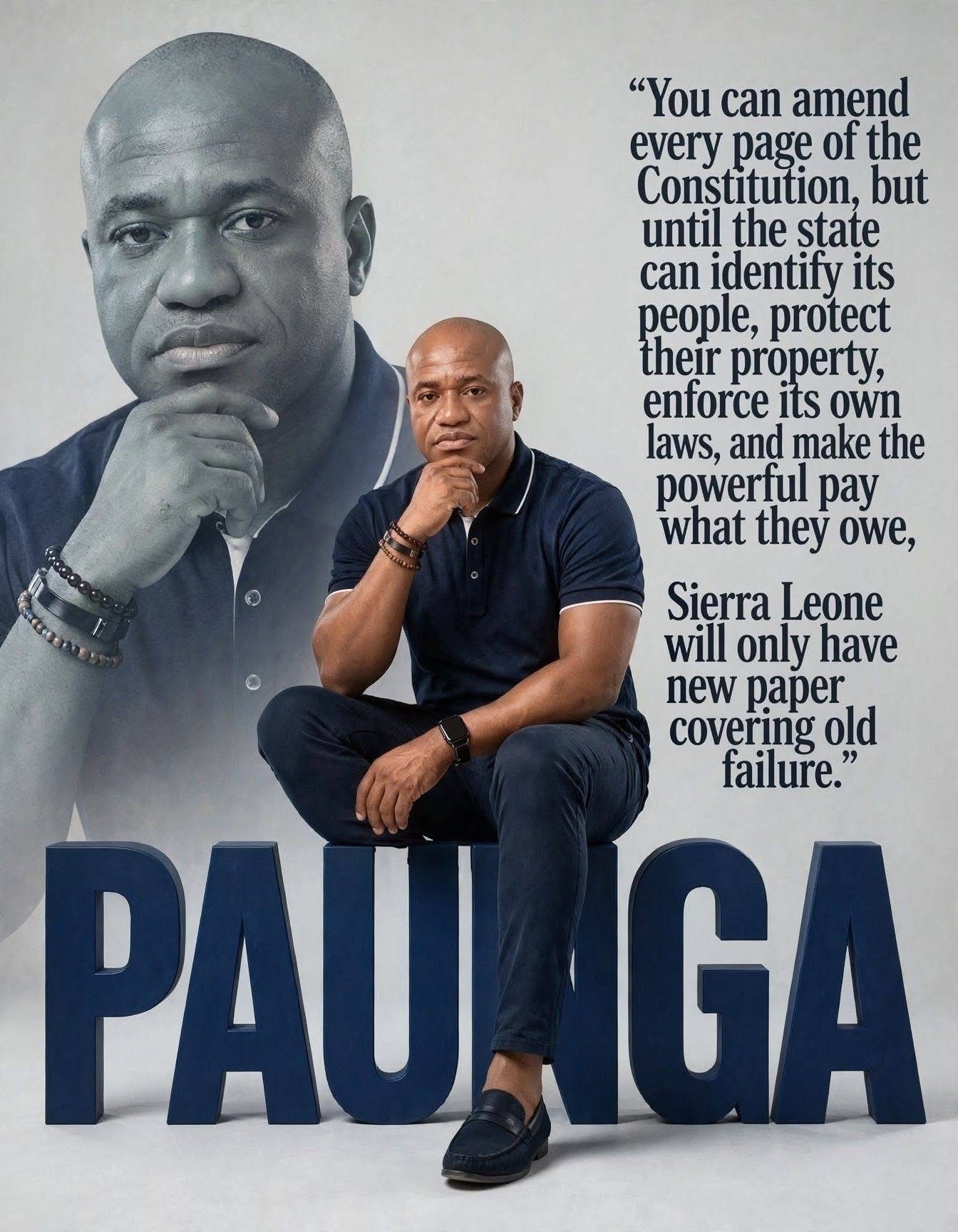
By Paunga Absenstous- Manor Sesay
In my first article, I promised Sierra Leoneans that I would deal carefully with Attorney General Alpha Sesay’s argument that our country must move from what he calls a “constitution of survival” to a “constitution of prosperity.”
This is the beginning of that promise.
I will not rush this discussion, because the Constitution is not a small matter. It belongs to the poor woman selling pepper by the roadside, the driver struggling with fuel prices, the student wondering whether education will lead anywhere, the farmer protecting a small piece of family land, the businessman afraid to invest, and the young graduate who has learned that knowing the right person can sometimes matter more than knowing the right thing.
It belongs to all of us.
So this first piece will do one thing: it will examine Alpha’s broad case for constitutional reform and give my broad response. On Thursday, I will go further. I will explain why Alpha and I may look at Sierra Leone differently, even though we both studied law at Fourah Bay College and he was one year ahead of me.
After that, next week, I will take the proposed constitutional reforms one by one. I will not shout. I will not insult. I will not hide behind friendship. I will ask what every serious Sierra Leonean has the right to ask:
What problem is this amendment solving? Who gains power from it? Who loses protection? And how will it improve the life of the ordinary citizen?
That is how constitutional questions should be handled.
Not with praise singing.
Not with fear.
Not with long speeches that make confusion sound like intelligence.
ALPHA’S BROAD ARGUMENT
Alpha Sesay’s argument, as I understand it, is that Sierra Leone has outgrown the 1991 Constitution.
He says the Constitution was made in a difficult period, when the country needed stability, survival, peace, political order, and a way to hold itself together. He now argues that Sierra Leone must go further: toward prosperity, wider political participation, better representation of women and young people, electoral reform, clearer governance, social and economic rights, and a more modern political order.
At first hearing, that sounds attractive.
Who does not want prosperity?
Who does not want more women in public life?
Who does not want fair elections?
Who does not want better institutions, better education, better health care, better opportunities, and a Sierra Leone that can stand with confidence among nations?
The difficulty is not in wanting these things.
The difficulty is in pretending that writing them differently in a Constitution is the same as building them in real life.
That is where Alpha and I part company.
Alpha appears to begin with the Constitution. He looks at the country’s difficulties and sees a legal framework that must be redesigned.
For me as a son of Bo#2 I begin with the citizen. I look at the same country and ask whether the state can perform its most basic duties before it starts promising new constitutional miracles.
Can it identify people?
Can it keep records?
Can it protect land ownership?
Can it collect water and electricity bills?
Can it enforce contracts?
Can it stop politically connected people from behaving as if public institutions belong to them?
Can it ensure that a poor person receives the same justice as a rich person?
Can it make an investor believe that a signed agreement will remain meaningful after an election?
These are not small questions. They are the foundation beneath every beautiful national promise.
THE COWAN REPORT IS NOT SCRIPTURE
Alpha often takes comfort in the fact that constitutional reform has been discussed for years. He points to the Lomé Peace Agreement, the Truth and Reconciliation Commission process, the Edmond Cowan Constitutional Review Committee, public consultations, stakeholder engagements, and more recent reform discussions.
That history may explain why the conversation exists. It does not settle whether every proposal is wise.
The Edmond Cowan report is not scripture.
It was written by human beings. It can be questioned by human beings. It can contain good ideas, weak ideas, borrowed ideas, fashionable ideas, political ideas, and ideas that sound serious but do not fit the real problems of Sierra Leone.
Sierra Leone has a dangerous weakness: we often confuse activity with achievement.
A committee meets.
A report is prepared.
A consultant is paid.
A hotel hall is filled.
A minister speaks.
A document is launched.
Pictures are taken.
Then the poor man goes home to the same broken water pipe, the same disputed land, the same unemployed son, the same slow court, the same unpaid public bills, and the same government office where nobody can find the file.
That is not reform.
That is movement without progress.
A country can produce enough reports to fill a library and still fail to provide water to a neighbourhood.
WHAT A CONSTITUTION CAN DO
Let us be fair. A Constitution matters.
It can protect rights. It can limit the powers of the President. It can define the responsibilities of Parliament. It can establish the Judiciary. It can guide elections. It can protect citizens from abuse. It can create rules for the transfer of power. It can give people a lawful weapon when government becomes arrogant.
That is serious work.
But a Constitution is not a housing estate.
It is not a rice farm.
It is not a car factory.
It is not a commercial bank.
It is not a national identity card.
It is not a title deed.
It is not a water meter.
It is not a court judgment.
It is not an electricity bill paid by a man who believes he is too connected to pay.
A Constitution can create the rules. It cannot make people obey them.
A Constitution can promise a right. It cannot build the institution that delivers that right.
A Constitution can say a citizen deserves housing. But who will survey the land, build the roads, provide the pipes, finance the homes, register the titles, and stop party men from sharing the best plots among themselves?
A Constitution can speak about health care. But who will buy the medicine honestly, distribute it fairly, maintain the clinics, pay the nurses, and stop public supplies from disappearing?
A Constitution can announce prosperity. But who will protect property, enforce contracts, ensure stable policy, and give investors confidence that their business will not be destroyed by political uncertainty?
The Constitution can point to the road.
It cannot walk it for us.
SIERRA LEONE’S REAL EMERGENCY
Sierra Leone’s real emergency is not that we have too little constitutional language.
Our real emergency is that we have too little institutional discipline.
We have laws that are not enforced.
We have records that cannot be trusted.
We have land that can be claimed by several people at once.
We have utility services that cannot collect money from those who use them.
We have courts that too often move slowly while poor people wait.
We have public offices where an ordinary citizen can be sent from desk to desk until he either gives up or finds someone important to call.
We have a state that often knows how to announce a policy but struggles to carry it from paper into the life of the citizen.
That is why I keep returning to the simple example of water.
Suppose a politically connected man uses water for months and refuses to pay. What happens?
Can the water company identify him beyond doubt?
Can it confirm his address?
Can it connect him to the property?
Can it recover what he owes without a politician calling to stop the process?
Can it take lawful steps that work?
Or must the public company simply watch the bill grow, while poor citizens are harassed, disconnected, or treated as criminals for much smaller debts?
That one example carries the whole national problem inside it.
If the state cannot identify, record, enforce, and recover, it cannot govern seriously.
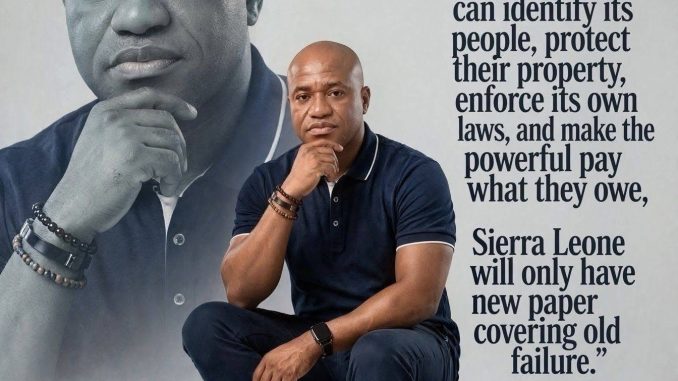
And if it cannot govern seriously, a new Constitution will become another beautiful document sitting on top of old confusion.
WHY ALPHA AND I DIFFER
On Thursday, I will speak more directly about why Alpha sees this matter as he does, and why I see it differently.
We were both trained in law. We both passed through Fourah Bay College. He was one year ahead of me. We both understand the dignity of legal ideas, the value of constitutional order, and the importance of institutions.
But life does not teach every lawyer the same lesson.
WHY I PAUNGA IS DIFFERENT FROM ALPHA
A man’s professional journey shapes the questions he asks.
Some people spend their lives near policy, legal theory, government offices, international organisations, reform projects, conferences, commissions, and constitutional language. They become trained to see national problems first as problems of structure, law, policy, and institutional design.
Others spend their lives closer to the daily risks of business: bills, payroll, customers, agreements, property, permits, records, debts, losses, taxes, delays, and the hard truth that a system either works or it does not.
Neither path makes a person foolish.
But the paths do not produce the same instincts.
I will explain on Thursday why Alpha’s professional journey may have taught him to place more faith in constitutional redesign, while mine has taught me to ask whether the existing system can first carry out its ordinary duties.
For now, I will only say this: intellectual strength is not measured by how many big words a man can use, how many reports he can cite, or how serious he looks while speaking.
Intellectual strength is measured by whether a man can see the real problem beneath the language.
And Sierra Leone’s real problem is not that we have failed to write enough promises.
Our real problem is that we have failed to build systems strong enough to keep promises.
WHAT COMES NEXT
Next week, I will take the proposed reforms one at a time.
I will examine questions around electoral reform, proportional representation, women’s participation, presidential-election rules, independent candidacy, the Electoral Commission, citizenship, and any other proposed change placed before the country.
I will ask whether each proposal strengthens the citizen or strengthens the political class.
I will ask whether it increases accountability or merely gives party leaders more power.
I will ask whether it makes elections more credible or merely makes winning easier for those already close to power.
I will ask whether it protects democracy or dresses political advantage in constitutional clothing.
I do not believe Sierra Leone needs a new Constitution because a report says so.
I do not believe Sierra Leone becomes prosperous because a lawyer gives poverty a new constitutional name.
And I do not believe that a nation is transformed by paper while its land records remain confused, its courts remain slow, its utility bills remain unpaid, its public servants remain unaccountable, and its citizens remain unable to obtain ordinary justice.
Alpha, my friend, I respect your learning. I respect your office. I respect the kindness you showed my family.
But Sierra Leone deserves more than intellectual decoration.
It deserves a government that can identify its people, protect their property, enforce their agreements, collect what is owed to the public, punish corruption, and apply the same law to the powerful and the weak.
That is where prosperity begins.
Not with another report.
Not with constitutional theatre.
But with a country that finally decides that its rules must work in real life.
Leave a Reply