
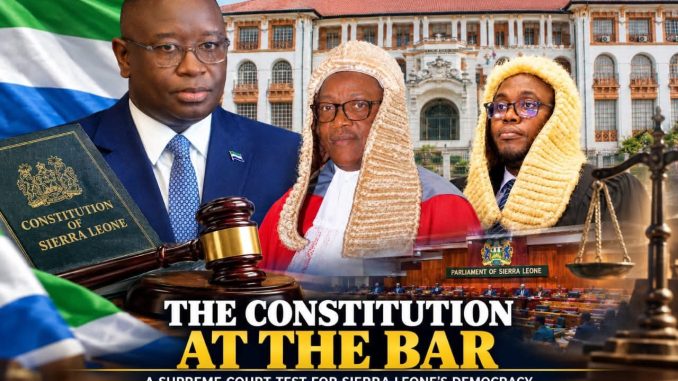
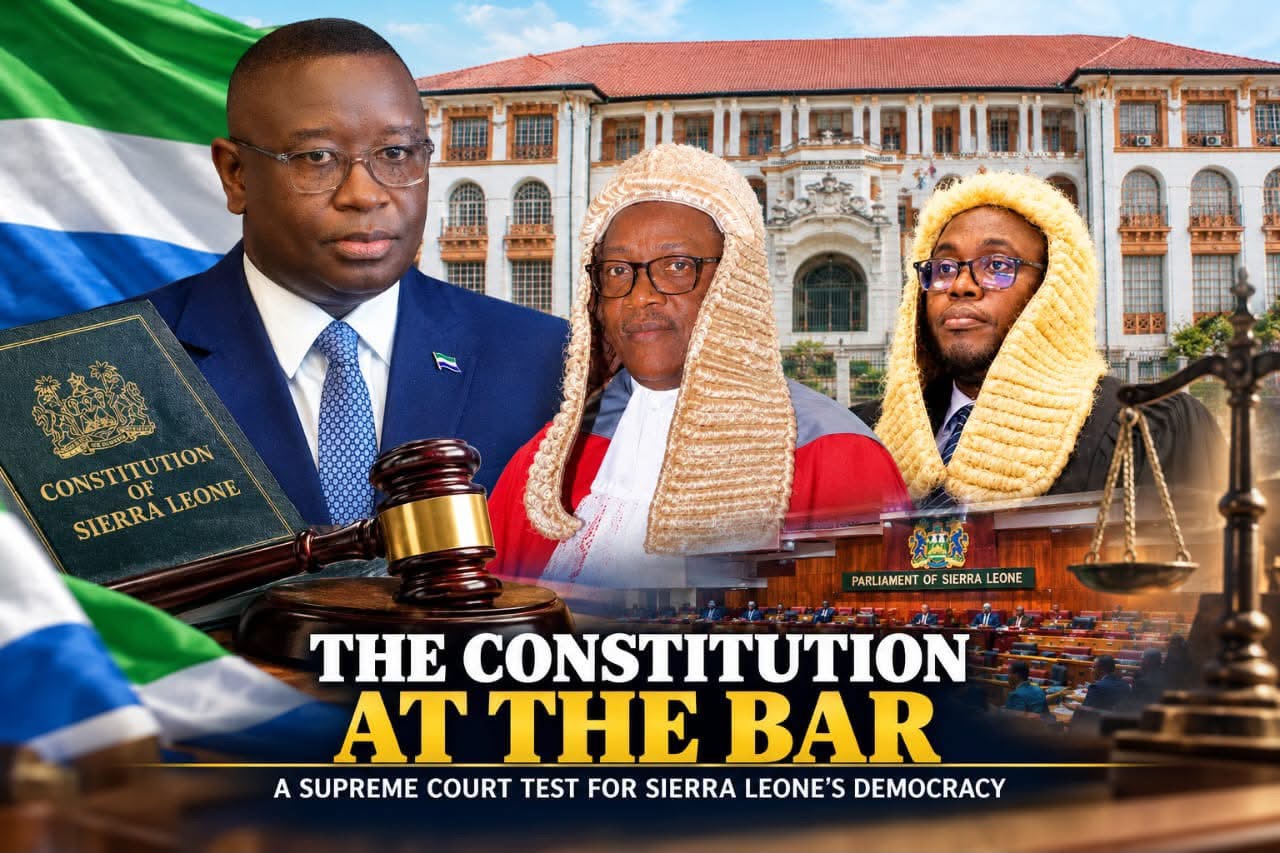
THE CONSTITUTION AT THE BAR
By Mahmud Tim Kargbo
Tuesday, 6 October 2026
Sierra Leone’s constitutional amendment dispute has reached the Supreme Court, with a basic question at its centre: did Parliament use the procedure the Constitution requires to change the Constitution? The question follows the Speaker’s ruling of 10 August and President Julius Maada Bio’s decision to seek judicial guidance before deciding whether to assent to the Constitution of Sierra Leone (Amendment) Bill, 2025. What appears at first to be a dispute over parliamentary arithmetic is, in fact, a test of whether constitutional power remains subject to constitutional limits.
Section 91(1) establishes the ordinary parliamentary rule: a question is decided by a majority of Members present and voting, “Except as otherwise provided in this Constitution”. Section 108(2)(b), however, prescribes a specific requirement for constitutional amendment, requiring support at the second and third readings by “not less than two thirds of the Members of Parliament”. The central legal issue is therefore not whether section 91 exists, but whether its ordinary voting rule can govern where section 108 supplies a specific constitutional threshold.
The uncertainty then becomes narrower, but more consequential: what does “two thirds of the Members of Parliament” mean? Section 108(2)(b) does not expressly use the phrase “present and voting”, which appears in section 91(1). The constitutional text therefore leaves room for disagreement over the denominator. Does two thirds refer to the full membership of Parliament, or to the Members participating in the relevant vote? That is the interpretive question the Supreme Court must resolve before the validity of the vote can properly be assessed. Contemporary legal analysis has identified this precise issue.
The figures explain why the distinction matters. Parliament has 149 Members, while contemporary reports state that 96 Members voted in favour after opposition Members withdrew from the sitting. If the constitutional denominator is the full membership, 96 falls below two thirds. If the relevant denominator is determined differently, the legal calculation changes. The arithmetic is therefore not disputed in the abstract; what is disputed is the constitutional rule by which the arithmetic must be measured.
The proposed amendments make the issue more than theoretical because the Bill expressly alters provisions including sections 85 and 87. The Speaker’s ruling treated the Bill as falling within the ordinary majority rule, while the opposition has argued that the constitutional amendment procedure required a higher threshold. Those positions should be understood as competing interpretations, not as established legal conclusions. The Supreme Court must determine whether the provisions being altered attract the special constitutional procedure and, if so, how the prescribed threshold is to be calculated.
The Speaker’s reliance on parliamentary practice also deserves careful treatment. Earlier constitutional amendments may provide evidence of institutional understanding, but practice cannot by itself amend or override constitutional language. The relevant question is whether the precedent concerned materially comparable provisions and procedures. Parliament’s authority derives from the 1991 Constitution, not from the accumulated habits of previous sittings. Past practice may illuminate interpretation; it cannot replace the constitutional text.
The opposition walkout presents a related but distinct question. If the Constitution requires two thirds of the Members of Parliament, can that requirement effectively be altered by the number of Members who remain in the chamber to vote? The answer depends upon the meaning assigned to the constitutional denominator, not upon the political circumstances of the sitting. A constitutional safeguard cannot be reduced to a matter of attendance if the text intends it to operate by reference to the whole membership. Conversely, if the constitutional language permits a participation based calculation, that conclusion must come from interpretation rather than convenience.
President Bio’s referral has consequently placed the dispute where it belongs. After receiving the Bill for assent, the President sought Supreme Court guidance following concerns raised by the Institute for Governance Reform, including questions surrounding the two thirds requirement. Contemporary reporting records the referral as an attempt to obtain constitutional determination rather than allow the disagreement to be resolved solely through competing political assertions. That distinction matters because constitutional legitimacy depends upon an authoritative answer to the legal question, not simply upon the strength of the parliamentary majority.
The Supreme Court’s task is therefore narrower than the political controversy surrounding the Bill. It is not being asked to decide whether the proposed reforms are desirable, nor whether the governing SLPP or opposition APC has the stronger political case. It must determine which constitutional procedure applies, what “two thirds of the Members of Parliament” requires, and what legal consequence follows if that requirement was not met. That judgment would establish a rule capable of governing Parliament beyond the present dispute.
The stakes extend beyond the Bill itself. Constitutional reform acquires legitimacy not merely because its objectives are popular or politically significant, but because the route to reform respects the rules that make constitutional government possible. President Bio has publicly associated constitutional and electoral reform with the country’s wider governance agenda, which makes procedural legitimacy especially important. The most durable judgment will therefore be one that settles the law without becoming an instrument of either political camp.
The Court need not resolve every political argument to settle the constitutional question. It needs to explain, with precision, whether section 108(2)(b) supplies a binding threshold distinct from the ordinary rule in section 91(1), what denominator the phrase “Members of Parliament” establishes, and how that interpretation applies to the vote on the Bill. If another constitutional safeguard is engaged by the particular provisions being altered, that too should be identified from the text rather than assumed. Clarity, rather than political victory, is the proper measure of the judgment.
The ultimate question is simple: can Sierra Leone change its Constitution without first obeying the rules that govern how it may be changed? If the Supreme Court answers it through the constitutional text rather than political expectation, its reasoning will outlast the present dispute. The amendment Bill belongs to today’s politics; the rules governing constitutional change belong to every government that follows. A Constitution is strongest when those with the power to change it remain bound by the law that gives them that power.


Leave a Reply