

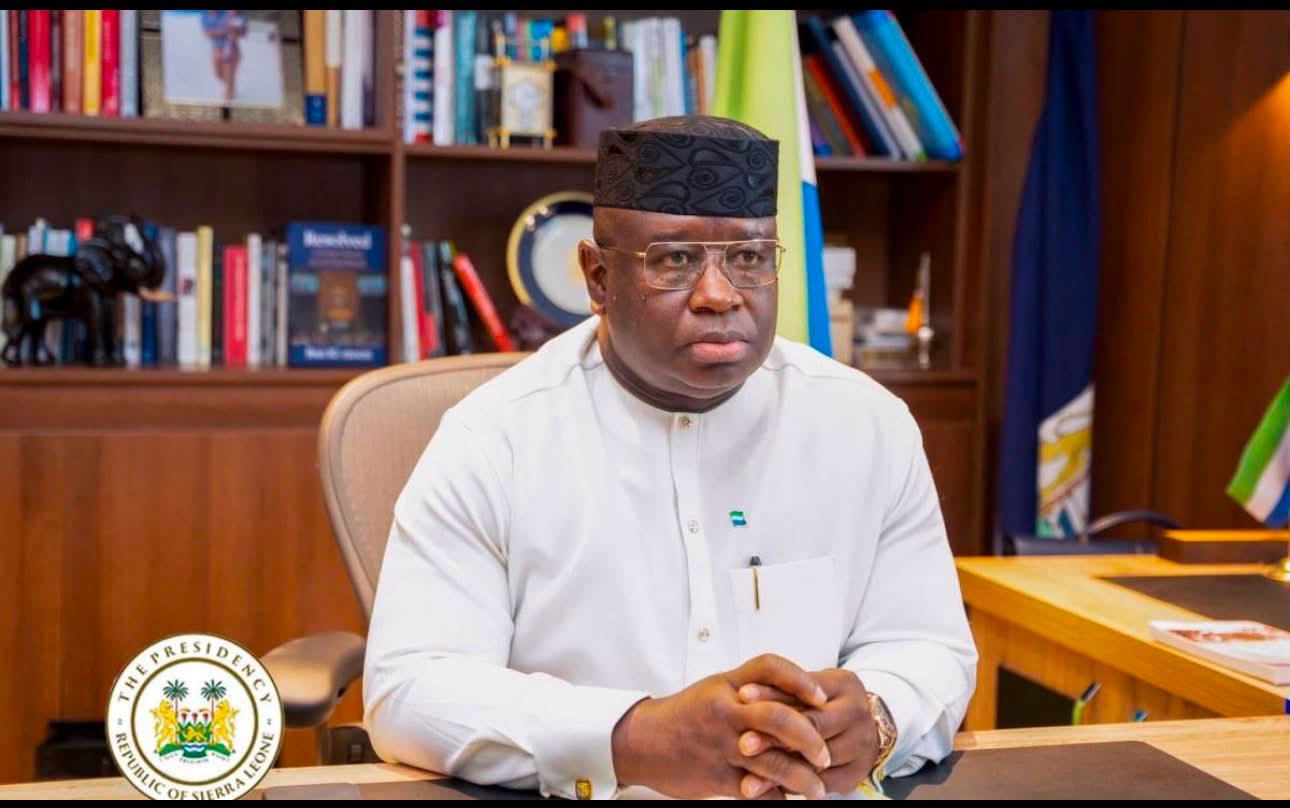
PROVE THE DOUBTERS WRONG, MR PRESIDENT
ILRAJ.
LAWYERS SOCIETY.
The Inter-Religious Council.
The Labour Congress.
SLAJ.
CAN.
CHRDI.
The Opposition.
Leading lawyers.
Prominent politicians.
Concerned citizens.
Different voices. Different constituencies. But increasingly, the same concern about what happened in Parliament and the same hope that President Bio will not assent to the Bill.
Oumar Farouk Sesay reflected that thirty years after President Bio built his democratic reputation by relinquishing military power to an elected civilian government, history presents him with another defining test: whether, when confronted with a disputed constitutional process, political power will submit to constitutional restraint.
Sulaiman Banja Tejan-Sie has appealed to President Bio to “hold the pen”—also reminding him of his democratic credentials and urging him not to assent to the constitutional amendment Bill.
Like many citizens, I am tempted to make the same appeal.
I could romanticise about President Bio’s democratic credentials. I could remind him that he once presided over a transition from military rule to an elected civilian government. I could remind him that, as President, he did what others before him failed to do: abolished the death penalty and repealed the criminal and seditious libel laws.
And I could ask him, at this defining moment, to once again do what may not be politically convenient: rise above the immediate interests of power and protect the Constitution. But I hesitate to make that plea.
Because this is a President who has democratic achievements to his credit, yet whose administration has also accumulated a record that gives me little confidence that he will resist executive power when it matters most.
I would therefore be pretending if I said I had much confidence that another plea would succeed.
President Bio, as an individual, can be remarkably charming and warm. But when personal impressions give way to the record of his administration, optimism becomes difficult.
We have witnessed repeated controversies over fundamental democratic safeguards: the suspension and eventual removal of the Auditor-General; the confrontation with NEW; lawyers prevented from holding their AGM; the weakening of the Sierra Leone Bar Association as an independent institutional voice; the continued refusal to register LAWYERS SOCIETY; and the extraordinarily heavy-handed treatment of Zainab Sheriff, despite appeals from many quarters.
Beyond these democratic controversies lies another painful chapter: the devastating kush crisis and the growing reputational damage caused by Sierra Leone’s recurring association with allegations and investigations concerning transnational drug trafficking.
These too form part of the record against which this presidency will ultimately be judged.
And throughout it all, this administration has hardly demonstrated an appetite for surrendering the enormous executive power from which successive Sierra Leonean presidents have benefited. The Supreme Court’s expansive interpretation of “supreme executive authority” was condemned by the SLPP while in opposition and continues to be criticised even by prominent supporters of this administration. Yet, after more than eight years in office, the administration has continued to enjoy the very breadth of presidential power so often criticised, without any meaningful attempt to reform or constrain it.
More troubling still is the rhetoric increasingly coming from some of those surrounding and advising the President. Too often, constitutional questions are reduced to partisan score-settling: what did the APC do when it was in power? As though the people of Sierra Leone are pieces in an endless political game of retaliation, and the Constitution an instrument through which yesterday’s grievances may be avenged rather than the supreme law to which governments, APC, SLPP or otherwise must submit.
A Constitution is not an instrument of revenge. And a country cannot be governed indefinitely on the principle that yesterday’s wrong justifies today’s.
So I will not simply ask President Bio to hold the pen.
I will ask him to look at it with introspection.
Because the pen before him is no longer merely about appending his signature to a Bill. It represents a choice about how this chapter of his presidency will be written.
That signature cannot erase the bitter political memories already created under his watch. History does not work that way.
But presidencies are ultimately remembered for those defining moments when leaders found the courage to change course.
And perhaps therein lies the significance of this pen.
It cannot rewrite what has already happened. But it can still determine how the story ends.
A President whose administration has left many deeply disappointed by its handling of democratic institutions now has an opportunity, at perhaps one of the most consequential moments of his presidency, to demonstrate that there are limits even he will not cross in the pursuit or preservation of executive power.
So, what will history record?
Will it remember a President under whose watch constitutional safeguards were progressively weakened and institutions meant to restrain power became increasingly vulnerable?
Will his record make some of the constitutional excesses we once condemned under previous governments begin to look like mere footnotes?
Or will history record that, when it mattered most, President Bio surprised even his critics—and those of us who had come to doubt whether he would resist the pull of executive power?
Will it record that, despite the imperfections and controversies of his administration, there came a moment when he found the courage to say: This far, but no further.
That when confronted with the choice between political convenience and constitutional restraint, he chose something higher.
Something higher than executive power.The Constitution. The Republic. The people.
Sulaiman Banja Tejan-Sie asked the President to hold the pen. Perhaps he should. Because the question is no longer whether this moment will become part of President Bio’s history. It will. The question is what kind of history he chooses to write with that pen.
Will it add another chapter to the bitter memories already accumulated under his watch? Or will this be the moment when he changes the ending?
Mr President, the pen is in your hand. So, too, is the choice. I am one of the doubters. But Mr President, you still have an opportunity to prove us wrong.
I stand ready to be corrected that such valour still exists.


Leave a Reply