
MR. YANSANEH BLOWING HIS MIND
———————-
Karma at the Bar: How Politicization Has Finally Turned the Sierra Leone Bar Association Against Itself, And How Partisan Interference Destroyed the SLBA’s Integrity and Invited Its Own Downfall
By Tab Barber
The events of 31 July 2026 at the Bintumani International Conference Centre should concern every Sierra Leonean who values the rule of law, constitutional governance, and the independence of democratic institutions. Images of armed police officers surrounding the venue, barricaded entrances, restricted movement, and members of the Sierra Leone Bar Association (SLBA) publicly protesting what they described as interference in their affairs have sent shockwaves across the nation. For many observers, these events represent an unprecedented assault on the legal profession. Yet they also compel an uncomfortable question: how did the country’s oldest and most respected legal institution become so vulnerable to political interference? The answer lies in years of politicization.
The Sierra Leone Bar Association was established as an independent professional body dedicated to defending the Constitution, promoting justice, protecting legal ethics, and safeguarding the independence of the judiciary. It earned the respect of the nation because it was expected to stand for the law, not for political parties or governments. Over time, however, that reputation gradually eroded as political interests increasingly found their way into the affairs of the Association. Leadership contests became viewed through partisan lenses, public statements were interpreted as serving political interests rather than constitutional principles, and lawyers increasingly aligned themselves with opposing political camps instead of maintaining the professional neutrality expected of officers of the court. As the institution became more politically divided, confidence in its independence steadily declined.
Many respected legal professionals who believed the Bar had abandoned its constitutional mission eventually distanced themselves from the Association. Rather than continue internal conflicts, they established the independent Sierra Leone Lawyers Society, presenting it as an alternative professional body committed to legal ethics, institutional independence, and constitutional values. Whether one agrees with that decision or not, the emergence of a parallel legal organization reflected a deeper institutional crisis. It demonstrated that a significant number of legal practitioners no longer believed the SLBA represented the unity, impartiality, and independence upon which its authority had traditionally rested. That fragmentation weakened the legal profession at precisely the moment Sierra Leone required strong and impartial legal institutions.
The police blockade at the Bintumani Complex is therefore more than an isolated incident. It represents the predictable outcome of years during which institutional independence was gradually compromised. Ironically, many Sierra Leoneans have compared these events with the earlier incident in Kenema, where critics argued that the same Bar leadership appeared reluctant to challenge actions widely viewed as inconsistent with democratic principles. At the time, many warned that selectively defending constitutional rights would eventually weaken the Bar’s own credibility. Those warnings now appear particularly significant. Institutions cannot effectively defend constitutional freedoms only when politically convenient. The rule of law is either applied consistently or it gradually loses its authority.
When professional organizations tolerate political interference because it appears to benefit preferred political interests, they unintentionally establish precedents that may later be used against themselves. The events of 31 July illustrate precisely that danger. An institution that once defended constitutional order now finds itself seeking protection from the very forms of interference that critics argue it previously failed to resist with equal determination. History repeatedly demonstrates that weakened institutions rarely protect those who helped weaken them. The situation confronting the SLBA today is therefore not merely unfortunate; it is a sobering reminder that compromising institutional integrity eventually carries consequences.
This is not simply an internal disagreement among lawyers. It is a constitutional warning for Sierra Leone. The legal profession occupies a unique position in every democratic society. Lawyers defend constitutional rights, represent vulnerable citizens, challenge unlawful government actions, protect judicial independence, and ensure that justice remains accessible to all. When the legal profession itself becomes divided by political loyalties, society loses one of its strongest safeguards against the abuse of power. No democracy benefits when its Bar Association is viewed as politically aligned rather than professionally independent. Likewise, no government benefits from being perceived as interfering with independent legal institutions. Both developments weaken public confidence in the country’s constitutional framework.
The greatest casualty is not the Sierra Leone Bar Association itself. The greatest casualty is public trust. Citizens must believe that lawyers defend principles rather than politicians. Judges must know that professional organizations will defend judicial independence regardless of political consequences. Young lawyers must be inspired to pursue justice rather than partisan advantage. Without that confidence, constitutional democracy becomes increasingly fragile, and the institutions designed to protect the public become vulnerable to manipulation and loss of legitimacy.
The present crisis therefore requires more than assigning blame. It demands institutional renewal. The Sierra Leone Bar Association must recommit itself to professional independence above political affiliation. Internal governance should become more transparent, leadership should remain accountable to its members rather than political interests, and ethical standards must once again become the defining characteristic of the legal profession. At the same time, divisions within the wider legal community deserve honest reflection. Rebuilding unity will require dialogue, mutual respect, and a shared commitment to constitutional principles rather than partisan victories. Professional reconciliation should never mean abandoning accountability. Instead, it should involve rebuilding institutions on stronger ethical foundations capable of resisting future political pressures.
Governments also bear responsibility. Independent professional bodies should be respected, not intimidated. Democratic governments strengthen themselves by allowing independent institutions to operate freely, even when criticism proves uncomfortable. The strength of constitutional democracy is measured not by how effectively governments control institutions but by how confidently they tolerate their independence.
Ultimately, the events at the Bintumani Complex should become a national lesson rather than simply another political controversy. Every institution that sacrifices integrity for political convenience eventually discovers that political favour is temporary, while institutional damage can endure for generations. The Sierra Leone Bar Association still has an opportunity to reclaim its historic role, but that journey will require courage. It will require acknowledging mistakes, placing constitutional duty above political loyalty, and restoring the public’s confidence that the legal profession belongs to the Constitution—not to any political party, government, or opposition movement.
The events of 31 July 2026 should therefore serve as a turning point. If the legal profession embraces genuine reform, professional independence, ethical leadership, transparency, constitutional discipline, and reconciliation, it can once again become one of Sierra Leone’s strongest democratic pillars. If it does not, future crises may prove even more damaging. History has delivered a painful reminder: when institutions abandon principle, politics eventually abandons them. Justice cannot flourish where independence is compromised, and democracy cannot endure where the guardians of the law lose the confidence of the people they were created to serve.
——_————————
SIERRA LEONE:- The SIERRA LEONE BAR ASSOCIATION.
From Guardians of Justice to Victims of Power.
When “ORDERS FROM ABOVE” Supersede the Rule of Law.
By Alusine Sesay
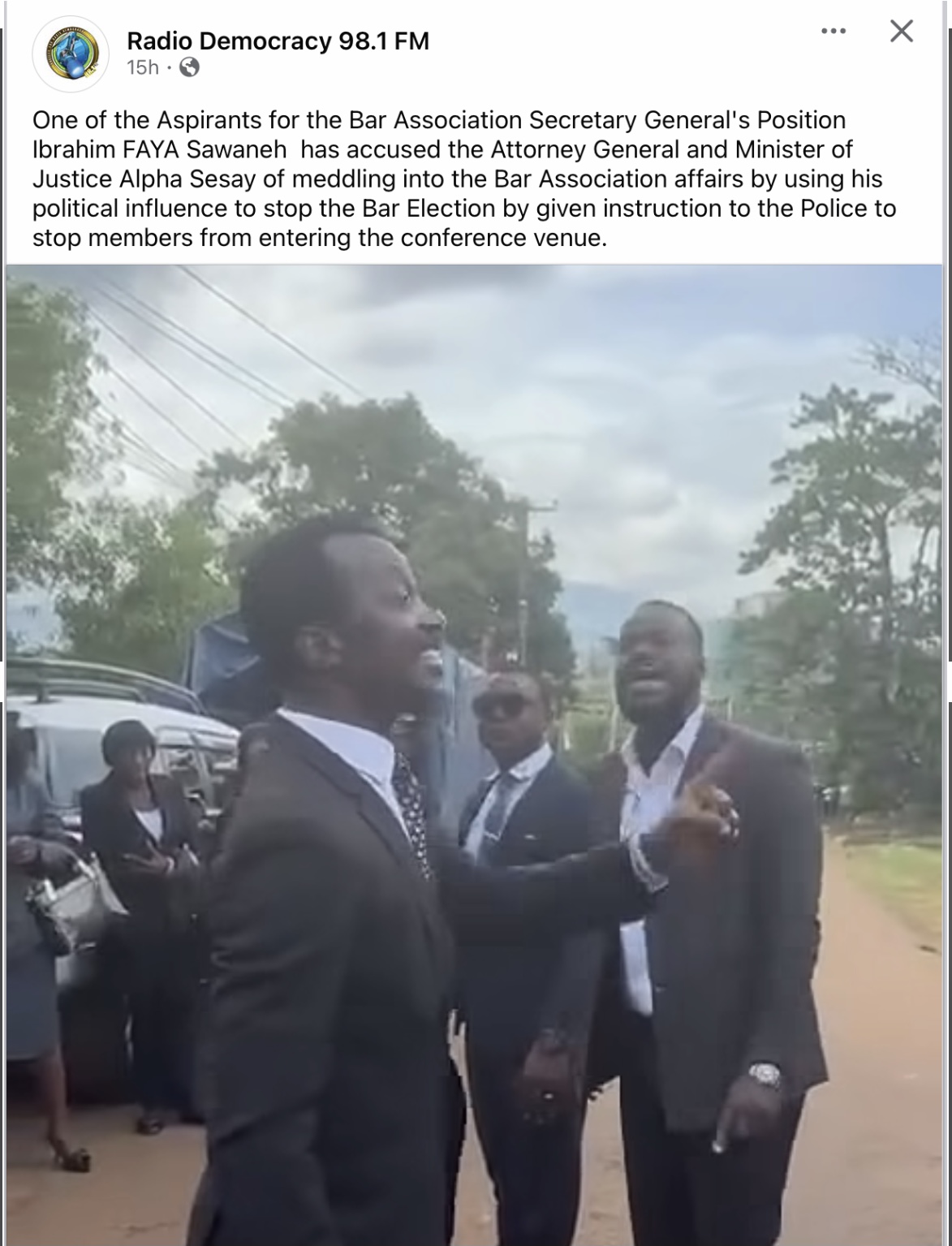
Earlier today, The Sierra Leone Bar Association (SLBA) was reportedly scheduled to hold its Annual General Meeting (AGM) at the Freetown International Conference Centre, in Aberdeen.
Remarkably, however, members of the Association were allegedly met by a significant deployment of officers from the Sierra Leone Police (SLP), who prevented them from entering the premises.
According to those present, police officers informed representatives of the SLBA that they had been expressly instructed not to permit the Association access to the conference facility. Their explanation was both unequivocal and troubling: they were acting on “ORDERS FROM ABOVE.”
The officers reportedly advised members of the Bar Association to engage directly with their superiors, who were standing only a short distance away. They maintained that they were merely executing instructions from senior command and, irrespective of the circumstances, would not allow the Association to enter the building.
If it is indeed true that the legal profession of Sierra Leone was prevented from convening its Annual General Meeting without any valid legal justification, then profoundly serious constitutional and legal questions inevitably arise.
This leads me to an important constitutional question:
Can a Police officer in Sierra Leone lawfully obey an order issued by the Inspector General of Police, or The Attorney General, if that order is itself unlawful?
The answer, in law, is straightforward: NO
As a matter of constitutional principle, a police officer in Sierra Leone is under no legal obligation to comply with an unlawful command, regardless of whether that command originates from the Inspector General of Police (IGP) or any other superior officer.
The reason is both simple and fundamental: THE RULE OF LAW
The 1991 Constitution of Sierra Leone, is the supreme law of the Republic. Every public official, including the President, the Inspector General of Police, Attorney General, Cabinet Ministers, Judges, and Police officers, is subject to the Constitution and to the law.
Therefore:
The President cannot lawfully authorise conduct that the law expressly prohibits.
The Inspector General of Police cannot invoke presidential authority as a lawful justification for unconstitutional or unlawful conduct.
Likewise, no police officer may lawfully defend an illegal act merely by asserting that it was carried out pursuant to “ORDERS FROM ABOVE”.
For far too long, this deeply entrenched culture of “ORDERS FROM ABOVE” has undermined constitutional governance and reduced the Rule of Law to little more than a rhetorical aspiration.
Such a doctrine has no place within a constitutional democracy.
Neither the President nor the Inspector General of Police is above the law.
Yes I know that the President serves as Commander-in-Chief of the Armed Forces and possesses constitutional authority to appoint the Inspector General of Police in accordance with the Constitution and applicable legislation, those powers are neither absolute nor unlimited. They must always be exercised within clearly defined constitutional and statutory boundaries.
The Constitution itself provides explicit protection for these fundamental liberties.
Section 26 of the 1991 Constitution of Sierra Leone, guarantees every person’s right to FREEDOM OF ASSEMBLY and ASSOCIATION.
Section 26(1) provides: and I quote:-
“No person shall be hindered in the enjoyment of his or her freedom of assembly and association. This includes the right to assemble freely with others and, in particular, the right to form or belong to political parties, trade unions, and other economic, social, or professional associations, whether national or international, for the protection of his or her interests.”
end quote..
In practical terms, this constitutional guarantee protects the right of every citizen to:
Assemble peacefully with others.
Organise and attend lawful public meetings.
Participate in peaceful demonstrations.
Establish or join political parties, professional associations, trade unions, and other lawful organisations.
Therefore, if the President were to instruct the Inspector General of Police to prohibit a peaceful meeting without lawful authority, or to disperse a peaceful gathering merely because it expressed criticism of the Government, the Inspector General would be constitutionally obliged to determine whether compliance with such an instruction would violate the rights guaranteed under Section 26.
Constitutional fidelity must always prevail over political expediency.
But I must say this though, the present circumstances also invite uncomfortable introspection regarding the Sierra Leone Bar Association itself.
It is pertinent to observe that since the incident at the AGM in Kenema last year, the SLBA appears to have permitted itself to become enmeshed in the taint of political interference. The Association, it seems, has relinquished its independent voice, allowing partisan influences to corrode its institutional integrity.
That the Inspector General , the President, or indeed anyone, should exhibit such audacity as to treat the Bar Association with manifest contempt is indicative of the depths to which that body has DESCENDED.
PERCEPTION has STEADILIY ERODED PUBLIC CONFIDENCE in its institutional independence.
An organisation established to serve as the guardian of constitutionalism, legal independence, and the Rule of Law must NEVER be perceived as politically compromised.
The legal profession derives its moral authority not from political patronage but from its unfaltering commitment to justice, impartiality, and constitutional principle.
You know , Institutions SELDOM lose credibility overnight.
Their decline is often gradual, occurring through repeated compromises, selective silence, and the normalisation of conduct that should have been unequivocally condemned from the outset if you ask me.
If an institution knowingly subjugates itself to the products of fraudulent and corrupt processes, and refrains from condemning the manifold irregularities that infiltrate its executive corridors because they prove convenient or advantageous, then it must likewise summon the fortitude to confront the consequences when the intricate web of deceit, lies and tricks inevitably unravels and recoils upon its architects.
The SLBA, in succumbing to such complicity, cannot now be exempt from the repercussions that such moral and institutional failings inevitably engender.
An institution that fails to resist the erosion of legality when others are affected may ultimately discover that the very machinery it tolerated has turned against it.
(I pause for now)
======


Leave a Reply