
A Dawn Interrupted: The Fight for the Soul of the Bar
August 1, 2026
Freetown
It was supposed to be a new dawn for the Sierra Leone Bar Association (SLBA). Instead, the gates of the Bintumani Hotel in Aberdeen remained closed, and the voices of the nation’s legal minds were silenced by the very authorities meant to protect their rights.
In a scene more befitting a political showdown than a professional gathering, the Sierra Leone Police barricaded the entrance to the Freetown International Conference Centre, effectively canceling the much-anticipated Annual General Meeting (AGM). The reason? A vague and unsatisfying reference to “circumstances beyond our control” and “security concerns” from Assistant Inspector General Sylvester Koroma. The legal fraternity, and the nation, are left scratching their heads, waiting for a statement from the Sierra Leone Police to clarify the rationale behind such a heavy-handed intervention.
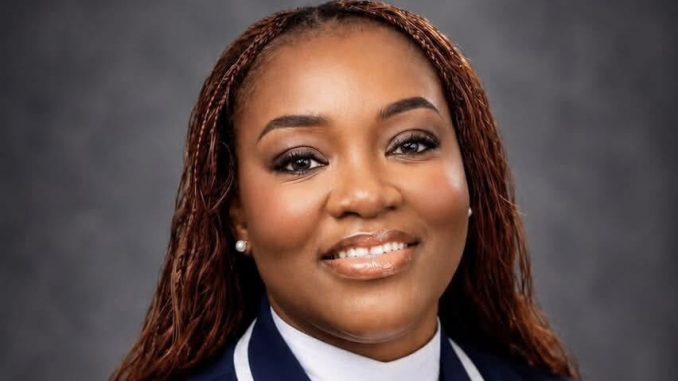
Martina Egbenda: A Voice Silenced, But Not Deterred

MARTINA EGBENDA
Among the crowd of disappointed lawyers was Martina Baindu Egbenda, a woman who had been “fired up” and ready to lead. As the leading presidential candidate, her “Uniting the Bar” campaign has swept across the nation, from the northern districts of Bombali to the eastern reaches of Kono, promising a restoration of dignity and unity to a profession that has seen better days.
Her vision of “One Bar, One Voice, One Commitment” has resonated deeply with lawyers who yearn for a return to the SLBA’s glory days as the most effective pressure group and the voice of the voiceless in Sierra Leone.
While she is equally disappointed by the “unfortunate situation” that has robbed the association of its democratic exercise, Martina Egbenda remains the beacon of objective and unifying leadership the Bar so desperately needs.
Setting the Record Straight: Baseless Allegations Must Be Rejected
In the midst of this regrettable episode, it has become necessary to address the utterly baseless and unfounded allegations leveled by the now-resigned Public Relations Officer, Alfred Kamanda. In what can only be described as an unethical and scandalous display on live broadcast, Mr. Kamanda recklessly suggested that the cancellation was a calculated ploy designed to install Martina Egbenda as President of the SLBA. This accusation is not only misleading but deeply offensive to every principle of fairness and due process that the legal profession holds sacred. To set the record straight: only qualified, registered, and fully paid-up members are entitled to vote and elect a president of the Bar. Martina Egbenda has not, and will not, collude or conspire with any individual, group, or public entity to take undue advantage for the purpose of being elected at all costs. Her integrity is beyond reproach, and her distinguished record as a legal practitioner with an unblemished career speaks volumes without the need for desperate and irresponsible fabrications. Such reckless statements do a disservice to the profession and only serve to distract from the real issues at hand. We call on well-meaning members of the Bar to reject these baseless claims and focus instead on the urgent need for transparent leadership and institutional renewal.
A Legacy of Advocacy Under Threat
Historically, the Sierra Leone Bar Association has been a formidable force for justice and good governance. During the turbulent days of the 1970s and beyond, the Bar was often the only entity brave enough to speak for the voiceless, representing journalists and citizens against state repression and defending the rule of law. It was an institution revered as the guardian of the Constitution.
Today, that legacy is under threat. The cancelation of the AGM, following a pattern of internal disputes and alleged external interference, raises serious questions about the independence of the legal profession. This is not just about a postponed meeting; it is about preserving the integrity of an institution central to Sierra Leone’s democracy.
A Call for Transparency and a New Dawn
The Sierra Leone Police are expected to put out a statement to give clarification on the matter to the leadership of the BAR and the general membership. We await this explanation, hoping for a speedy resolution and a clear timeline for the next date for the AGM.
As we yearn for a new dawn that will reunite the Bar, Martina Egbenda stands as the candidate capable of mending the divisions and restoring the SLBA to its rightful place as the “most effective voice of the voiceless.” Her leadership promises not just to heal a fractured profession, but to ensure that the Bar remains the bastion of the rule of law it was always meant to be.
The rights of the people are too important to be left to the confusion of a canceled meeting. The fight for justice continues.
(C) Team Martina Egbenda
ANOTHER VIEW BY KHALIL THE BLOGGER
WHAT HAPPENED TO THE LAWYERS OF THE SIERRA LEONE BAR ASSOCIATION IS A BIG WAKE-UP CALL TO ALL OF US
——–
What happened yesterday to members of the Sierra Leone Bar Association should not be viewed as just another disagreement among lawyers, or merely as an internal problem within the legal profession.
It should be a serious wake-up call to every Sierra Leonean who cares about justice, democracy, constitutionalism, accountability and the future of our country.
When lawyers, the very people who are expected to stand in court and fight for the rights of ordinary citizens, find themselves caught in circumstances where access, due process, transparency and the proper application of the law are being questioned, every Sierra Leonean should pause and ask:
“If this can happen to lawyers, what happens to the ordinary citizen who has no legal knowledge, no influence and no powerful voice?”
The reported denial of access to the venue for the Bar Association’s Annual General Meeting and the subsequent indefinite postponement of the AGM are deeply concerning.
The Sierra Leone Bar Association exists to promote professional standards, justice and the rule of law. Its own official mandate describes it as a professional body committed to justice, ethics and the rule of law.
That is why what is happening within and around the Association should concern everybody.
The rule of law is not supposed to be something we defend only when it benefits us. It is not supposed to be respected only when our political party is in power, when our candidate wins an election, or when the decision of an institution favours our side.
The rule of law means that the law must apply equally to everyone — the powerful and the powerless, the government and the opposition, the lawyer and the ordinary citizen, the rich and the poor.
Justice cannot be selective.
Democracy cannot be selective.
Accountability cannot be selective.
And the Constitution cannot be respected only when it serves our interests.
The recent controversy surrounding the Sierra Leone Bar Association is therefore bigger than the personalities involved.
It is about institutional integrity.
It is about whether professional bodies can govern themselves transparently.
It is about whether elections can be conducted fairly.
It is about whether court orders will be respected.
It is about whether people who disagree with those in authority can seek justice without fear or intimidation.
That should teach us something very important: institutions must be stronger than individuals.
No president of an association should be bigger than the institution.
No government official should be bigger than the law.
No lawyer should be bigger than the Constitution.
No political party should be bigger than Sierra Leone.
And no individual should be allowed to manipulate an institution simply because they have the power or influence to do so.
This is where we must begin to understand the true meaning of justice.
Justice is not revenge.
Justice is not about destroying an opponent.
Justice is not about protecting your friends while condemning your enemies.
Justice is about fairness.
Justice is about due process.
Justice is about giving every person a fair opportunity to be heard.
Justice is about applying the same rules to everyone.
And justice is about having the courage to say NO when something is wrong, even when saying no is uncomfortable or unpopular.
This is why I strongly believe that we should stop teaching our young people to simply “work for the system.”
Do not work for the system.
Work for justice.
Work for the people.
Work for the truth.
Because systems can become corrupt.
Institutions can become captured.
People in authority can become intoxicated by power.
And when good people decide to remain silent because “that is how the system works,” injustice becomes normal.
That is how nations begin to lose their moral compass.
Sierra Leone has already experienced the devastating consequences of institutional failure, injustice, political division and the abuse of power. We should therefore be extremely careful not to create conditions that allow those painful lessons to repeat themselves.
The greatest danger to a nation is not always the person who commits injustice.
Sometimes it is the educated person who sees injustice and remains silent.
It is the lawyer who knows the law but refuses to defend it.
It is the judge who sees wrongdoing but refuses to confront it.
It is the journalist who knows the truth but chooses convenience over courage.
It is the public servant who knows that something is wrong but says, “I am only following the system.”
And it is the ordinary citizen who sees injustice but believes it is not their problem.
It is everyone’s problem.
Today it may be a lawyer.
Tomorrow it may be a journalist.
The next day it may be a student, a civil servant, a businessperson, a political activist, a farmer, a teacher or an ordinary citizen who has no connection to power whatsoever.
When the rule of law is weakened, eventually everyone becomes vulnerable.
That is why we must defend institutions, not personalities.
We must defend principles, not political parties.
We must defend justice, not individuals.
We must demand accountability from those we support just as strongly as we demand it from those we oppose.
And we must never allow political loyalty to become more important than national interest.
The Sierra Leone Bar Association should therefore see this moment not merely as a crisis, but as an opportunity for serious reflection and reform. Lawyers should be at the forefront of demonstrating how disagreements can be resolved through dialogue, transparent procedures, lawful processes and respect for the courts.
The legal profession carries a special responsibility because when ordinary people have nowhere else to turn, they turn to lawyers and the courts.
If lawyers cannot defend the rule of law within their own professional institution, how can the ordinary Sierra Leonean continue to believe that justice will protect them?
That is the question this moment presents to all of us.
Let this not become another political battle.
Let it become a national lesson.
Let us choose justice over revenge, truth over propaganda, principle over political loyalty, accountability over impunity, and the rule of law over the rule of men.
Sierra Leone does not belong to politicians.
Sierra Leone does not belong to lawyers.
Sierra Leone does not belong to government officials.
Sierra Leone belongs to all of us.
And if we truly love this country, we must be prepared to defend the institutions that protect its people — even when those institutions are imperfect, even when the truth is uncomfortable, and even when justice demands that we stand against our own friends and allies.
Do not work for the system. Work for justice.
Do not protect power. Protect the people.
Do not defend injustice because it benefits your side.
Defend the truth because it benefits Sierra Leone.
This is the wake-up call.
Thank you for your attention.
KA LiL a blogger✊🏿✊🏿 — feeling inspired with Tunde Scott and Mohamed Kamarainba Mansaray in Yogomaia, Northern, Sierra Leone.
Leave a Reply