
Territorial Encroachment and Violation of Sovereignty: Why Liberia Should Arrest Every Guinean Soldier Illegally on Its Territory
By Mulbah Kesselly
When foreign soldiers cross into Liberian territory, raise their flag, interfere with local activities, displace hundreds of civilians, and act as if they can rewrite the map by force, it is not a routine border matter to be addressed diplomatically alone. It is a direct challenge to Liberia’s sovereignty, a violation of international law, and an insult to the authority of the Liberian state. Therefore, the Liberian government must immediately send a strong message to the autocratic Guinean rebel leader who seized power illegally, removing President Alpha Condé.

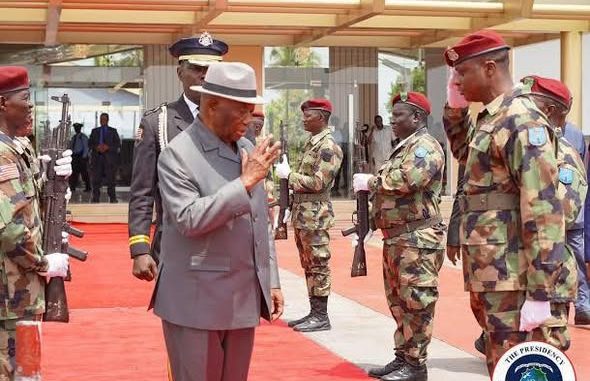
PRESIDENT JOSEPH BOAKAI AND LIBERIAN TROOPS
Armed men from one country do not have the right to enter another country’s territory without permission, seize property, intimidate civilians, and fly a foreign flag as if sovereignty were negotiable. However, I am not surprised by the order from the Guinean president, given that he is semi-literate and a ruthless tyrant intent on destabilizing the subregion. But the Liberian government needs to show the Guinean rebel leader that our sovereignty is not optional; it is the foundation of our nationhood. Liberia does not have to shout to prove its rights; it must enforce them.
The United Nations Charter makes clear that all states are sovereign equals and that no state may threaten or use force against the territorial integrity or political independence of another. That principle is not symbolic or for arbitrary use; it is the core rule distinguishing lawful international conduct from aggression. The latest actions by Guinea are nothing short of aggression and a declaration of war by an illiterate despot against Liberia, a country that helped Guinea gain independence from colonial rule.
The African Union Constitutive Act mandates respect for borders established at independence and prohibits the use of force among member states. This means the Liberia-Guinea border is not open to unilateral changes, symbolic occupation, or military posturing. Again, a government that kills its own people for power, such as Guinea’s, is either too uneducated to understand this simple principle or does not value human life and will do anything to cause more harm to its own society and beyond.
The Economic Community of West African States Protocol on Non-Aggression reinforces this same rule. Member states are obligated to refrain from force or aggression against each other. This is crucial because border stability in West Africa depends on respecting each other’s territory and resolving disputes through lawful means, not military displays.
If a country has a legitimate concern at a border, it can raise it diplomatically, seek dialogue, mediate, or pursue arbitration. But it cannot send soldiers across the border and act as if force creates law. They cannot cross into another country’s territory with armed personnel without permission; such acts escalate from a regular dispute over lines on a map to a matter of territorial integrity, illegal coercion, and potential violence. Planting a flag on foreign soil with armed troops is not a gesture of sovereignty but a claim backed by intimidation. International law does not recognize such claims. The small man with the small rocket needs to understand that he may start a war, but that war will outlive him; he will not be there to see its end.
Liberia is not powerless within its borders, nor is it legally obligated to tolerate unlawful armed presence on its soil. However, the Liberian government and its people have shown they are civically minded and do not want chaos in the region. Rocket Man believes his bravado keeps his soldiers illegally on our land, but the truth is we have men, we are born warriors, though we will never shoot the first shot. Still, when necessary, I will be on the front lines. We are brothers and sisters in Africa; these uncivilized acts have no place in our region. Rocket Man needs to withdraw his band of thieves masquerading as troops of a legitimate government; we know they have no legitimacy. Rocket Man seized power.
Liberian law grants the state criminal jurisdiction over conduct within its borders, regardless of nationality. If armed foreign personnel unlawfully enter Liberia and interfere with people or property, they commit several offenses, including:
- Criminal trespass for unauthorized entry.
- Criminal mischief for damaging or tampering with property.
- Assault and threats to public safety for intimidating civilians at gunpoint or using force.
- Illegal possession or use of firearms, carrying weapons without lawful authority.
- Acts against state security, undermining territorial integrity or public order.
These are straightforward legal categories; they form the basis of national self-protection. Those Guineans unlawfully occupying Liberian territory are violating these laws.
Liberia can detain foreign soldiers who enter unlawfully, and the longer these trespassers remain, the more necessary arrest becomes. The government has the right to secure its borders, protect civilians, and eliminate unlawful armed presence. That includes detaining those actively violating Liberian law on Liberian soil.
The Guinean soldiers or Rocket Man’s band of thieves may argue they were acting officially. That involves issues of state immunity and the law of armed conflict. These doctrines do not erase the violation but influence the appropriate response, which explains why Liberia has hesitated to enforce its laws with arrests.
The goal is not arrests for headlines but lawful control of the territory, preserving evidence, and removing illegal occupants. Liberia can and should consider detaining these bandits, but only to restore order and secure borders, not to provoke wider conflict because Rocket Man wants to prove a point.
To resolve this peacefully and prevent escalation, Liberia must first take control of the affected area, securing the territory, removing foreign symbols, and reasserting visible Liberian authority.
Second, documentation: each witness statement, photograph, video, coordinate, and property record should be preserved. Clear evidence makes denial harder.
Third, diplomacy backed by the law: Liberia must issue a formal protest and demand withdrawal through official channels. This is not weakness but the legal stance of a sovereign nation.
Fourth, regional escalation: the Economic Community of West African States and the African Union exist specifically for moments like this, when border tensions threaten regional stability. Liberia should bring the issue before these bodies and demand that rules governing interstate conduct be enforced.
Fifth, international recourse if needed: the United Nations Security Council can be involved if there are threats to peace, and the International Court of Justice may be called upon for boundary issues or state responsibility.
At its core, this is not just about soldiers or flags, it is about whether Liberia’s borders are meaningful in practice.
If foreign militaries can enter Liberia and plant flags without consequences, it sends a dangerous message: our borders are negotiable by force. It legitimizes testing sovereignty by crossing borders.
That message must be rejected outright!
Liberia’s dignity depends on its territory; its legal order relies on its authority. Its future hinges on the principle that no foreign force has the right to decide what happens on Liberian soil.
Liberia has every legal reason to act; such incursions violate the United Nations Charter, regional obligations, and Liberian laws.
The response should be firm, lawful, and proportionate.
Liberia must assert its sovereignty without hesitation. It should document every violation. It should utilize all regional and international legal channels. And if unlawful armed personnel remain, the state should not hesitate to detain them to restore order and protect the nation.
This is not about hostility but about principle.
A sovereign state must not wait to be respected; it must enforce laws that make respect mandatory.
Leave a Reply