

By Luseni Gbessay Dassama
“I truly believe that with love, all things are possible”
The Conspiracy of Silence: Why Nobody Heard Sierra Leone Scream
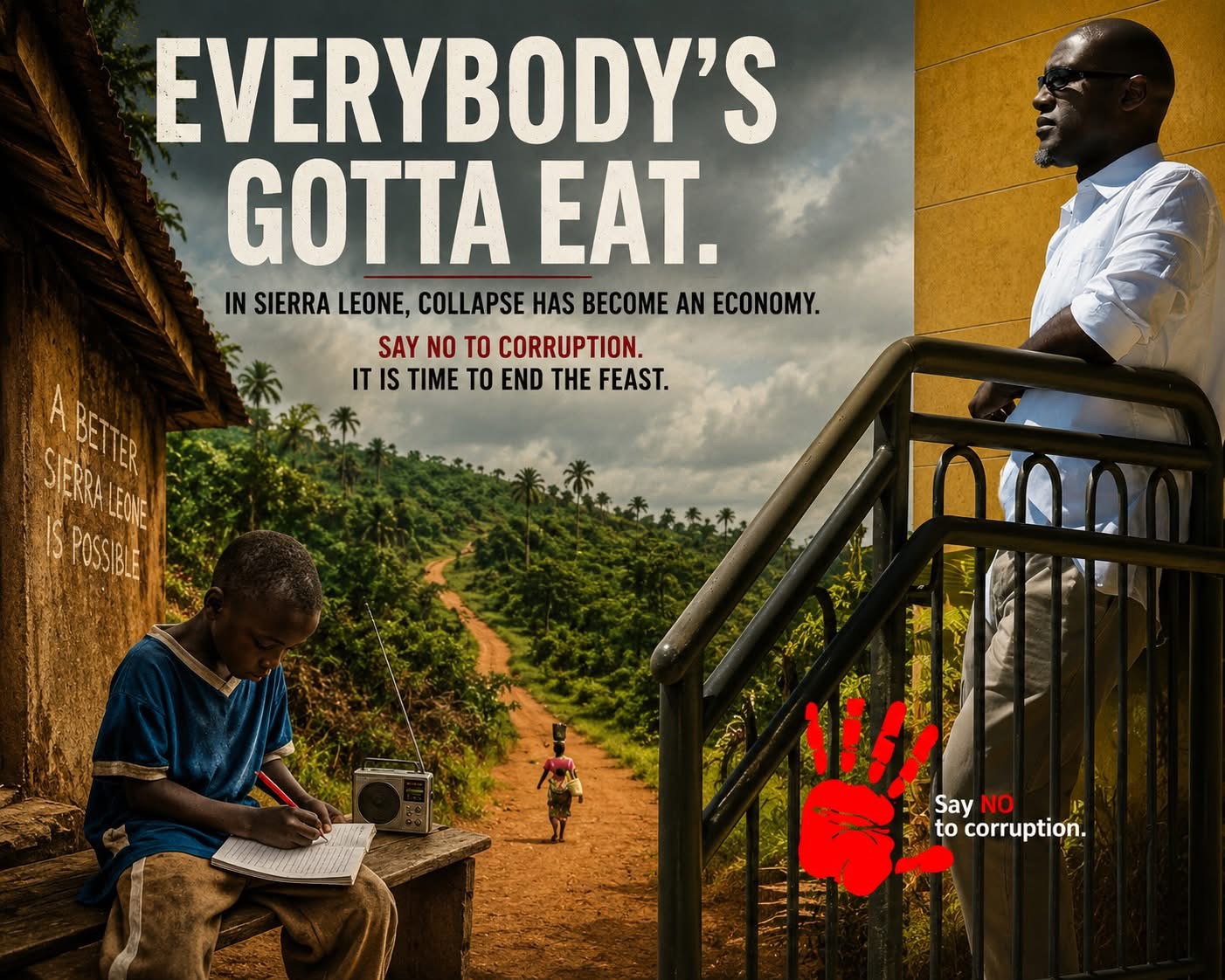
“Everybody’s gotta eat.”
That is the sentence whispered to justify every stolen contract, every inflated invoice, every unpaid teacher, and every child who goes hungry while a small class grows rich from national collapse. And everyone at the table has a mouthful.
1. The Political Elites: They eat from procurement contracts, inflated by 40%, paid in dollars, and awarded without tender. The IMF confirms Sierra Leone loses 12.7% of its GDP to corruption annually. That is more than the government collects in total revenue.
2. The Import Cartels: They profit from the rice and fuel trade, pocketing the margin between a falling Leone and fixed dollar prices. We bleed $200 million importing rice every year while local farmers watch their own harvests rot. The Leone has lost over 60% of its value since 2018—every tick downward is profit for the importer and hunger for the family.
3. The Judiciary: They depend on a legal system where justice is a commodity. The World Bank ranks Sierra Leone among the worst globally for enforcing contracts. Land disputes fester across generations, and cases drag for years while connected actors continue extracting wealth in plain sight. A predictable court system would threaten the elite’s ability to capture assets. So, predictability is never built.
4. Civil Society: Some genuinely fight. The rest have become the conscience-laundering service of the extraction machine—trading silence for workshop grants.
5. Non-Governmental Organisations: They eat from the social safety net that the government refuses to build. They deliver emergency food, run parallel clinics, and manage donor-funded schools. They are no longer filling gaps; they are providing the cover that allows the state to permanently abandon its sovereign duty to its citizens.
6. The International Donors: They normalize the debt trap under the guise of stabilization. The IMF commits hundreds of millions in credit, fully aware that the country remains at a “high risk of debt distress” and that debt service will consume 140.5% of government revenue by 2026. They praise fiscal targets in air-conditioned boardrooms while the hospitals a few miles away run out of oxygen and syringes. They lend to a leaking bucket, ensuring the system never fully collapses, but never truly recovers. The Fund collects its interest. The country collects its chains.
7. The Media: Some journalists risk their lives. But too many owners protect their access, sustained by government advertising and the patronage of the politicians they are supposed to audit. A hungry journalist does not bite the hand that feeds. A media house dependent on state contracts does not investigate state contracts.
8. The Security Services: They survive inside a system that underpays them, pushing checkpoints, arrests, and intimidation into informal sources of income. When the state cannot feed its own protectors, the protectors learn to feed themselves. The law becomes a tool to harass the poor, and the citizen learns to fear both the criminal and the cop.
To be clear: there are honest public servants, brave journalists, and dedicated aid workers trapped inside these institutions. But honesty alone cannot survive inside a structure that rewards extraction more consistently than service.
Do you notice who is missing from the list?
The ordinary Sierra Leonean. The farmer who watched her tomatoes rot because the feeder road washed away. The teacher who hasn’t been paid in three months. The 26% of our children under five who are permanently stunted because the cold chain failed and the vaccines spoiled.
But even the citizen is not entirely free from blame. When survival depends on political patronage, people stop voting for competence and start voting for access to survival itself.
Sierra Leone is not collapsing from a lack of resources. It is collapsing from organized appetite.
In Sierra Leone, collapse has become an economy.
This is not an accident. Our 8.6 million people cannot form an army that troubles any Western capital. Our GDP is too tiny to trigger a financial contagion. No superpower needs to invest in our stability; they only need to ensure our chaos does not spill across their borders.
But Sierra Leone is also too rich to be ignored. Diamonds. Rutile. Iron ore. Gold. Deep-water ports. Agricultural land that could feed the sub-region.
And there lies the fatal equation:
Too small to threaten the world. Too rich to escape exploitation.
The tragedy of Sierra Leone is not that the country lacks wealth, but that too many powerful people profit from its weakness.
This is the conspiracy of silence. Nobody planned it in a single smoke-filled room. But every actor in this system—political, commercial, diplomatic, civic—has learned the same unspoken truth: You can take from Sierra Leone without consequence.
The politicians will not reform the system because the system feeds them.
The contractors will not resist because the margins are enormous.
The donors will not leave because the crisis justifies their presence.
The media softens its voice because survival requires access.
And the people grow exhausted because exhaustion is the point.
But systems like this only appear permanent until public truth becomes impossible to suppress. Every extraction system in history eventually weakens when enough citizens understand the mechanism clearly enough to reject it together. The conspiracy relies on the dark; it cannot survive the light of open ledgers and an awakened electorate.
The people of Sierra Leone were never meant to survive on scraps beneath the table of their own country. This nation belongs to the teachers, the traders, the nurses, the farmers, the fishermen, and the children who carried its suffering while others carried away its wealth.
The table is full.
The feast has lasted too long.
It is time to end it.
A Personal Note: A Sierra Leonean Love Story
People will ask why I write with such urgency. The answer is simple: this is personal.
Let me be absolutely clear about my motives: I write this without a single ounce of political ambition. Should any nomination for public office be offered to me, I will reject it instantly. My goal is not to win an election; my goal is to break a broken system.
For me, Sierra Leone is simply a love story.
I walk in the footsteps of my grandfather, Chief Borbor Gbessay Dassama, who dedicated his life to the struggle for our independence. He rejected the poison of tribalism and championed education as our greatest weapon, but he passed away in 1958 with the promise of our nation unfulfilled.
I carry the legacy of my late father, Dr. Leslie S. Dassama, who spent his professional life fighting to save our women and children, and my mother, Mrs. Hannah Dassama, who as a Health Visitor dedicated her working years to maternal healthcare.
They gave their lives to uplifting the human condition in Sierra Leone. My duty is to honour their sacrifices by shifting our national discourse away from the politics of extraction and toward credible, data-driven solutions.
I do not seek power.
I seek a Sierra Leone worthy of the sacrifices already made for it.
And with this, I conclude my love letter to the people of Sierra Leone…………..
Leave a Reply