
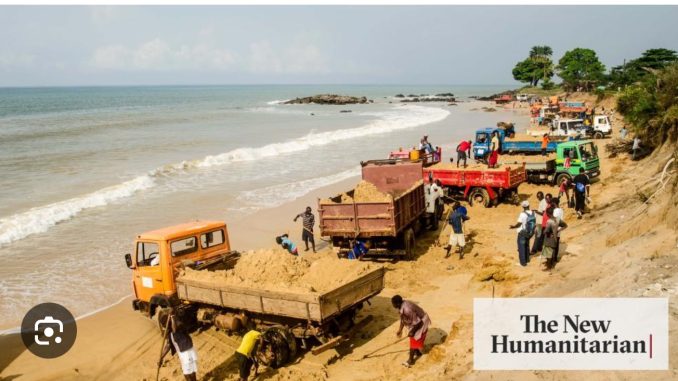
As sand becomes more valuable, Sierra Leone’s Mahera Coast grows more vulnerable

A man shovels sand into bags on Mahera beach. Image by Patricia Sia Ngevao.
- Sand mining at Sierra Leone’s Mahera Beach is impacting local tourism and coastal ecology while also defacing the landscape.
- Nearly 50,000 cubic meters is extracted from Mahera Beach annually, even as communities are torn between eking out a living and conserving coastal ecosystems.
- Many involved in the sand value chain are women and they disproportionately bear the economic and social burden of the trade.
PORT LOKO, Sierra Leone — When the tide pulls away from the beach in the agricultural regions in Mahera in Lungi, about 27 kilometers (17 miles) across the sea from the country’s capital, Freetown, the digging commences. Young men shovel sand into cement bags and carry them to a flat open area to pile sand into heaps to be sold by local women to truck drivers.
These women are dedicated sand sellers. They negotiate prices, buy sand from the shovelers and sell to heavy-duty truck drivers to be transported to Lungi, Port Loko and other areas.
The income helps pay for food, school fees and other basic needs of their families. However, their work relies heavily on the seasonal tide: The sellers can buy sand during low tide but are banned from doing so during high tide.
In Mahera, the sand trade began as a survival strategy for 14 women who became family breadwinners, mostly due to absent partners.
Aminata Kargbo is the chairperson of the sand sellers in the locality in Mahera, and entered the business to support her seven children after her husband’s death.
“Most of these women have lost their husbands, and the money we make goes to support our children,” she said. She oversees about 19 sand sellers, the majority of them women.
Many of these women have become widows after losing their husbands to Sierra Leone’s war and other illnesses.
The sand trade in Mahera has created a small supply chain involving young men who extract the sand, women who buy and resell, landowners who provide storage facilities and truck drivers who transport the sand. It has also thrown a lifeline at women without an income..
Around the world, rising demand has turned sand into a valuable resource, linking its trade to construction, transport and environmental concerns. Globally, sand and gravel are the second-most extracted natural resources by volume, after water.
At present, sand mining provides an income in a place where alternate work is scarce. The earnings, though woefully inadequate, help meet basic needs.
Even though many widowed women in Mahera rely heavily on sand trading and despite high reliance on the extractive industry, women like Kargbo welcome economic alternatives so they could quit the sand trade. They are aware of the impacts caused by the unregulated trade that weaken their environment landscape and acknowledge that their landscape is changing.
“Since we started three years back, the changes have affected the way water moves on the beach area,” said Kargbo.
Ecological impacts
Their fears are confirmed by the World Bank assessment report which offers detailed insights on how coastal sand extraction could disrupt sediment flows, increase erosion and damage ecosystems and tourism assets. The report estimates approximately 50,000 cubic meters (1.8 million cubic feet) of sand are extracted annually from Mahera Beach alone and calls for stronger monitoring and clearer limits on extraction.
Demand for sand in Sierra Leone is driven largely by local construction. The study notes that local construction accounts for 61-77% of sand use in the country, while the Mahera-Lungi corridor meets about 8% of that demand. The trade supports shovelers, women sellers and truck drivers along the supply chain.
The sand trade sits at the intersection of livelihoods, construction demand and coastal protection.
Pa Morlai Kargbo, senior headman of Mahera town, told Mongabay that once Mahera Beach was considered among the best beaches in Lungi, attracting people from as far as Freetown for recreational outings. He said those visits have declined as the beach has increasingly become a hive of sand mining rather than a location for recreation.
To reduce the impact of sand mining, he said the community has demarcated mining areas that also protect nearby fishing zones.
For Aminata Kargbo and other women in Mahera, sand trading offered a way to earn money without raising yet another loan for family support. “When we get sand, we sell it,” she said.
The trade has since developed into a small chain involving the women who buy the sand, young men who extract it, landowners who provide areas where it is stored and truck drivers who transport it to buyers.
Nineteen-year-old Abdulai Conteh is a sand miner and loader. A former tailor, he left the job, as the income was inadequate. “I am doing this work to support my family,” he said. A shoveler like him earns 2 leones ($0.08) per bag and can carry 20-30 bags a day.
Conteh told Mongabay that sand mining offers work for unemployed youth, and halting the trade without offering alternatives could lead the youth to vices like theft. “If sand mining is stopped, stealing could increase. Right now, many young people depend on this work,” he said.
In the artisanal and commercial sand extraction trades, it is the women who are often exploited and underpaid.
According to Pa Morlai Kargbo, women earn less compared with the transporters and truck owners who buy sand cheap but resell at much higher prices. While exact prices vary by quantity and destination, the figures suggest truckers earn more than the miners and sellers.



Leave a Reply