

The ruling Sierra Leone People’s Party ( SLPP ) has thrown the Agreement of National Unity into complete disarray by rejecting the arrangement agreed upon between them and the opposition All People’s Congress ( APC ) in their just- concluded tripartite engagement with the moral guarantors to have parliamentary oversight of the Elections Commission.
This shocking development comes a day after the opposition All People’s Congress ( APC ) called off their boycott and decided to return to governance at the end of the tense tripartite meetings after which moral guarantors urged them to return to government and the councils .
Barber reports :
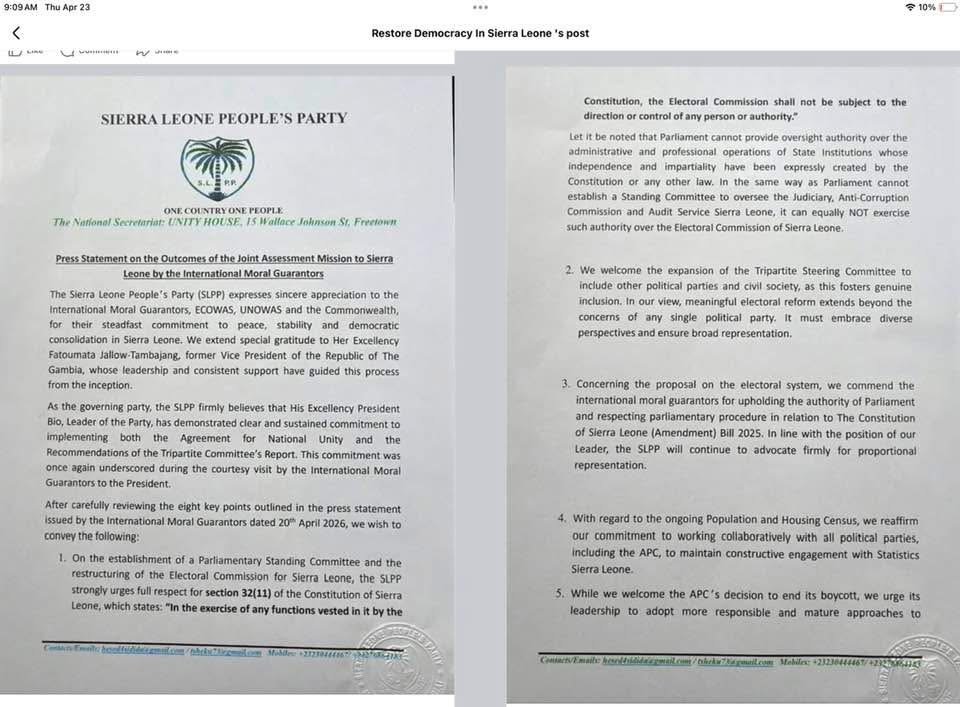
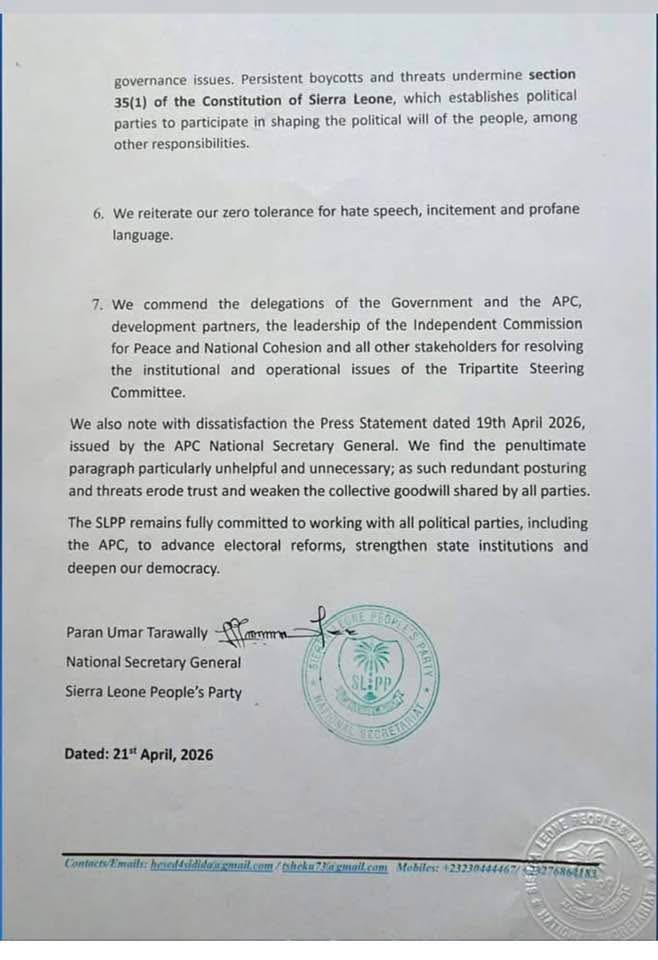
SLPP Rejects Proposed Parliamentary Electoral Committee — Cites Constitutional Concerns
The Sierra Leone People’s Party (SLPP) has formally rejected a proposal for the establishment of a Parliamentary Standing Committee on Electoral Matters, a recommendation advanced by a group of stakeholders referred to as moral guarantors.
The decision has reignited national debate on the appropriate limits of parliamentary oversight and the constitutional independence of electoral institutions.
According to the SLPP, the proposed committee raises significant constitutional and institutional concerns, particularly in relation to the independence of the Electoral Commission for Sierra Leone (ECSL). The party maintains that the ECSL is a constitutionally established body mandated to operate independently and free from political interference, in order to safeguard the credibility, transparency, and fairness of elections.
The SLPP argues that while parliamentary oversight is a fundamental pillar of democratic governance, extending such oversight into the operational and administrative functions of the electoral body could create room for undue political influence. The party further cautioned that such a development may erode public trust in the neutrality of the electoral process, especially in a politically sensitive environment.
Party officials also emphasized that the ECSL already operates within a well-defined legal and institutional framework that ensures accountability. These mechanisms include judicial review processes, oversight by civil society organizations, and statutory reporting obligations. In this regard, the SLPP contends that the creation of an additional parliamentary committee dedicated specifically to electoral matters would be redundant and could potentially lead to institutional overlap or conflict.
The proposal by the moral guarantors, originally intended to strengthen electoral governance and enhance transparency, has instead generated divergent interpretations among political actors and governance stakeholders. While some view the initiative as a constructive step toward improving accountability and addressing electoral concerns, others caution that it risks blurring the line between oversight and interference.
Political analysts observe that the development highlights a longstanding structural tension in Sierra Leone’s democratic system: the need to balance institutional accountability with the protection of independence for key democratic bodies. On one hand, Parliament is constitutionally empowered to exercise oversight over public institutions; on the other hand, electoral management bodies must remain insulated from political pressure to ensure fairness and credibility in electoral outcomes.
The SLPP’s firm rejection has also raised broader questions about the prospects for consensus-building among political parties, civil society groups, and governance partners on electoral reform. Critics of the proposal warn that any perceived political involvement in the administration of elections could deepen mistrust and intensify political polarization, particularly during election cycles.
Conversely, proponents of the initiative argue that structured parliamentary engagement could strengthen the electoral system by improving coordination, enhancing transparency, and addressing recurring challenges such as electoral disputes, logistical inefficiencies, and voter confidence concerns.
As consultations and discussions continue, it remains uncertain whether the proposal will be revised, restructured, or ultimately withdrawn. However, the SLPP has maintained a clear and consistent position that the independence of the ECSL must not be compromised under any reform framework.
In conclusion, the debate underscores a critical democratic dilemma: how to strengthen accountability mechanisms without undermining institutional autonomy. The outcome of this discourse is likely to play a significant role in shaping the future of electoral governance and democratic consolidation in Sierra Leone.
Leave a Reply