
WHO SETS THE THRESHOLD?
By Mahmud Tim Kargbo
Wednesday, 19 August 2026
A Constitution is seriously tested when those exercising political power must decide whether the Constitution permits them to exercise more of it. Sierra Leone has reached a critical point with the Constitution of Sierra Leone (Amendment) Bill, 2025 and the Speaker’s ruling of 10 August 2026. The immediate dispute concerns a number: whether the required two thirds is calculated from the whole membership of Parliament or from Members present when the vote is taken. Yet beneath that arithmetic lies a more consequential question about constitutional authority. When Parliament and its Speaker advance an interpretation of the supreme law, who has the constitutional authority to determine what that law actually means?
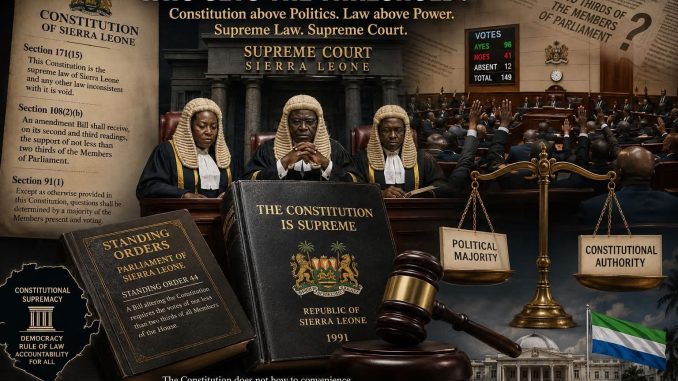
The answer begins with a principle that must govern the entire controversy: the Constitution is supreme. Section 171(15) declares that the Constitution is the supreme law of Sierra Leone and that any other law inconsistent with it is void to the extent of the inconsistency. Parliamentary Standing Orders, established practice and rulings from the Chair therefore operate beneath the Constitution, not alongside it as competing sources of constitutional authority. Parliament has previously recognised this principle in its constitutional review material. The consequence is straightforward: the Supreme Court is not being asked to choose between the Constitution and Standing Orders; it is being asked to determine what the Constitution requires. https://www.parliament.gov.sl/constitution-of-sierra-leone.html
Section 91(1) provides the ordinary rule for parliamentary decision making: except as otherwise provided in the Constitution, questions are determined by a majority of Members present and voting. Section 108 governs alteration of the Constitution and section 108(2)(b) requires an amendment Bill to receive, on its second and third readings, the support of not less than two thirds of the Members of Parliament. The constitutional question is therefore whether section 108 supplies the special rule that displaces section 91 when Parliament exercises the distinct power to alter the Constitution. Ordinary parliamentary procedure cannot be the starting point where the Constitution itself has prescribed a particular procedure for changing the supreme law.
The Speaker’s reasoning gives the controversy its present difficulty. The argument distinguishes between “of Parliament” and “in Parliament”, treating the former as referring to the wider membership and the latter as referring to Members physically present in the chamber. Yet the critical question is whether that ordinary voting formula can determine the denominator where section 108 expressly requires “two thirds of the Members of Parliament.” It is whether that single preposition can constitutionally convert a threshold based on Parliament’s membership into one based upon attendance at a particular sitting. The earlier ruling on the removal of former Auditor General Lara Taylor Pearce and her Deputy is relevant, but it concerns a different legal provision. In interpreting section 137(7), the Speaker reasoned that “a two thirds majority in Parliament” referred to Members present and voting and contrasted “in” with “of”, relying upon section 91 and Standing Order 44. The ruling concerned section 137(7), not section 108(2)(b), and does not become binding constitutional precedent merely because it addresses constitutional language. It is relevant only because it identifies an interpretive approach the Supreme Court may examine. https://www.parliament.gov.sl/uploads/votes/20TH%20DECEMBER%202024.pdf
That distinction becomes sharper when the constitutional language is placed side by side. Section 137(7) speaks of “a two thirds majority in Parliament”, whereas section 108(2)(b) speaks expressly of two thirds of the Members of Parliament. The Supreme Court must determine whether “in Parliament” merely describes the institution in which a vote takes place or whether it establishes a constitutional denominator based upon physical presence. The fact that the Speaker previously attached significance to “in” does not establish that the same approach governs a different provision containing materially different language. Where the Constitution uses different words, the Court must first ask what work those words were intended to do.
Section 108(3) adds another dimension. It identifies specified constitutional provisions whose alteration requires a referendum, creating an additional safeguard for protected provisions. A constitutional system can require both a parliamentary supermajority and popular approval for provisions considered especially important. The Court must read section 108 as an integrated scheme and determine whether subsection (2)(b) supplies the parliamentary threshold while subsection (3) adds popular approval for specified provisions. The existence of a referendum requirement does not, by itself, establish that amendments outside that category are subject only to section 91(1). https://www.parliament.gov.sl/constitution-of-sierra-leone.html
Standing Order 44 is relevant, but only within its proper constitutional limits. Paragraph (3) states that a Bill altering a constitutional provision requires, on its second and third readings, votes of not less than two thirds of all Members of the House. That mirrors section 108(2)(b) and shows Parliament’s procedural understanding. But Standing Order 44 does not create the constitutional threshold; section 108 does. If a Standing Order conflicts with the Constitution, section 171(15) requires the Constitution to prevail. https://www.parliament.gov.sl/standing-orders.html
That point is essential because the Supreme Court will not be asked to decide whether Standing Order 44 is preferable to the Speaker’s ruling. It will be asked to interpret the Constitution. Previous votes and institutional practices may provide context, but practice cannot amend the supreme law by repetition. Nor can a Speaker’s ruling acquire the authority of a Supreme Court judgment simply because the issue before the Chair concerns constitutional language. Parliament administers its proceedings within the constitutional order; it does not stand above that order.
The political dimension should likewise remain subordinate to the constitutional question. The SLPP and APC may have different interests, but neither party’s preferred interpretation becomes constitutionally correct because it produces a favourable political result. The proper test is whether the interpretation remains defensible when political advantage changes hands. A constitutional rule must operate for the Republic, not as an instrument for whichever political coalition happens to command the House.
The Supreme Court’s role is therefore decisive. The Judiciary of Sierra Leone states that the Supreme Court has exclusive jurisdiction to determine all questions relating to the interpretation of the Constitution. The Court must determine the relationship between sections 91 and 108, the meaning of “two thirds of the Members of Parliament”, the scope of section 108(2)(b), and the relationship between the parliamentary threshold and section 108(3). Standing Orders, parliamentary precedent and political arguments may form part of the surrounding record, but they cannot supply the final constitutional answer. https://www.judiciary.gov.sl/?page_id=58

The Court should therefore confront the real questions directly. Does section 108(2)(b) prescribe a special parliamentary threshold for constitutional alteration? Does that provision displace the ordinary rule in section 91(1)? What is the proper constitutional meaning of “two thirds of the Members of Parliament”? And can “in Parliament”, used elsewhere in the Constitution, legitimately alter the denominator where section 108 uses different and more explicit language? Those questions cannot be conclusively answered by political arithmetic, Standing Orders or parliamentary custom. They require interpretation of the supreme law by the institution constitutionally entrusted with that task.
The deepest issue, then, is not attendance, grammar, Standing Order 44 or even the present amendment Bill. It is whether Sierra Leone’s supreme law will remain supreme when its meaning becomes politically consequential. The Constitution must stand above parliamentary procedure, institutional convenience and temporary majorities, while the Supreme Court determines its meaning from the constitutional text and structure. Today’s majority should be willing to live under the constitutional rule it establishes for tomorrow’s minority. That is the real test of constitutional supremacy: not whether Parliament can exercise power, but whether those who possess power remain subject to the constitutional rules that give that power its legitimacy.
Leave a Reply