
*IS PRESIDENT BIO TRYING TO WASH HIS HANDS OF THE CONSTITUTIONAL AMENDMENT BILL?*
*By Frequency Modulations 44.4*
*Revealing Truth 4 Political Progress*
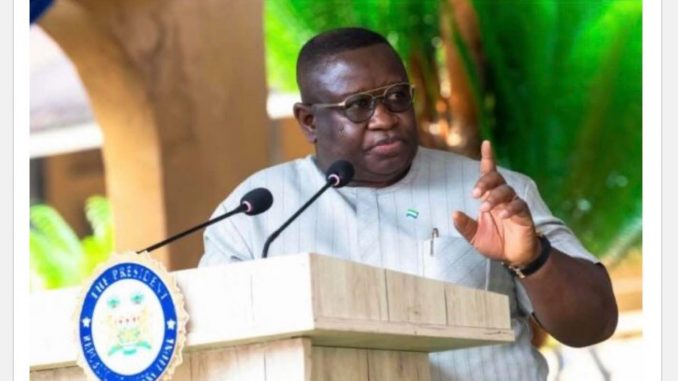
President Julius Maada Bio has referred the petition challenging the constitutional amendment bill to the Supreme Court. But while the judges prepare to address the legal questions, a political question remains at State House: is the President protecting the Constitution, protecting himself, or attempting to do both?
Seeking judicial guidance can be a legitimate exercise of presidential responsibility. It can also offer political protection. If the Court endorses the disputed process, the administration gains a judgment it can invoke in its defence. If the Court rejects it, Bio can point to his decision to withhold assent as evidence of caution. Neither outcome, however, should allow the President to disappear from the account of how his administration handled this controversy.
The Constitution permits the President to refer a petition requiring his final decision to the Supreme Court for a judicial opinion. FM 44.4 therefore recognises that the referral itself is not proof of wrongdoing. What deserves scrutiny is whether a lawful constitutional mechanism is also being used to move the burden of public accountability from the presidency to the judiciary.
This was a reform programme promoted by Bio’s government. In July, Attorney-General Alpha Sesay publicly presented the proposed amendments as a major advance in Sierra Leone’s democratic development. The administration cannot claim ownership of the promised progress while treating questions about the process as somebody else’s responsibility. Political leadership requires answering for both the destination and the route taken to reach it.
The dispute concerns the safeguards governing changes to the country’s supreme law. Section 108 requires two-thirds support at the second and third readings of a constitutional amendment bill. Serious objections have been raised about how that requirement was interpreted and applied. Those objections deserve a transparent examination of the parliamentary record, including the votes at the relevant stages.
A government confident in its constitutional position should welcome that scrutiny. Publish the records. Explain the arithmetic. Show the public how the requirements were satisfied. Citizens should not have to choose between competing party accounts when official parliamentary documents ought to establish what happened.
The President must also explain his own choice. If he considered the objections sufficiently serious to withhold assent, why did he prefer a judicial referral to returning the bill to Parliament with reasons? Seeking an opinion may be legally available, but the availability of that option does not place his political judgment beyond question.
The timing requires equal clarity. Reporting identifies September 10, 2026, as the date the legislation was presented for presidential assent. On that account, the fourteen-day period had not expired as of September 16. It would therefore be premature to declare the bill invalid simply by counting from its passage in Parliament.
Nevertheless, State House’s reported intention to await the Court’s opinion beyond fourteen days raises an important question. Section 106(7) requires a President who refuses to sign to return the unsigned bill with reasons within fourteen days of presentation. What legal basis permits the proposed delay, and how does the referral power interact with that requirement? The government owes the public an answer grounded in the Constitution.
A presidential announcement cannot, by itself, settle that question. Nor should critics assume that a missed deadline automatically destroys the bill. The country needs an authoritative explanation of the law, supported by a clear account of the relevant dates and decisions.
The Supreme Court now carries a substantial public responsibility. Its opinion must address the constitutional language, the parliamentary proceedings and the strongest objections presented. Whatever the outcome, the reasoning should be available for citizens to examine. Public confidence grows when difficult questions are answered openly and convincingly.
FM 44.4 does not need to pronounce the judges guilty of treason to insist on that responsibility. Treason is a grave legal allegation, and the referral alone does not establish it. The sharper political question is whether the Court is being placed in a position where its eventual opinion could become the administration’s principal defence against public criticism.
That possibility deserves attention without being presented as a proven conspiracy. A favourable judicial opinion would not erase the government’s role in promoting the reforms. An unfavourable opinion would not eliminate questions about why the disputed process reached this stage. Each institution must answer for its own decisions.
Nor does the case for accountability require unverified stories about Bio’s military past. The conduct of his presidency in this matter provides sufficient grounds for scrutiny. His administration should publish the petition, the questions referred to the Court, the relevant parliamentary records and its explanation of the presidential timetable.
Has President Bio attempted to wash his hands of the constitutional amendment controversy? His private motive remains unproven. The political opportunity to shift responsibility is clear enough to warrant vigilance. Sierra Leoneans should resist any eventual suggestion that “the judges decided” answers every question about what the government did.
The President has sought judicial guidance. He must still explain his own judgment, defend his administration’s conduct and accept responsibility for the choices within his office.
The matter may now be before the Supreme Court. Presidential accountability remains at State House.


Leave a Reply