
*Now Let the Constitution Speak*
*Reflections on the Constitutional Questions That May Follow 10 August*
By Yoni Emmanuel Sesay
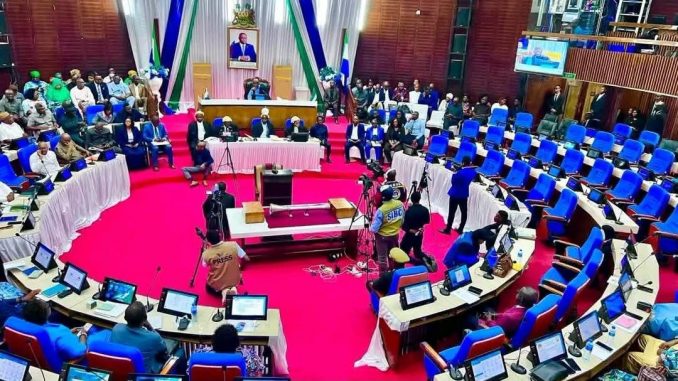
Parliament has spoken. The Speaker has ruled. Government and opposition have taken their positions.
What may come next is constitutional interpretation.
Following the proceedings in Parliament on 10 August, the Speaker indicated that the constitutional question arising from his decision would be referred to the Supreme Court. The opposition has likewise indicated its intention to seek judicial determination. At the time of writing, however, there is no published confirmation available to me that either course has resulted in proceedings being formally commenced before the Supreme Court.
This article therefore does not comment upon any pending case or seek to predict how the Supreme Court might decide one. It is an academic reflection on the constitutional questions raised by 10 August.
In an earlier article, Pontius Pilate in Parliament: The Hands Had Already Acted Before the Water Arrived, I considered responsibility for what occurred in Parliament. This discussion begins where that one ended.
The central question is more fundamental:
_What limits does the 1991 Constitution impose upon Parliament when Parliament seeks to alter the Constitution itself?_
*Parliament Within the Constitution*
Sierra Leone’s Parliament possesses extensive legislative authority. But under a written Constitution that authority is not unlimited. Parliament derives its powers from the constitutional order within which it operates.
The fact that Parliament voted establishes a parliamentary decision. It does not necessarily answer the separate question whether the procedure by which that decision was reached complied with the Constitution.
That distinction lies at the heart of the controversy.
Section 91 provides the general rule governing decisions in Parliament. Significantly, it begins: *“Except as otherwise provided in this Constitution…”* Section 108, meanwhile, deals specifically with alteration of the Constitution and provides that an amendment Bill shall not be passed unless, among other requirements, it receives the votes of not less than two-thirds of MPs at its second and third readings.
The interpretative question is therefore how those provisions operate together. Does section 108 constitute an instance in which the Constitution has *“otherwise provided”?*
Entrenchment exists for a reason. It does not prevent constitutional reform. It regulates the manner in which reform may lawfully occur.
There is a profound difference between saying the Constitution may be changed and saying it may be changed by whatever procedure is politically convenient.
*Was There Any Discretion?*
Before asking whether the Speaker exercised discretion properly, there is a logically prior question:
_Was there any relevant discretion to exercise?_
Speakers necessarily possess considerable procedural authority. Residual authority may legitimately fill gaps where the rules provide no answer.
But where the Constitution has expressly prescribed a procedure, can residual authority modify or displace it?
The controversy may therefore turn out not to concern an abuse of discretion, but the existence and extent of discretion.
Residual power should fill genuine gaps. It should not become a solvent for express constitutional restrictions. Otherwise, the institution restrained by the Constitution could determine when the restraint ceased to apply.
The creation would begin determining the limits of its creator.
*_And If Discretion Existed?_*
If some relevant discretion did exist, another body of public-law principles becomes interesting.
Discretion does not mean unlimited choice. Depending upon the applicable legal framework, questions can arise about relevant and irrelevant considerations, proper purpose, predetermination and, at the extreme, irrationality.
English public law famously developed the idea of a decision so unreasonable that no reasonable decision-maker, properly directing himself, could have reached it. Whether that particular doctrine—often associated with Wednesbury unreasonableness—could properly apply to any aspect of the events of 10 August would depend upon the nature of the power, the jurisdiction invoked and the issues actually placed before a court.
The better constitutional question may therefore be simpler:
Was the course adopted constitutionally available at all?
A court would not need to describe Parliament’s decision as foolish, immoral or politically undesirable in order to conclude, if the constitutional text required that conclusion, that Parliament lacked authority to proceed in a particular manner.
Indeed, section 124 expressly gives the Supreme Court exclusive original jurisdiction over constitutional interpretation and over questions whether an enactment was made in excess of the power conferred upon Parliament.
The issue is therefore not whether Parliament made a good decision.
It is whether the Constitution authorised the route Parliament chose.
*Five Days Earlier*
Context nevertheless matters.
On 5 August 2026, five days before the disputed proceedings, the Speaker stated:
“The Office of the President should be a very powerful office in the Republic”
and that he would not:
“sit here as Speaker and allow the position of the President to be watered down.”
Those words do not, by themselves, establish bias, improper purpose or predetermination.
But the particularly interesting words are “as Speaker.”
A citizen may favour a powerful presidency. An MP may favour one. The Speaker may personally favour one.
But when exercising the authority of the Chair, the Speaker’s responsibility is neither to strengthen nor weaken the Presidency. It is to preside according to the Constitution and applicable parliamentary rules.
The President may advocate. The Speaker must preside.
The question is therefore what, if any, legal significance a previously expressed constitutional preference might have when considering the subsequent exercise of procedural authority.
There may be none. There may be some.
That requires evidence and legal analysis, not political assumption.
*A Separate Question of Parliamentary Integrity*
There is another matter that should be kept analytically separate from the interpretation of sections 91 and 108.
The Leader of the Opposition has alleged that opposition MPs, including himself, were approached with financial inducements intended to persuade them to vote with the Government.
An allegation is not proof. Nor should an allegation that inducements were offered be transformed into an assertion that MPs accepted them or that votes were actually purchased. Those are fundamentally different propositions.
But if credible evidence of attempted financial inducements were established, the question would potentially extend beyond whether a particular constitutional interpretation was reasonable.
It could raise questions about the integrity of the parliamentary process itself.
Who allegedly made the approaches? On whose behalf? What was allegedly offered? For what purpose? Were the allegations reported to the appropriate parliamentary or other authorities? Was the Speaker aware of them? And, if so, did any legal or procedural responsibility arise?
Those questions should not be answered by accusation. They should be answered, if they become material, by evidence.
Nor should allegations of inducement simply be forced into the language of Wednesbury unreasonableness. If established, corruption or attempted corruption concerns the integrity and purpose of public decision-making and may raise distinct legal issues.
The Constitution itself declares that the State shall take steps to eradicate corrupt practices and abuse of power.
That principle makes allegations of financial interference with constitutional decision-making worthy of serious scrutiny—but not prejudgment.
*Parliamentary Autonomy and Constitutional Supremacy*
There remains a difficult institutional boundary.
Section 94 gives Parliament authority, subject to the Constitution, to regulate its procedure. Section 94(2) also provides unusually strong protection against judicial inquiry into decisions of Parliament or the Speaker relating to parliamentary procedural rules.
Courts should not become routine supervisors of parliamentary procedure.
But Parliament also operates under a written Constitution.
The difficult distinction may therefore be between reviewing an internal procedural ruling and determining whether Parliament possessed constitutional authority to exercise legislative power in the manner alleged.
How that boundary should be drawn is itself a serious constitutional question.
*Four Constitutional What-Ifs*
Sometimes the significance of events becomes clearer when they are removed one at a time.
What if the Speaker had not ruled that section 91 allowed Parliament to proceed?
Without that ruling, Parliament might have had to confront section 108 more directly.
What if the Speaker had not subsequently announced that the constitutional question would be referred to the Supreme Court?
If the uncertainty warranted authoritative judicial consideration afterwards, it is legitimate to ask why clarification was not sought beforehand.
What if the announced referral never occurs?
There is, at the time of writing, no published confirmation available to me that either the Speaker’s proposed referral or the opposition’s proposed litigation has resulted in Supreme Court proceedings. It would therefore be premature to say that anyone has failed to follow through.
But if the referral ultimately does not materialise, what becomes of the constitutional uncertainty considered sufficiently important to warrant judicial determination?
And finally:
What if a court were eventually to conclude that the constitutional interpretation underlying 10 August was simply unavailable under the Constitution?
Then the issue would not need to become whether Parliament acted outrageously or irrationally.
It would be more elementary:
Parliament may possess enormous legislative power without possessing the power to disregard the constitutional conditions governing its exercise.
None of these questions establishes unlawfulness or bad faith.
They illuminate consequence and sequence.
*Now Let the Constitution Speak*
There is presently no reason to prejudge litigation which, on the published information available to me at the time of writing, has not been confirmed as having commenced.
But 10 August has raised questions that extend beyond one Bill: the relationship between sections 91 and 108; the existence and limits of procedural discretion; the boundary between parliamentary autonomy and constitutional supremacy; and, separately, the integrity of a constitutional process in which allegations of attempted inducement have been made.
If those questions eventually reach the Supreme Court, the judges must be free to determine what is properly before them according to law.
A judgment favouring the Government would not, without more, demonstrate judicial weakness. A judgment favouring the opposition would not, without more, demonstrate judicial courage.
What matters is the reasoning.
A carefully reasoned judgment could do more than determine the fate of one Bill. It could strengthen confidence in the Supreme Court, demonstrate in practice the judiciary’s ability to protect its independence, and contribute significantly to the development of Sierra Leone’s constitutional jurisprudence.
Governments change. Parliamentary majorities change. Speakers change.
Sound constitutional principles should endure beyond them.
If these questions are eventually and properly placed before the Supreme Court, they may provide an opportunity—not to defeat the Government, vindicate the opposition or draw judges into politics, but to demonstrate the quiet courage upon which judicial independence depends: the willingness to identify what the Constitution requires, explain why, and follow that reasoning wherever it leads.
Parliament has spoken.
The constitutional questions remain.
And if those questions eventually arrive before the Supreme Court, the country should expect neither political rescue nor political retribution, but independent constitutional judgment.
Then the Supreme Court will have the opportunity to do what constitutional courts exist to do: let the Constitution speak.
Leave a Reply