
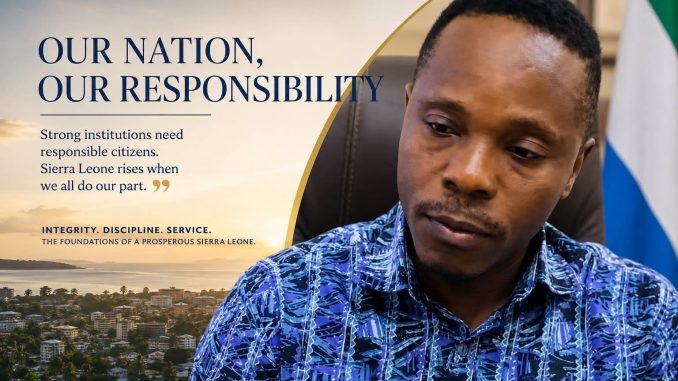
A NATION IS BUILT BY ITS PEOPLE
By Mahmud Tim Kargbo
Monday, 6 July 2026
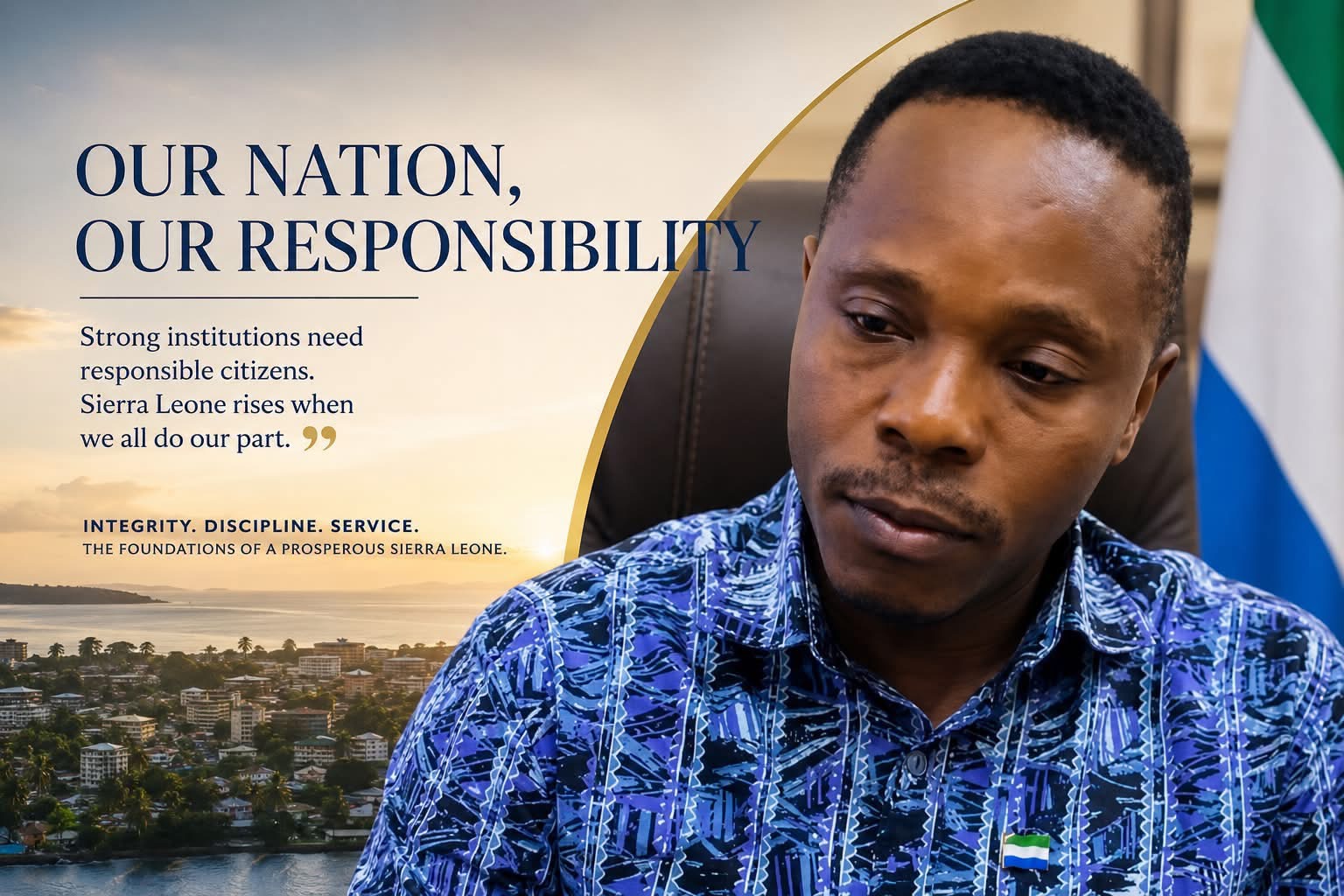
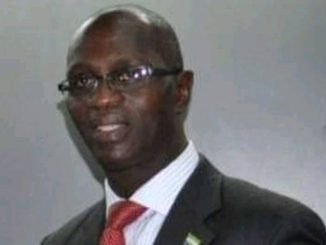
Every enduring nation is built twice. It is first constructed through constitutions, institutions, public investment and the rule of law. It is then built again, every single day, through the conduct of its citizens. Governments may lay roads, erect hospitals, expand schools and formulate ambitious economic policies, but no administration can legislate integrity, manufacture civic discipline or compel patriotism. These qualities are cultivated within society itself, shaping whether public investment becomes lasting prosperity or dissolves into recurring cycles of waste and decline. It is this timeless principle that gives recent reflections by Sierra Leone’s Chief Minister, Dr David Moinina Sengeh, significance far beyond the immediate context in which they were made. His remarks are not simply about government. They invite Sierra Leoneans to reconsider the very foundations upon which successful nations are built.
For decades, political discourse across much of Africa has been dominated by a familiar expectation. Governments are expected to provide employment, education, healthcare, electricity, roads and security, while citizens frequently judge national progress almost exclusively through the performance of the state. Such expectations are entirely legitimate because government exists to promote the public good. Yet history consistently demonstrates that governments alone do not create prosperous societies. They provide the framework within which prosperity becomes possible. Whether that framework succeeds depends upon the conduct of millions of ordinary people whose daily decisions either strengthen or weaken public institutions. Development, therefore, is never a one sided undertaking. It is a partnership between capable leadership and responsible citizenship.
This distinction assumes particular importance within post independence Africa. Many newly independent states inherited highly centralised systems that positioned government as the principal driver of national transformation. In the years that followed, citizens naturally looked to the state to deliver rapid economic and social progress. While understandable, this expectation gradually fostered a culture in which national development became viewed primarily as government’s responsibility rather than a shared civic enterprise. The consequence has been a persistent imbalance. Governments are held accountable for every shortcoming, yet comparatively little attention is devoted to the extent to which individual behaviour either supports or undermines public policy. Dr Sengeh’s intervention challenges precisely this misconception.
His argument begins with an observation that appears simple but carries profound implications. Government is not a distant institution existing separately from society. It is composed of teachers, nurses, police officers, engineers, administrators and public servants who originate from the very communities they serve. Public institutions therefore reflect the values, expectations and habits of the society from which they emerge. When citizens imagine government as something external, responsible for solving every national challenge while demanding little of themselves, they weaken the partnership upon which democratic governance depends. Effective government cannot flourish where civic responsibility is absent.
Political philosophy has long recognised this relationship. The social contract, articulated by thinkers from Thomas Hobbes to John Locke and Jean Jacques Rousseau, rests upon the principle that rights and responsibilities are inseparable. Citizens surrender certain freedoms in exchange for security, justice and public services, while governments exercise authority only insofar as they serve the public interest. Modern democracies continue to operate according to this understanding. Elections confer legitimacy, but legitimacy is sustained through mutual trust between governments that govern responsibly and citizens who recognise that nation building requires more than electoral participation. Democracy is strengthened not only at the ballot box but also through everyday acts of honesty, discipline and civic responsibility.
Dr Sengeh’s reflections acquire particular relevance when viewed through the lens of public finance. Every government operates within financial constraints. Resources allocated to one purpose cannot simultaneously finance another. Economists describe this as opportunity cost, yet its practical implications are often overlooked within public debate. Every Leone diverted towards correcting avoidable mistakes represents a Leone unavailable for expanding schools, improving hospitals, investing in agriculture or strengthening infrastructure. Sound fiscal management therefore depends not only upon prudent budgeting within government but also upon responsible behaviour throughout society.
The demolition of illegal structures erected within wetlands provides an instructive example. Such developments violate planning regulations while exposing surrounding communities to heightened flood risks. Government is consequently compelled to spend scarce public resources removing unlawful construction, restoring damaged environments and mitigating disasters that should never have occurred. These expenditures create little lasting value because they are directed towards repairing preventable damage rather than advancing national development. Sierra Leone’s environmental and land management policies continue to emphasise sustainable urban planning as essential to protecting communities and supporting long term development through institutions whose work is outlined by State House at http://www.statehouse.gov.sl.
Environmental responsibility more broadly illustrates the hidden economic costs of civic indiscipline. Blocked drainage systems, indiscriminate waste disposal and uncontrolled urban expansion have repeatedly intensified flooding across Sierra Leone. Considerable public expenditure is devoted each year to drainage clearance and emergency response, yet these interventions often become repetitive because the underlying causes remain behavioural. Every plastic bag discarded into a drainage channel appears insignificant in isolation. Multiplied thousands of times, however, such actions impose enormous financial costs upon the nation while placing lives and livelihoods at unnecessary risk. Protecting the environment is therefore not merely an ecological obligation. It is an essential component of sound economic management.
The same principle applies with equal force to corruption. Public attention understandably focuses upon investigations and prosecutions undertaken by institutions such as Sierra Leone’s Anti Corruption Commission, whose constitutional mandate is available at http://www.acc.gov.sl. Yet enforcement addresses only the consequences of corruption after public resources have already been compromised. Prevention is invariably less expensive than prosecution. Every act of corruption diverts funds intended for development, increases project costs, weakens institutional credibility and erodes public trust. The financial damage is measurable, but the deeper injury lies in the gradual normalisation of dishonesty, which undermines confidence in public institutions and discourages investment.
Trust has become one of the defining assets of successful economies. The World Bank consistently argues that effective governance, institutional accountability and citizen participation are indispensable to sustainable development because economic growth depends as much upon confidence as capital. See http://www.worldbank.org. Investors seek predictable legal systems, transparent institutions and governments capable of enforcing contracts fairly. Citizens cooperate more readily when they believe public resources are managed responsibly. Trust therefore functions as a form of economic infrastructure, invisible yet indispensable to national prosperity.
Electricity offers another compelling illustration of the relationship between individual conduct and economic development. Governments invest heavily in power generation, transmission infrastructure and network maintenance because reliable electricity underpins modern economies. Hospitals require uninterrupted power to save lives. Schools depend upon electricity to support digital learning. Businesses rely upon stable energy supplies to remain productive and competitive. When electricity is stolen through illegal connections or consumers deliberately evade payment, the financial burden extends throughout the entire system. Revenue losses reduce maintenance, delay expansion and weaken the sustainability of essential services. What appears to be an individual act of opportunism therefore becomes a national economic cost borne by every legitimate consumer.
International experience demonstrates that this relationship between civic culture and development is neither theoretical nor accidental. Singapore’s transformation from a resource poor island into one of the world’s most competitive economies was achieved through institutional excellence reinforced by an uncompromising culture of civic discipline. Botswana similarly demonstrated that prudent governance, respect for public institutions and responsible stewardship of national resources could sustain one of Africa’s strongest records of economic stability. Rwanda’s reconstruction placed equal emphasis upon institutional reform and civic responsibility, recognising that lasting national renewal requires both effective government and active citizenship. These countries differ profoundly in history and political context, yet they converge upon one enduring lesson. Governments create opportunity. Citizens determine whether opportunity becomes prosperity.
The United Nations Development Programme similarly identifies accountable governance, strong institutions and citizen participation as indispensable foundations for sustainable development, emphasising that progress becomes durable only when governments and societies reinforce one another. See http://www.undp.org. Development partners increasingly recognise that financial assistance alone cannot transform nations where civic responsibility remains weak. Roads can be financed. Schools can be built. Hospitals can be equipped. Without a culture that values honesty, public discipline and institutional respect, those investments struggle to realise their full potential.
Sierra Leone today stands at an important moment in its national journey. The country continues to invest in education, healthcare, agriculture, infrastructure and human capital while strengthening democratic governance and expanding international partnerships. These priorities remain central to the Government’s long term development strategy, as reflected in official policy documents published through http://www.statehouse.gov.sl. They represent investments not merely in physical assets but in the future capacity of the nation itself. Their success, however, depends upon whether citizens become active custodians of national development rather than passive observers awaiting government intervention.
It is here that Dr David Moinina Sengeh’s reflections assume their greatest significance. His message was not an attempt to transfer responsibility from government to citizens, nor to diminish the obligations of the state. Rather, it was a reminder that genuine development emerges only where governments and citizens recognise themselves as partners in the same national enterprise. Public institutions must continue improving governance, enforcing the law and delivering essential services. Citizens must demonstrate equal commitment through integrity, civic discipline, environmental responsibility and respect for public resources. Neither responsibility diminishes the other. Together they define the foundations of a successful democracy.
The enduring lesson extends beyond Sierra Leone. Throughout history, nations that achieved lasting prosperity understood that development is sustained not by government expenditure alone but by a shared culture of responsibility. Institutions become effective because citizens protect them. Public investment generates lasting returns because communities preserve it. Economic growth becomes inclusive because trust reduces the costs of doing business and strengthens confidence in the future. These are not abstract ideals. They are practical realities confirmed by experience across continents and generations.
Sierra Leone possesses abundant natural resources, a youthful population, expanding democratic institutions and growing international credibility. Yet the country’s greatest asset cannot be measured beneath its soil or within its national accounts. It resides in the character of its people. The future of the Republic will be shaped not only by decisions taken in Cabinet or Parliament but also by the countless choices made each day in homes, schools, marketplaces, offices and communities across the nation. Every citizen who rejects corruption, protects the environment, respects public property, pays honestly for public services and places the national interest above personal convenience becomes an architect of Sierra Leone’s future. That is the deeper truth illuminated by Dr Sengeh’s remarks. Nations are not transformed by governments acting alone. They are transformed when citizens recognise that the destiny of their country is inseparable from the choices they make, the values they uphold and the legacy they choose to leave behind.
Leave a Reply