
Built by Many, Broken by One: The Unraveling Story of the Sierra Leone People’s Party (SLPP).
by Victor Peter Mammy
The Sierra Leone People’s Party is not just another political organization; it is the oldest political party in Sierra Leone—a party built on the sacrifices, vision, and collective will of generations. It once embodied national unity, discipline, and a clear ideological direction.

By 2018, the country was in distress. Under the All People’s Congress, Sierra Leone faced a collapsing economy, runaway inflation, a weakened Leone, massive youth unemployment, entrenched corruption, fiscal indiscipline, procurement fraud, institutional decay, poor service delivery, and a general breakdown of public trust. Governance had become synonymous with excess and impunity. The people were tired—and they voted accordingly.
The emergence of Julius Maada Bio as the SLPP flagbearer was therefore not just timely; it was inevitable. The APC did not merely lose—the people rejected it. The SLPP was handed power on a silver platter of public expectation and hope.
But what has happened since then is not a matter of speculation. It is a matter of record and lived political reality.
President Bio has systematically sidelined seasoned, loyal, and experienced SLPP politicians—men and women who built the party, defended it in opposition, and sustained its grassroots structures. In their place, he has elevated individuals with little or no political experience, and in some cases, people with no historical ties to the SLPP. This is not inclusion; it is displacement.
Today, it is no longer accurate to say that the SLPP is in power. What exists in reality is a governing structure dominated by a group widely known as “PAOPA”—a tight-knit circle largely composed of the president’s personal allies, associates of his wife Fatima Bio, and individuals connected to Bo School, his alma mater. Loyalty within this circle is not to the party, but to personalities. That distinction is critical—and dangerous.
This shift has hollowed out the institutional core of the SLPP. The party’s internal democracy has been weakened, its veteran voices marginalized, and its identity blurred. What was once a broad-based political movement has been reduced to an exclusive network of influence.
The consequences of this are already clear—and they will define 2028.
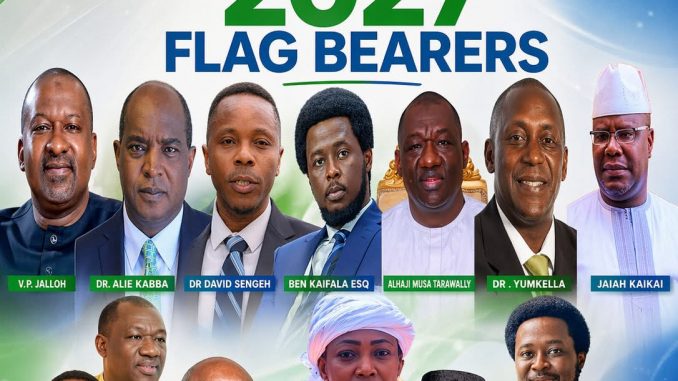
President Bio has, in effect, set up competing centers of power within the same party. These are not theoretical divisions; they are real, visible, and entrenched. The ambitions of key figures such as Mohamed Juldeh Jalloh, David Moinina Sengeh, Kandeh Yumkella, Sidie Tunis, and Alie Kabba are not aligned—and they will not easily yield to one another.
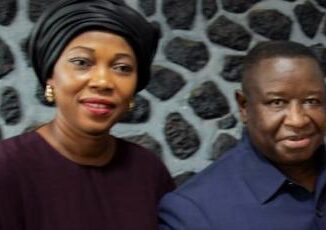
Add to this the growing political visibility and influence of the First Lady, Fatima Bio, and the equation becomes even more complicated. There are simply too many power centers, too many competing loyalties, and no unifying internal mechanism strong enough to reconcile them.
This is not conjecture—it is the logical outcome of how the party has been managed.
What lies ahead is a collision. The SLPP is heading into 2028 not as a united political force, but as a fragmented coalition of rival ambitions. The very structure that was built to secure power is now primed to destroy itself.
History will not be kind in its judgment. When a party abandons its foundations, sidelines its builders, and replaces collective leadership with personal networks, decline is not a possibility—it is an inevitability.
The SLPP was built by many.
If it falls in 2028, it will be because it was broken—by one
Leave a Reply