
*ECOWAS: A Force for Good? The _Sierra Leone_ Experience*
By Delwyn Thomas
As ECOWAS Heads of State gather in Sierra Leone for the 69th Ordinary Session of the Authority, one question deserves an honest answer: _Has ECOWAS been a force for good in Sierra Leone?_
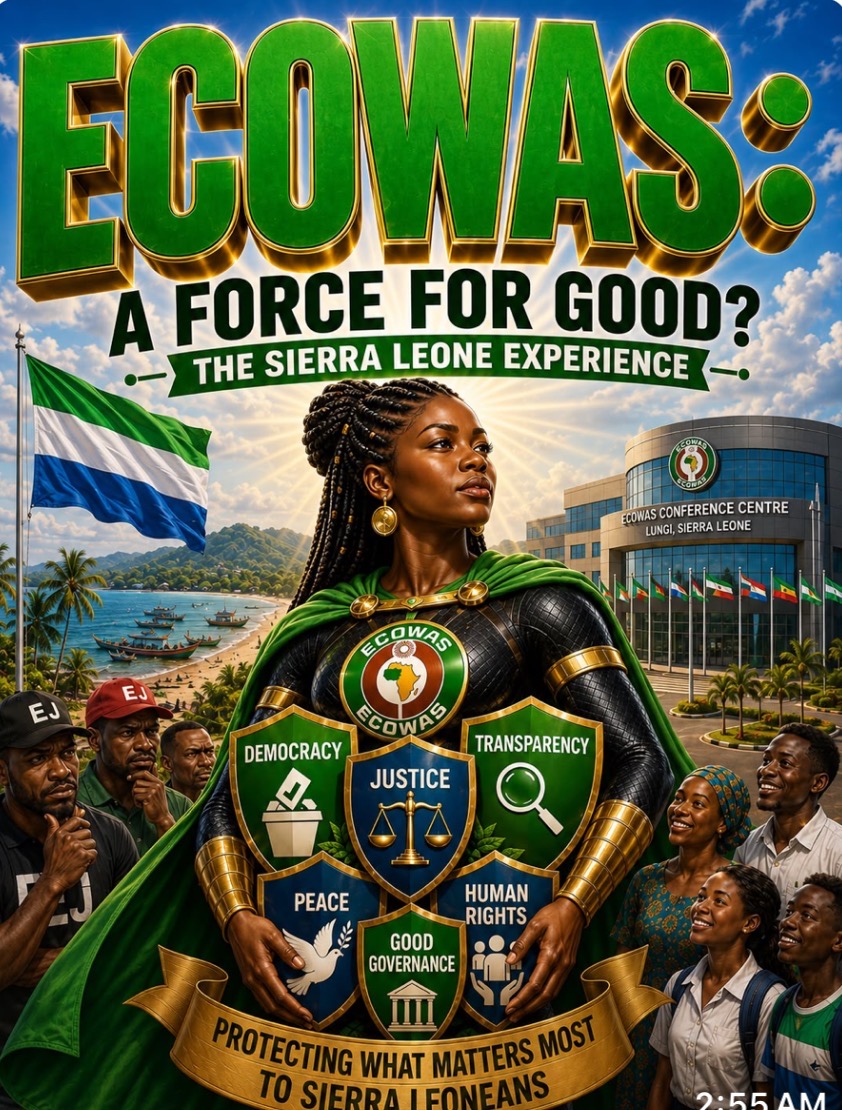
For many within the Electoral Justice (EJ) campaign, the answer is an emphatic “*not enough*.” They point to the disputed 2023 elections, concerns over transparency, calls for the full implementation of the Tripartite Committee recommendations, reform of the Electoral Commission, and wider allegations relating to governance, organised crime and illicit financial flows. These are *serious concerns* that deserve public debate, not dismissal.
But they also deserve to be examined through the lens of ECOWAS’ *actual* mandate.
ECOWAS is not an opposition movement, an international election tribunal or a regional government empowered to remove elected leaders whenever elections are contested. Its *authority* is derived from treaties agreed by Member States, most notably the 2001 ECOWAS Protocol on Democracy and Good Governance, which promotes constitutional rule, transparent elections and zero tolerance for unconstitutional changes of government.
Within those *legal limits*, ECOWAS has played a *constructive* role in Sierra Leone.
Working alongside the African Union, the Commonwealth and the United Nations, ECOWAS brokered the Agreement for National Unity, helped establish the Tripartite Committee and today serves as one of the International Moral Guarantors overseeing implementation of its recommendations. Rather than encouraging confrontation, it created space for constitutional dialogue and institutional reform.
Importantly, *legal* remedies remain available. Sierra Leone’s domestic courts continue to function, while organisations such as *The Progressives* have exercised their right to seek relief before the ECOWAS Court of Justice. That is precisely how democratic societies should resolve disputes—through independent institutions governed by evidence and law rather than *political pressure*.
Many Sierra Leoneans—including civil society organisations, governance advocates and members of the Electoral Justice campaign—have also raised *concerns* about drug trafficking, money laundering, organised crime and the possible infiltration of public institutions by criminal networks. These are legitimate regional security concerns. *Fortunately*, they are not ignored by ECOWAS. Through its Political Declaration and Regional Action Plan against Drug Abuse, Illicit Drug Trafficking and Organised Crime, the work of GIABA (the Inter-Governmental Action Group against Money Laundering in West Africa), and ECOWAS conventions on mutual legal assistance and extradition, the Community has established one of Africa’s most comprehensive regional frameworks for combating transnational organised crime. These instruments promote intelligence sharing, financial investigations, asset recovery and judicial cooperation. They do not, however, *authorise* ECOWAS to pronounce guilt or sanction governments solely on the basis of allegations without credible evidence and due legal process.
*That distinction matters*.
Perhaps the greatest lesson from Sierra Leone’s post-election experience is that some of ECOWAS’ fiercest critics—including some voices within the Electoral Justice movement—have not always distinguished between what they hope ECOWAS can do and what its treaties actually empower it to do. The same misunderstanding is sometimes extended to the African Union, the United Nations and other international organisations. These institutions cannot simply validate political narratives or determine election outcomes on demand; they must operate within the legal mandates entrusted to them by their Member States.
The true measure of ECOWAS is not whether it fulfils every political expectation. It is whether it prevents conflict, strengthens democratic institutions, promotes the rule of law and leaves nations *better prepared* for the future. If Sierra Leone fully implements the Tripartite reforms before 2028 and continues to resolve political disputes through constitutional institutions, domestic courts and regional mechanisms, then the answer to the question posed by this article is clear.
*Yes—ECOWAS has been a force for good, not because it promises miracles or takes sides in domestic politics, but because it has remained committed to peace, constitutional governance, regional cooperation and the rule of law. Understanding that mandate is essential if Sierra Leoneans are to judge not only ECOWAS, but all international organisations, fairly and realistically.*

Leave a Reply