Illegal & Overfishing by Chinese Trawlers Leave Local Fishermen ‘Starving’

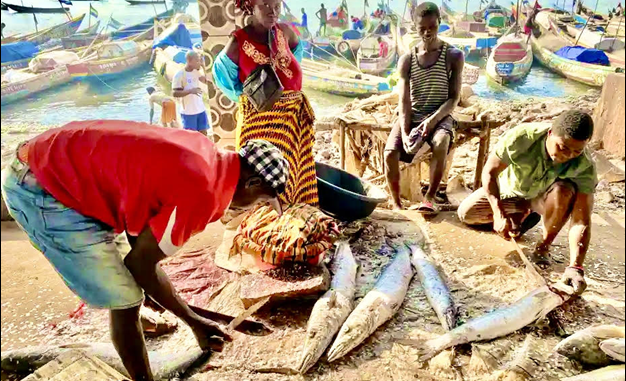
Traders at Tombo market descaling fish. Photograph: Peter Yeung
By Peter Yeung in Tombo
As illegal industrial-scale fishing by foreign fleets pillages fish populations, despairing coastal communities say they feel powerless. Along Tombo’s crumbling waterfront, dozens of hand-painted wooden boats are arriving in the blistering midday sun with the day’s catch for the scrum of the market in one of Sierra Leone’s largest fishing ports. In a scrap of shade at the bustling dock, Joseph Fofana, a 36-year-old fisherman, is repairing a torn net.
Fofana says he earns about 50,000 Leones (£3.30) for a brutal, 14-hour day at sea, crammed in with 20 men, all paying the owner for use of his vessel. “This is the only job we can do,” he says. “It’s not my choice. God carried me here. But we are suffering.” Every day, about 13,000 small boats like Fofana’s cast off from Sierra Leone’s 314-mile (506km) coastline. Fisheries employ 500,000 of the West African nation’s nearly 8 million people, represent 12% of the economy and are the source of 80% of the population’s protein consumption.

But a dozen fishermen interviewed by the Guardian say their catch is dwindling rapidly due to sustained overfishing on a large scale.
“Many years ago, you could see fish in the water from here, even big ones,” says Fofana. “Not any more. There’s less fish than ever before.”
Tombo’s fishing community put the blame squarely on foreign fleets. About 40% of industrial licences are owned by Chinese vessels; though legal, locals say they pay meagre fees for their permits, under-declare their catch and add little to the local economy.
At the same time, illegal, unregulated and unreported (IUU) fishing is a huge problem, costing Sierra Leone $50m a year, President Julius Maada Bio said in 2018. Last year, a joint operation by the Sierra Leonean navy and the conservation organisation Sea Shepherd Global led to the arrest of five foreign-owned fishing vessels in two days, including two Chinese-flagged trawlers found to be fishing without a licence.
Those in Tombo who have protested at the illegal fishing say they face violence from the crews. Alusine Kargbo, a 34-year-old mackerel fisherman, says trawlers’ crews threw boiling water at him when he confronted them with overfishing in areas where trawling is prohibited. “Before the trawlers weren’t in our zones, now they are,” Kargbo says. “The difference is so great [in terms of his catches] compared with before, I’m struggling to feed my children.”
Others are being forced farther afield in search of fish. Ibrahim Bangura, 47, often goes on three-day fishing trips into the Atlantic, a deadly venture in the rainy season. But while the potential reward is greater, he says conflicts with Chinese trawlers are more likely. “There’s so, so many of them,” says Bangura. “They disturb my property, trash my nets. And if you try to stop them, they will fight you.” In addition to dominating licensed markets, China is consistently ranked as the worst offender for IUU fishing in a global index of 152 countries. Across West Africa, illegal trawling is devastating marine ecosystems and undermining local fisheries, which are a critical source of jobs and food security. A study in 2017 found that Sierra Leone, Senegal, Mauritania, the Gambia, Guinea-Bissau and Guinea lose $2.3bn (£1.7bn) a year due to IUU fishing, which amounts to 65% of the legal reported catch.
Some experts warn that Sierra Leone’s coastal communities face devastating consequences of legal and illegal overfishing.
“The Chinese fleet has been taking the profits of the fisheries for 30 years and the impact on fish stocks has been terrible,” says Stephen Akester, an adviser to Sierra Leone’s Ministry of Fisheries and Marine Resources between 2009 and 2021.
“The resources are disappearing, fishermen are suffering, families are starving. Many have just one meal a day.”
“Imagine working for weeks and not being able to catch food,” says Woody Backie Koroma of the Sierra Leone Artisanal Fishermen Union. “They are getting debts. They go to bed without food.”

Such is the strain, says Koroma, that one debt-ridden fisherman in Tombo killed himself last year after his boat was confiscated by the local authorities.
Efforts to manage the sector, including the creation of an inshore exclusion zone that prohibits all but subsistence fishing in the six nautical miles closest to shore, installing movement trackers on industrial trawlers and creating community fishing associations to promote sustainability, have so far had limited impact due to policing and funding challenges, according to officials. A month-long ban on industrial fishing in 2019 was criticised as being too short to allow stocks to replenish.
“We receive a lot of reports and intelligence of illegal fishing,” says Abbas Kamara, an officer at Tombo’s fisheries ministry. “But it’s difficult to corroborate. The trawlers work day and night.
“Fish is very important to Tombo – it’s how people survive – but the fish go to the Chinese,” says Kamara.
The Chinese embassy in Freetown did not respond to the Guardian’s request for comment.
Amara Kalone, at the Environmental Justice Foundation, a charity that monitored foreign vessels in Sierra Leone until last year when funding for the project ran out, says fleets are adapting their tactics to evade restrictions brought against industrial fishing.
“Semi-industrial ships are coming closer to the estuaries, and they are in a legal grey area,” he says. “Other crews are using very fine, monofilament nets, which are illegal but hard to track.”
Another major concern is the rise of marauding fishing crews from neighbouring countries such as Guinea and Liberia, which catch juvenile fish in protected breeding grounds, fatally undermining fish populations, according to Salieu Sankoh, coordinator of the West Africa Regional Fisheries Programme in Sierra Leone. “It’s a serious threat to the nutrition of the population,” he says. “Some local boats go to the sea and come back with nothing.”
In Tombo, as the sky turns orange over Sierra Leone’s Western Peninsula and the ocean becomes unusually still, a sense of despair sets in for the many artisanal fishers struggling to stay afloat.
Low hauls mean that Ali Mamy Koroma, a 40-year-old fisherman with two wives and six children, has had to borrow 1m leone (£65) to pay his bills. “I feel like I’m drowning,” says Koroma, slumped against the wall at the back of Tombo’s indoor market. “But I can’t swim. There is no way out.”
© The Guardian