
By Conton Badamassie
Emanuel Rising Sun Writes ✍️.
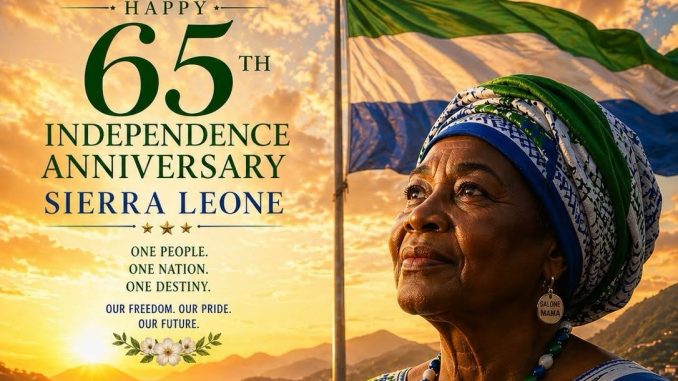
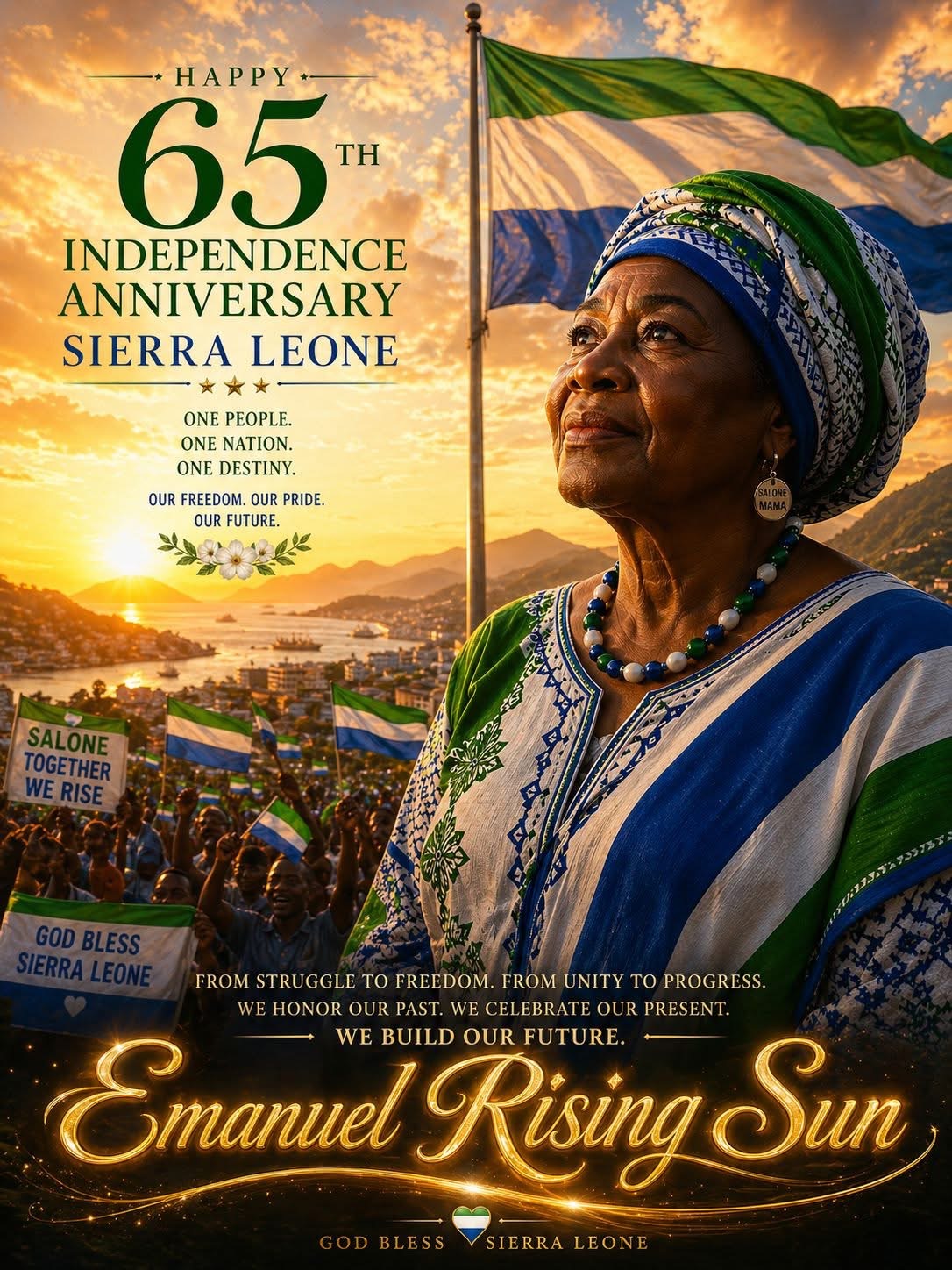
As we commemorate Mama Salone’s 65th Independence Anniversary, I offer a sincere and heartfelt prayer that our beloved nation will continue to rise, and that we, her children, will live to see a future defined by unity, peace, prosperity, and greater national achievement.
This moment is not only one of celebration, but also of responsibility. Independence calls us not just to rejoice, but also to reflect—with honesty, courage, and clarity.
Fellow citizens, history is not distant—it lives within us. And if we are to move forward as a nation, we must be willing to examine it truthfully. It is in that spirit that I invite us to reflect on the role of the Sierra Leone People’s Party (SLPP) in matters concerning national unity, peace agreements, and political responsibility.
For many, the recent actions of the SLPP leadership in rejecting the added recommendations in the tripartite agreement for national unity may come as a surprise. For me, they do not. They are consistent with patterns that history has already revealed.
In 1995, under the National Provisional Ruling Council (NPRC) led by Valentine Strasser, a decree was enacted to lift the ban on political parties in preparation for democratic elections. Significantly, this opportunity was extended to the leader of the Revolutionary United Front (RUF), Foday Sankoh, inviting him to participate in a democratic process that could have contributed to ending the war.
From all indications, this initiative was genuine.
However, the RUF declined to engage in dialogue. It is widely believed that internal influences played a role in that decision to decline.
Notably, Julius Maada Bio—then a key figure within the NPRC who was well connected to Sankoh—discouraged him from engaging in such an offer, suggesting that Strasser and his men were not genuine. He reportedly indicated that he could not guarantee Sankoh’s safety, and instead advised him to remain in hiding until he removed Strasser from power, after which he would guarantee his security and safety.
This raises a critical question: what happens when opportunities for peace are overshadowed by political calculation?
Captain Strasser is widely regarded as having made efforts to bring the RUF to the negotiating table in pursuit of national unity. Yet, those efforts were undermined at a crucial time. The implications of that moment cannot be overlooked, as they may have altered the trajectory of both the war and the nation’s political future.
Consider this carefully:
How can a nation fully prepare for elections—with resources mobilized and structures in place—only to interrupt that process through a palace coup led by Maada Bio, followed by a sudden shift to a “peace before elections” campaign? 🤔
Well na una get the answer.
Sierra Leoneans from all walks of life took to the streets in defense of democracy. With support and pressure from the international community, the path toward elections was restored.
Yet, the consequences of delayed peace were severe.
The conflict escalated. Innocent lives were lost. Communities were destroyed. The brutality reached unimaginable levels.
“enti una wan vote, na way una get hands or fingers for vote make una dae say elections before peace.”
These words remain a haunting reminder of the cost of failed peace efforts.
For those of us who witnessed the civil war, we understand the weight of these events. We know that when agreements are not honored, it is the people who suffer most.
In contrast, the late President Ahmad Tejan Kabbah demonstrated a commitment to peace that continues to be widely recognized. Through collaboration with national and international partners, he worked diligently to bring the conflict to an end.
The Abidjan Peace Accord marked an early attempt at resolution. This was followed by the Lomé Peace Accord, which sought to establish lasting peace through inclusion and power-sharing arrangements.
However, when key provisions of these agreements were presented to Parliament, resistance emerged—particularly from within the SLPP—on constitutional grounds, despite prior commitments.
And so I ask:
“Hmmmmm me Fambul dem…”
“How una go don signed to sometin den you turn round en say no we nor dae gree because the constitution nor say so but way una bin dae signed una nor bin dae think of the constitution 🙄?”
This is not merely a legal issue—it is a question of trust, consistency, and national integrity.
At the time, international leaders such as Tony Blair and Kofi Annan advocated for pragmatic solutions in the interest of peace. Their position reflected a broader understanding: that sometimes, preserving a nation requires flexibility guided by wisdom.
Today, similar concerns continue to emerge—particularly around electoral transparency, accountability, and parliamentary oversight of the ECSL and its conduct in future elections.
To those who question the role of parliamentary oversight, I say clearly:
“common Paran Tawarally for goodness sake parliament is not a separate or private entity…”
At this defining moment, we must choose the kind of nation we want to build—a nation that honors its commitments, or one that repeats the missteps of its past.
Despite all challenges, my belief in Mama Salone remains unwavering.
She has endured conflict. She has endured division. Yet she continues to stand—with strength, resilience, and hope.
On this 65th Independence Anniversary, I extend my warmest wishes to every patriotic Sierra Leonean. May we embrace peace, uphold unity, and pursue truth in all that we do.
I also recognize Samura Kamara, the APC leadership, and all those who continue to advocate for justice, fairness, and national cohesion.
And to His Excellency President Julius Maada Bio:
Leadership is measured by the choices made in moments of national importance. I respectfully encourage you to act in the interest of lasting peace and unity. May the wisdom of the late President Ahmad Tejan Kabbah guide your leadership.
In closing, one truth remains undeniable:
Mama Salone will rise.
No matter the obstacles.
No matter the trials.
She will prevail.
A proud and glorious 65th Independence Anniversary to our beloved nation.
Emanuel Rising Sun

Leave a Reply