
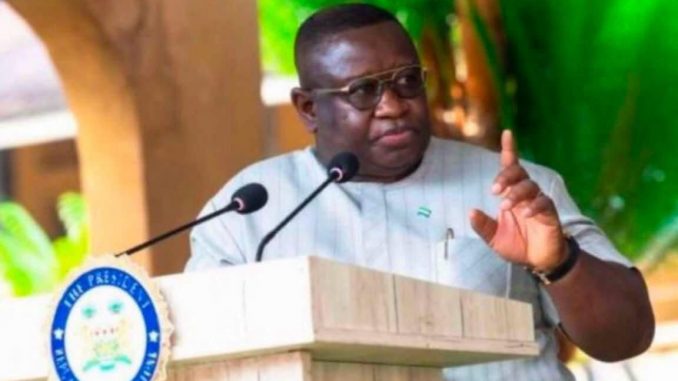
ANOTHER HUMAN RIGHTS ADVOCATE PETITIONS THE ICC ON JULIUS MAADA BIO
I am officially notifying the International Criminal Court – ICC that I have submitted this petition to its office on behalf of the victims & Sierra Leoneans.
TO:
The Prosecutor
Office of the Prosecutor
International Criminal Court
The Hague, Netherlands
FROM:
Ibrahim Fornah
Petitioner and Sierra Leonean Human Rights Advocate
DATE: 22 August 2026
SUBJECT: FORMAL PETITION REQUESTING INTERNATIONAL CRIMINAL-LEGAL REVIEW, EVIDENCE PRESERVATION, JURISDICTIONAL DETERMINATION AND APPROPRIATE PROSECUTORIAL ACTION CONCERNING ALLEGED INTERNATIONAL CRIMES COMMITTED DURING THE NPRC REGIME IN SIERRA LEONE, 1992–1996
I. FORMAL PETITION
I, Ibrahim Fornah, respectfully submit this petition requesting that the Office of the Prosecutor of the International Criminal Court undertake a formal legal assessment of documented allegations concerning the 29 April 1992 military coup, the subsequent conduct of the National Provisional Ruling Council (NPRC), and the alleged extrajudicial executions, torture, unlawful detention and other grave violations committed during the NPRC period.

I make this petition in the public interest and on behalf of the principle that no political office, military rank, decree, amnesty or passage of time should extinguish the right of victims of grave international crimes to truth, justice and accountability.
I expressly request that the Prosecutor not treat the allegations contained in this petition as a finding of guilt against any individual. Rather, I ask that the competent authorities investigate the evidence and determine individual criminal responsibility according to the applicable standards of international criminal law.
II. THE HISTORICAL RECORD
The Sierra Leone Truth and Reconciliation Commission provides a particularly important evidentiary foundation.
The TRC found that the 29 April 1992 coup was a pre-conceived military coup and described it as an unconstitutional seizure of power. It further identified Valentine E. M. Strasser, Julius Maada Bio and Solomon A. J. Musa, among others, as central figures in the planning and establishment of the NPRC. (Sierra Leone TRC)
The TRC subsequently made findings of exceptional seriousness.
It found that:
1. NPRC forces were responsible for extrajudicial executions of civilians accused of being rebels or rebel collaborators;
2. The NPRC was responsible for torture of detainees;
3. Twenty-six persons were executed in December 1992 without due process of law, in violation of international standards;
4. the NPRC’s retrospective attempt to justify those executions by decree constituted an unlawful abuse of executive power;
5. the NPRC leadership was responsible for the broader management of the regime’s war effort; and
6. in relation to the December 1992 executions, the Commission stated that the leaders of the NPRC bore responsibility for the murders of the men executed. (Sierra Leone TRC)
These are not allegations originating solely from political opponents of the NPRC.
They are findings of Sierra Leone’s own statutory Truth and Reconciliation Commission, established to investigate the country’s human-rights violations and the causes of the conflict.
III. THE DECEMBER 1992 EXECUTIONS
The December 1992 executions deserve particular international scrutiny.
The TRC recorded that 26 persons were executed following an alleged coup attempt. It found that the purported proceedings did not constitute genuine judicial trials and that some of those subsequently executed had already been detained. (Sierra Leone TRC)
The Commission further recorded evidence concerning detention, torture and the subsequent execution of alleged coup suspects.
Most significantly, the Commission concluded that the NPRC leadership bore responsibility for the killings. (Sierra Leone TRC)
This raises a fundamental international-law question:
Can persons exercising governmental and military authority deliberately deprive detainees of life without lawful judicial process and then use executive decrees to immunize themselves from subsequent accountability?
I respectfully submit that this question warrants an authoritative international legal determination.
IV. THE INDEMNITY AND TRANSITION DECREE — NPRC DECREE NO. 6 OF 1996
On 14 March 1996, while still Chairman of the NPRC, Brigadier Julius Maada Bio promulgated the Indemnity and Transition Decree, 1996 — NPRC Decree No. 6.
The official Sierra Leone legislation describes the decree as legislation granting indemnity to members of the Armed Forces, the NPRC and NPRC appointees, while providing for the termination of the NPRC constitutional framework. (Sierra Leone Web)
The decree’s indemnity provisions were extraordinarily broad.
Section 2 addressed persons involved in bringing about the 29 April 1992 change of government.
Section 3 provided protection concerning acts, matters or things done during the relevant NPRC period by members of the Armed Forces, members of the NPRC and persons or bodies acting under their authority.
The decree purported to prevent civil or criminal proceedings concerning covered conduct.
Official primary document:
NPRC Decree No. 6 — Indemnity and Transition Decree, 1996
The legal significance of this document is profound.
It demonstrates that the outgoing military regime itself recognized the possibility of subsequent legal proceedings concerning acts carried out during its period of rule and attempted to establish statutory protection against them.
V. THE AMENDMENT — NPRC DECREE NO. 10 OF 1996
On 27 March 1996, two days before the transfer of power to President Ahmad Tejan Kabbah, the NPRC issued the Indemnity and Transition (Amendment) Decree, 1996 — NPRC Decree No. 10.
The official document identifies Brigadier Julius Maada Bio as Chairman of the NPRC. (Sierra Leone Web)
Official primary document:
NPRC Decree No. 10 — Indemnity and Transition (Amendment) Decree, 1996
VI. PARLIAMENT’S RESPONSE — ACT NO. 3 OF 1996
This point requires precision.
The parliamentary measure was The National Provisional Ruling Council Decrees (Repeal and Modification) Act, 1996 — Act No. 3 of 1996.
It was not Act No. 10.
Act No. 3 expressly placed:
“The Indemnity and Transition Decree except Section 4”
among the enactments repealed.
The consequence is legally significant: the broad indemnity provisions of the original decree were not simply left permanently intact by the restored civilian constitutional order. Parliament repealed the decree except Section 4, which concerned NPRC commissions of inquiry. (Sierra Leone Web)
Official primary document:
National Provisional Ruling Council Decrees (Repeal and Modification) Act No. 3 of 1996
Accordingly, any contemporary argument that Decree No. 6 continues today as an unlimited statutory shield against prosecution must confront Act No. 3 of 1996.
VII. THE INTERNATIONAL CRIMINAL LAW QUESTION
The allegations identified by the Sierra Leone TRC include conduct that, depending upon the facts and applicable law, may engage concepts of murder, torture, persecution and other serious violations of international criminal law.
The Rome Statute recognizes genocide, crimes against humanity, war crimes and aggression within the ICC’s jurisdiction. (International Criminal Court)
However, I recognize an important jurisdictional limitation.
Article 11 of the Rome Statute provides that the ICC has jurisdiction only over crimes committed after the entry into force of the Statute. The Statute entered into force on 1 July 2002. (International Criminal Court)
Accordingly, I do not ask the Office of the Prosecutor to disregard the Court’s temporal jurisdiction or to manufacture jurisdiction where none exists.
Instead, I respectfully request a formal determination addressing:
A. whether any alleged conduct by any person named in this petition continued beyond 1 July 2002;
B. whether any conduct falling within the factual circumstances identified by the TRC satisfies the temporal, territorial, personal and subject-matter jurisdictional requirements of the Rome Statute;
C. whether any applicable jurisdictional mechanism permits ICC action concerning the situation;
D. whether evidence submitted to the Office establishes information relevant to crimes otherwise falling within the Court’s mandate; and
E. if the Court concludes that the principal 1992–1996 crimes fall outside ICC temporal jurisdiction, whether the Office can identify or communicate the appropriate international or national mechanism capable of exercising jurisdiction over those crimes.
This approach is submitted precisely because the ICC’s jurisdiction cannot lawfully be expanded by political demand.
VIII. NO IMMUNITY SHOULD BE TREATED AS A SUBSTITUTE FOR INVESTIGATION
The existence of the 1996 indemnity legislation cannot itself answer the question of individual criminal responsibility.
The parliamentary repeal of the broad indemnity provisions is highly relevant to that issue. More importantly, the TRC record provides evidence that grave abuses occurred notwithstanding the existence of the NPRC’s legal framework.
The question for an independent prosecutor is therefore not:
“Did the NPRC declare itself immune?”
The question is:
“Who ordered, planned, facilitated, permitted, concealed or otherwise contributed to specific criminal acts, and what evidence establishes that responsibility?”
That is the standard I respectfully ask the competent prosecutorial authorities to apply.
IX. INDIVIDUAL CRIMINAL RESPONSIBILITY
The TRC identified numerous individuals who occupied senior NPRC positions during the period.
Among the principal military leaders identified in the TRC’s institutional findings are:
– Captain Valentine E. M. Strasser, Chairman/Head of State of the NPRC from 1992–1996;
– Lieutenant/Brigadier Julius Maada Bio, Vice Chairman and subsequently Chairman/Head of State from January to March 1996;
– Captain Solomon A. J. Musa, Deputy Chairman of the NPRC;
-Colonel Karefa Kargbo and other senior military and governmental officials whose individual roles must be established through evidence.
The TRC specifically found Solomon A. J. Musa (deceased) personally responsible for acts of torture involving detainees who were subsequently put to death, and it identified other officials in connection with the December 1992 executions. (Sierra Leone TRC)
The petition therefore requests investigation of individual responsibility rather than collective guilt.
No individual should be convicted merely because he or she held office.
Conversely, no individual should escape investigation merely because he or she subsequently became a civilian politician, government minister, head of state or otherwise acquired political status.
X. COMMAND AND SUPERIOR RESPONSIBILITY
Where evidence establishes that a military or civilian superior:
1. exercised effective command or authority;
2. knew or should have known that subordinates were committing crimes;
3. failed to prevent or repress those crimes; or
4. failed to submit the matter to competent authorities,
the applicable principles of individual and superior responsibility should be examined.
The purpose of this petition is therefore not to ask the Prosecutor to presume guilt.
It is to ask the Prosecutor to determine whether the documentary and testimonial evidence meets the applicable threshold for investigation and prosecution.
XI. THE TRC RECORD SHOULD NOT BE DISMISSED AS MERELY POLITICAL HISTORY
The TRC was established specifically to investigate Sierra Leone’s conflict and human-rights violations.
Its findings concerning the NPRC are unusually direct.
The Commission concluded that the NPRC was responsible for extrajudicial executions, torture and the unlawful December 1992 executions. (Sierra Leone TRC)
The Commission also examined the circumstances of the 1992 coup and identified Julius Maada Bio among the officers who had participated in planning the coup. Bio himself testified to the Commission that he was one of the actual planners. (Sierra Leone TRC)
These materials warrant preservation, authentication and further evidentiary examination.
XII. REQUESTS TO THE OFFICE OF THE PROSECUTOR
For the foregoing reasons, I respectfully request that the Prosecutor:
1. Formally register this communication as a submission concerning alleged international crimes and grave human-rights violations committed during the NPRC period.
2. Conduct a formal jurisdictional assessment concerning the crimes and individuals identified herein.
3. Preserve and assess the Sierra Leone TRC Final Report, transcripts, witness evidence and supporting documentation relating to the NPRC.
4. Examine the original NPRC Decree No. 6 of 1996, NPRC Decree No. 10 of 1996 and Parliament’s Act No. 3 of 1996.
5. Examine whether the indemnity provisions were intended to obstruct accountability for serious violations and whether their subsequent repeal has legal significance for national or international proceedings.
6. Examine the evidence concerning the December 1992 executions, including the role of senior NPRC officials in the arrest, detention, purported trials, torture and executions.
7. Examine allegations of extrajudicial executions, torture, unlawful detention and other grave abuses attributed to NPRC forces and officials throughout the NPRC period.
8. Determine, on the evidence, the individual criminal responsibility of Julius Maada Bio, Valentine Strasser, Solomon A. J. Musa and every other person against whom admissible evidence establishes responsibility.
9. Where the ICC lacks temporal jurisdiction over particular conduct, provide a formal explanation of that jurisdictional conclusion rather than allowing the historical allegations to disappear into a jurisdictional void.
10. Where appropriate and legally permissible, communicate the evidentiary findings or relevant information to competent national, regional or international authorities capable of exercising jurisdiction.
11. Examine whether any related conduct occurring after 1 July 2002 falls within the temporal jurisdiction of the ICC.
12. Preserve the historical record so that the passage of political power or the subsequent political status of an accused person cannot by itself erase evidence of alleged international crimes.
XIII. THE PRINCIPLE AT STAKE
This petition is not an attempt to rewrite Sierra Leonean history.
It is an attempt to ensure that history is not used as a substitute for justice.
The people of Sierra Leone have already endured a Truth and Reconciliation process. They have heard testimony. They have seen investigations. They have read findings concerning executions and torture.
What remains is the question of accountability.
A person cannot become legally innocent of a crime merely because he later became politically successful.
Likewise, a person cannot become legally guilty merely because he was politically unpopular.
Evidence must decide.
That is precisely why an independent prosecutorial examination is necessary.
XIV. CONCLUSION
I therefore respectfully call upon the Office of the Prosecutor to give this petition serious consideration and to make a formal determination concerning the jurisdictional and evidentiary issues raised herein.
I acknowledge that the ICC cannot exercise jurisdiction contrary to Article 11 of the Rome Statute.
But jurisdictional limitations should not become a reason for the historical record to be ignored.
Where the ICC has jurisdiction, I request that it exercise it in accordance with law.
Where the ICC does not have jurisdiction, I request that the Office identify the legal limitation clearly and, where permissible, facilitate the preservation and transmission of relevant information to competent mechanisms.
The victims of Sierra Leone’s conflicts deserve nothing less.
The central question is not whether the perpetrators subsequently held public office.
The central question is whether grave crimes were committed, who was responsible, and whether the rule of law permits those crimes to remain without accountability.
I respectfully request that the competent international authorities answer that question through evidence, law and due process.
Respectfully submitted,
IBRAHIM FORNAH
Petitioner
Sierra Leonean Human Rights Advocate
Public-Interest Human Rights Submission
Attachments / Principal Authorities
1. Sierra Leone Truth and Reconciliation Commission, Final Report, Volume Two, Chapter Two — Findings concerning the NPRC.
2. Sierra Leone TRC, Volume Three A, Chapter Three — evidence and findings concerning the December 1992 executions and NPRC leadership.
3. NPRC Decree No. 6 of 1996 — Indemnity and Transition Decree.
4. NPRC Decree No. 10 of 1996 — Indemnity and Transition (Amendment) Decree.
5. National Provisional Ruling Council Decrees (Repeal and Modification) Act No. 3 of 1996.
6. Rome Statute of the International Criminal Court, particularly Articles 5, 11, 12, 13, 17, 25, 27 and 53.
Primary legal sources:
https://www.sierra-leone.org/Laws/1996-NPRC6.pdf?utm_source=chatgpt.com
https://www.sierra-leone.org/Laws/1996-NPRC10.pdf?utm_source=chatgpt.com
https://www.sierra-leone.org/Laws/1996-3.pdf?utm_source=chatgpt.com
https://www.icc-cpi.int/sites/default/files/2025-05/Rome-Statute-EN-2025.pdf?utm_source=chatgpt.com

Leave a Reply