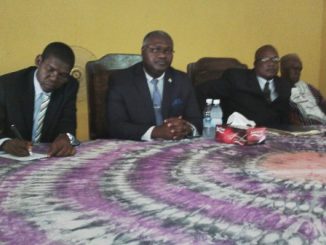

On Thursday morning, the lead story on most Newspapers was not why the Speaker of the Parliament of Sierra Leone refused to debate Constitutional Instruments Numbers 64 and 65 of 2018 entitled: ‘’The Commission of Inquiry (Examination, Inquiry and Investigation) at least in the interest of justice and as a mark of respect for our Constitution? Instead via the Clerk of Parliament, the House okay the mentioned instrument to a law without discussing it in Parliament.
On their face, any discussion on the said instrument which they’ve now turned law is not important. The Speaker simply avoid debating the said instrument because it distracts attention from a revelation that makes Bio SLPP “paopa” led government look bad. But dig deeper not debating such an important instrument before it became law in the House of Parliament and the proposed Commission of Inquiry meant to prosecute alleged corrupt State officials of the past regime the two stories are connected: They represent competing notions of what corruption is.
Speaker’s action highlights one of the enduring riddles of the Bio era. Bio’s supporters are now saying they care about corruption. In his pronouncement for a Commission of Inquiry for alleged corrupt officials of the past regime , they cheered his vow to “drain the swamp” in Sierra Leone. When you talk to any of them to explain why they dislike Ernest Bai Koroma and his former APC regime, the first-most-common answer is that he was “corrupt.” And yet, Bio supporters appear largely unfazed by the mounting evidence that Bio administration is also in the list of the least ethical regime in modern Sierra Leone history in terms of disrespecting our laws. When asked last whether they considered Bio corrupt, only very few among the current regime said yes. Even the Speaker’s action to disrespect Sections 170(7) and 86 (2) of the 1991 Constitution is unlikely to change that.
THE SWAMP ISN’T EASY TO DRAIN
The answer may lie in how Bio and his supporters define corruption. In his book titled How Fascism Works, the Yale philosophy professor Jason Stanley makes an intriguing claim. “Corruption, to the fascist politician,” he suggests, “is really about the corruption of purity rather than of the law. Officially, the fascist politician’s denunciations of corruption sound like a denunciation of political corruption. But such talk is intended to evoke corruption in the sense of the usurpation of the traditional order.”
Speaker’s decision to focus on turning the instrument to a law rather than debating the said instrument before it became law illustrates Stanley’s point. In the eyes of many SLPP “paopa” supporters and members, I suspect, the network hidden agenda isn’t ignoring corruption so much as highlighting the kind that really matters. When Speaker skilfully avoid to debate the mentioned instrument before it became law, he may have been violating the law. But he was upholding traditional “paopa”and class hierarchies like the former “tolongbo” Speaker was doing. Since time immemorial, powerful men in our social positions of trust have been cheating on our people and using their power to evade the consequences.
Perfecting the instrument to law, by contrast, signifies the inversion—the corruption—of that “traditional paopa order.” Throughout Sierra Leonean history, few people have been as sacrosanct as the belief that the Executive must be protected from other Arms of government. By murdering the debate on the instrument, Speaker did not merely violate the law. He did something more subversive: He polluted Sierra Leone’s modern days battle to fight against corruption with a sense of nationalistic purpose to genuinely win international and national admirations and attract genuine investors in the country.
Bio’s Supporters honour the Establishment Tradition of Discrimination:
Once you grasp that for Bio and many of his supporters, corruption means less the violation of law than the violation of established hierarchies, their behaviour makes more sense. In all his speeches, Bio has employed the phrase rule of law. Most of them refer to the illegal means of amassing wealth.
Why were Bio’s supporters so convinced that Ernest was the more corrupt president even as reporters uncovered far more damning evidence about Bio’s regime disrespecting our laws within few months in office than they did about Ernest’s? Likely because Ernest’s threatened and kill all economic growth with his regime as a one man show government which Bio isn’t an exemption. For many Sierra Leonenas, disrespecting the laws to specifically satisfy the Executive Arm —especially with an intention to satisfy a political party hidden agenda—in and of itself represents a form of corruption.
Refusing to debate the instrument before it turned to law makes it harder for SLPP “paopa” supporters to claim that Speaker didn’t violate the law. But it doesn’t really matter. For many “paopas”, Bio and his administration remain uncorrupt—indeed, anticorrupt—because what they fear most isn’t the corruption of Sierra Leone law; it’s the corruption of “paopa” hidden agenda. And in the struggle against that form of corruption—the kind embodied by nearly all of them—Bio isn’t the problem. He’s the solution.
 SLPP
SLPP