THE OSWALD HANCILES COLUMN
“Known unknowns…Unknown Unknowns..” of Sea Weed
Invasion
“…(As we) know, there are known knowns; there are things we
know we know. We also know there are known unknowns; that is
to say we know there are some things we do not know. But there
are also unknown unknowns – the ones we don't know we don't
know…” – United States Secretary of Defense Donald Rumsfeld,
2002
As far as the causes and consequences of the “sea weed
invasion” of Lumley Beach are concerned, they are largely
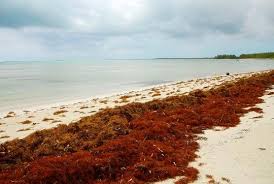
‘known unknowns’. This past Friday, June 17, 2016, I went to
Lumley Beach, in Freetown, Sierra Leone, with Professor
Percival A.T. Showers of the Institute of Marine Biology &
Oceanography, Department of Biological Sciences, Fourah Bay
College, University of Sierra Leone. To witness the “sea weed
invasion” there!! Lumley Beach could rank among the top 1% of
beautiful beaches in the world. But, the idyllic beach has been (is
being) made ugly: covered by brownish and yellowish “sea
weed”.
Page 2 of 11
2
“Ecological catastrophe” ongoing at Lumley Beach
Prof. Showers called the sea weed invasion an “ecological
catastrophe”. In a 2014 Paper prepared by Prof. Showers, he
warned that “something of grave ecological significance in
alarming proportions has started on the coasts of Sierra
Leone”. What is the solution? “heightened awareness”… AND
“intensified research”. To know about the unknowns!!. Well, we
know something about the sea weed.
Seaweeds, according to Prof. Showers, “ are marine macroalgae
or plant-like organisms”. The ones that have “invaded” Sierra
Leone have come from South America. They have come from an
area of awesome vastness – 5.2 million square kilometers of
ocean space called ‘the Sargasso Sea’ in the North Atlantic.
Page 3 of 11
3
The Sargasso Sea hosts a considerably high biodiversity rich
area – playing host to a diverse assemblages of fish, shell fish
(shrimps, crabs, lobster, etc.), reptiles (sea turtles) and other
living organisms.
Prof. Showers writes that “….The drifting of Sargassum traces a
trans-Atlantic route connecting Brazil and Sierra Leone…” (Brazil
and Sierra Leone have historic connection –for over three
hundred years between the 15 th century and the 19 th centuries
African slaves were taken from places like Sierra Leone across
the Atlantic Ocean to Brazil, and the Americas). At Lumley
Beach, Prof. Showers said “we have been expecting the sea
weeds this year. They are late in coming. But, they have now
arrived WITH A BANG”. The sea weed started invading in
2011. Every year since then, during the Rainy Season, the sea
weed would stage their invasion. Already, at just “Intensity-2”
level, there are “five tonne of sea weed on the beach”, Prof.
Showers said.
“Scientists all over the world are alarmed” by sea weed
invasion
Page 4 of 11
4
Brian Lapointe, a sargassum expert at Florida Atlantic University,
US, calls the profusion of sargussum as “harmful algal blooms” .
Why? “They can wipe out fish populations”. Fishermen could
not be able to catch fish. Were fish populations to be wiped out in
Sierra Leone, it would be like committing mass murder against
70% of the population: Sierra Leoneans get over 90% of their
protein needs from fish. Worse, these sea weeds can cause
“coastal dead zones”.
Prof. Showers writes that “This phenomenon points to some
major upset in the marine ecology of the entire Atlantic Ocean.
Scientists all over the world are alarmed by these events and
desperate measures are being exerted to combat it…”
Jeff Ardron, Director of the High Seas Program for the Marine
Conservation Institute in Washington, US, who has been tracking
the issue since 2011, said “something serious is afoot.”
What is “afoot” we don’t know. What is “known known” could be
this: Prof. Showers writes that the “ year 2011 had been marked
Page 5 of 11
5
by unusual weather patterns in the Northern Hemisphere, ranging
from extreme cold to extreme heat.”
And, the Sierra Leonean academic touches on something which
other experts are muted about: “The preceding year, 2010, had
recorded one of the greatest marine ecological disasters in history
– the Gulf of Mexico oil spill”. This could be a culprit. Petroleum
companies exploiting oil in Mexico!
Sea weed could manifest “Climate Change” on the oceans
The sea weed invasion is also being linked to the Biggest
Thing of our generation: Climate Change. Oceans are
warming. This could cause changes in ocean currents. Another
thing: people are chopping down the forests in the Amazon in
Brazil, and other tropical rainforest countries in the Americas –
for timber for furniture; for agriculture, for cows to feed the mostly
over-fed people in the US. This causes massive soil erosion.
The top soils rich in nutrients flow to the ocean. The ‘sea weeds’
in the ocean have ‘new abundant’ food. They grow aplenty. The
ocean currents bring the sea weeds to West Africa.
Page 6 of 11
6
According to Showers, in 2011, scientists felt the sea weed
invasion was a “freak of nature”. But, there was an invasion in
2012, 2013, 2014, and 2015; and now, 2016, ‘the sea weed
invaders’ are back…. Prof. Showers was tasked to highlight the
“meteorological and oceanographic influences which have
previously not been addressed in such clear context from an
oceanographic perspective”. He has to study “the dynamics of
the monsoons and the periodicity of the ITCZ”… Look, forget that
science talk. Just give support to whatever that needs to be done
by scientists like Prof. Showers. So that Prof. Showers can do
longer-time- series of assessments to get a “deeper understanding
of the (sea weed) scenario” . Don’t dare to think this does not
concern you. And, get scared when a scientist like Prof. Showers
writes: “Something terrible seems to have gone amiss to cause
such gigantic upheaval in the entire ecosystem of the north
central Atlantic…”. Something TERRIBLE!! What is it? We don’t
know. It is an unknown unknown!! What we know is that….
The bad things about sea weed invasion
Countries like Trinidad and Tabago, Bermuda in the Caribbean that
depend heavily on tourism have had their beaches defaced by the sea
weeds – like at Lumley Beach. Sierra Leone’s beach-dependent
tourism industry blighted by the Ebola enemy is now being given a
worse hit by the sea weed invasion. Sea weeds are not poisonous,
but they collect floating garbage, which can pose a health or
environmental risk. When the sea weeds decomposed in water, they
can promote blooms of harmful bacteria/microbes, resulting in serious
Page 7 of 11
7
skin irritation. One of the marketing thrusts for the beaches of Sierra
Leone is that the oceans before them have warm water. They are
excellent for swimming. But, if the sea weeds scare people off the
ocean in Sierra Leone..!!
The good things about sea weeds
The sea weed Sargassum is not that all bad. Sea weeds can be
eaten by human beings. You can fry it, boil it, steam it. It can
also be harvested to feed animals like cows. CAUTION: Prof.
Showers said that the sea weeds at Lumley Beach are “too tough”
to be eaten though, “because they need to be tough to survive the
journey across the Atlantic Ocean from Brazil…” Note also: sea
weeds are not only those that have come from across the Atlantic
Ocean. Some species of sea weeds are native to West Africa. In
Nigeria, they are doing studies to explore the option of GROWING
sea weeds – like you grow rice.
Sea weeds can also be used for medicines. Almost two thousand
years ago, the Chinese were using sea weeds to cure diverse
diseases. Nigeria is experimenting with this today.
Page 8 of 11
8
This information is found in the Paper titled, “The potentials and
utilization of Seaweeds” by J.F.N. Abowei and E. N. Ezekie of the
Department of Biological Sciences, Faculty of Science, Niger Delta
University, Wilberforce Island, Bayelsa State, Nigeria and Department
of Science laboratory Technology, School of Applied Science, Rivers
State Polytechnic, Bori, Rivers State, Nigeria respectively
Page 9 of 11
9
The sea weeds provide homes for fishes and other invertebrates.
A study sponsored by UNEP indicates at least “127 species of
fish and 145 invertebrate species have been associated with the
presences of Sargassum algae”. Of these species, 10 are known
to be endemic to West Africa’s ecosystem. It is hardly a
wonder the sea weed invasion is being heavily
internationalized. The West African nations affected by the sea
weed invasion met in Abidjan, Ivory Coast, in 2014 to strategize.
They concluded that they would include Sargassum on the 2nd
United Nations Environment Assembly (UNEA-2) agenda as
part of the now touted Sustainable Development Goals. The
objective for bringing Sargassum at the level of the United
Nations Environment Assembly is to draw attention of the wider
environment community on the severe impacts of Sargassum in
West Africa and the Wider Caribbean States, mobilize required
resources for regional programmes to address this new global
environmental phenomenon with emphasis on “inclusive green-
economy opportunities” which has the potential to contribute in
achieving UNEP’s global environmental mandate.
Page 10 of 11
10
Sea weed invasion means radical change to science mindset
in Africa
The sea weed invasion is another harbinger of what Climate
Change could mean for Africa. All Africa’s leaders must now
squelch that inclination of Africans to think in superstitious and
irrational ways. We must find ways to popularize science, and
make famous, scientists like Prof. Percival Showers. We
must retune how we think of religion and science. Pope Francis
last year said that science and Christianity are the same. Islamic
scholars a few centuries after the death of Prophet Mohamed
were the trailblazers of science in the world. In African countries
like Sierra Leone, we disdain science. Even in our universities,
we have laboratories LESS EQUIPED than, say, labs in primary
schools in countries like Singapore. We don’t encourage the
teaching of science in schools. We have relegated our science
teachers at all levels of our educational systems to the ranks of
the ‘Middle Class Poor’. Prof. Showers calls the sea weed
invasion an “ecological enigma” which has to be addressed by
science – all science is, at the beginning, enigmatic. Africans are
being urged to seek for the “unknown unknowns”….. Tropical
rainforest countries like Sierra Leone have species which are
about 60% of the global total – yet, with little science, we don’t
know what these plants and animals can do to help humanity
survive. ‘Going science’ is one of the paradigm shift Africans
must make today; as the ‘Climate Change wars’ ahead could be
tougher for Africa than the fight against European colonialism of
Africa and Apartheid put together. I PAUSE….
Page 11 of 11
11