

“The Label Game: Why Sierra Leoneans Are Quick to Brand Truth-Tellers as APC or SLPP Journalists”
Written by Dictionary Liam Caulker
Five days ago, Chernor Bah shared a post referencing a “report card” on activists, civil society actors, and media practitioners. His words appeared casual. But the reaction it triggered was anything but.
Citizens immediately began asking questions:
Who produced the report?
What was the methodology?
What agenda sits behind it?
And most importantly:
Why are individuals being labelled and politically profiled without clear evidence?
This is not an isolated incident.
It reflects a growing culture in Sierra Leone:
If you speak critically, you are tagged.
If you question power, you are labelled.
If you refuse alignment, you are suspected.
You are either called:
An APC journalist
Or an SLPP journalist
There is no middle ground.
No space for independence.
No room for professional neutrality.
Let’s be honest—and fair.
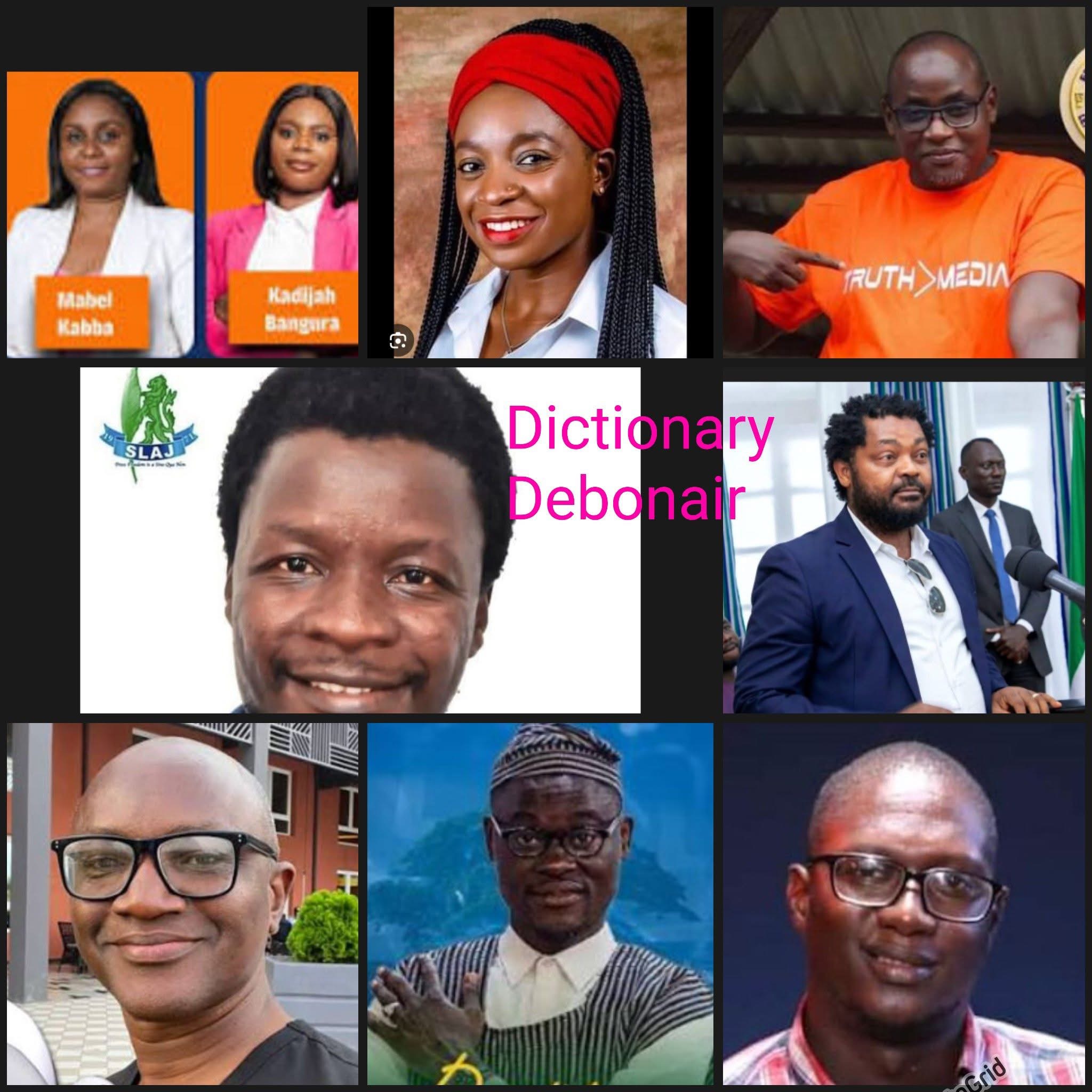
Yes, there are journalists who have openly aligned with political parties:
Some have drifted toward the All People’s Congress (APC)
Others have been absorbed into the orbit of the Sierra Leone People’s Party (SLPP)
That reality cannot be denied.
But here is where the problem begins:
The existence of partisan journalists does not justify the mass labelling of every independent voice.
Because what is happening now is lazy, dangerous, and deliberate.
Instead of engaging arguments, people attack identities.
Instead of debating facts, people assign political motives.
The tension between power and the press did not start today.
It has been a constant feature across every political era in Sierra Leone.
Under Siaka Stevens, the media operated under fear and control. Journalism was not just risky—it was dangerous.
During the time of Joseph Saidu Momoh, the system remained restrictive, with limited tolerance for dissenting voices.
The National Provisional Ruling Council (NPRC) regime did not fundamentally change that dynamic. Military rule came with its own form of pressure and control.
Under Ahmad Tejan Kabbah, there was some democratic opening but tensions between government and the media persisted.
The era of Ernest Bai Koroma saw both expansion in media freedom and moments of direct confrontation with journalists.
And today, under Julius Maada Bio, the pattern has not disappeared it has evolved.
Different governments.
Same underlying struggle:
Control vs scrutiny.
Power vs accountability.
Over time, laws have been introduced—some reformed, others enforced—in ways that directly affect journalistic practice.
While certain reforms have been celebrated, the reality on the ground tells a more complicated story:
Journalists still face intimidation
Legal pressure still exists
Professional risks remain high
And now, an additional layer has been added:
Public hostility driven by political labelling.
What makes the current situation more dangerous is this:
It is no longer just the state vs journalists.
It is now:
Citizens vs journalists.
When a journalist is labelled:
They become a target for online abuse
Their credibility is attacked without evidence
Their safety is quietly put at risk
Because once you are branded politically, you are no longer seen as a professional.
You are seen as an enemy.
The recent analysis attributed to Augustine Navo raises serious methodological and ethical concerns.
Monitoring hundreds of radio programs and publications sounds impressive.
But critical questions remain unanswered:
How were these programs selected?
What criteria defined “bias”?
How were percentages calculated?
Without transparency, such conclusions become questionable.
More importantly:
Assigning political identities to individuals without clear evidence is not analysis it is profiling.
And profiling, in a fragile democracy, is dangerous.
This culture of labelling has real consequences:
It discourages independent journalism
It pushes journalists into defensive positions
It weakens public trust in the media
It reduces national discourse into political camps
And ultimately:
It kills truth.
Because when every statement is judged based on perceived allegiance, facts no longer matter.
Only sides matter.
This is not about defending journalists blindly.
Journalists must be held accountable.
They must be:
Accurate
Fair
Professional
But accountability must be based on evidence not assumptions.
Because once society normalizes labelling:
Truth becomes secondary.
Narrative becomes dominant.
Sierra Leone is entering a politically sensitive period as 2028 approaches.
At such a time, the country needs:
Strong journalism
Independent voices
Fearless analysis
Not a system where:
Every critical voice is reduced to APC or SLPP.
This is the uncomfortable truth:
Not every journalist is APC.
Not every journalist is SLPP.
And not every opinion is political.
But if Sierra Leone continues down this path of labelling and discrediting its own voices, then the biggest casualty will not be journalists.
It will be the truth itself.
And once truth is lost in a democracy
Everything else follows.

Leave a Reply